LIGO: Detecting the Ripples of Spacetime
For decades, the existence of gravitational waves—ripples in the fabric of spacetime predicted by Albert Einstein—remained a theoretical possibility. This changed with the Laser Interferometer Gravitational-Wave Observatory, known as LIGO. By measuring infinitesimal changes in distance, LIGO has opened a new window into the universe, allowing scientists to "hear" cosmic events that are invisible to traditional telescopes.
Key Facts
- Primary Mission: Detecting gravitational waves from massive astrophysical events.
- Locations: Two observatories located in Hanford, Washington, and Livingston, Louisiana.
- First Detection: September 14, 2015 (published February 11, 2016), involving two merging black holes.
- Arm Length: Each detector arm is 4,000 meters long.
- Sensitivity: Advanced LIGO is at least three times more sensitive than the initial LIGO configuration.
How LIGO Works
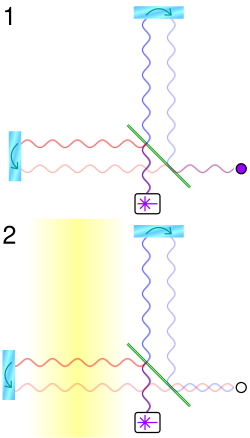
LIGO utilizes a process called interferometry. A beamsplitter divides a single coherent laser beam into two separate paths, which travel down long vacuum pipes (arms) and reflect off mirrors before recombining. Under normal conditions, the light waves cancel each other out.
When a gravitational wave passes through the Earth, it slightly stretches one arm and compresses the other. This change in length alters the interference pattern of the laser light, creating a signal that scientists can measure.
The Observatories
To ensure that a signal is cosmic and not caused by local vibrations (such as earthquakes or traffic), LIGO operates two identical sites. The LIGO Hanford Observatory in Washington and the LIGO Livingston Observatory in Louisiana work in tandem to verify detections.
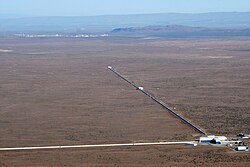
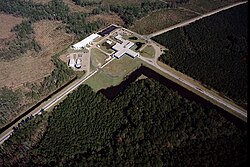
The physical scale of these facilities is immense, with the arms extending 4 kilometers in length to maximize the sensitivity of the interference measurements.


From Initial to Advanced LIGO
The project evolved from Initial LIGO to Advanced LIGO to increase the volume of the universe it could probe. This upgrade involved several technical enhancements to reduce noise and increase signal clarity.
Technical Enhancements
- Increased Laser Power: Boosting the strength of the light source to improve precision.
- Homodyne Detection: A method used to measure the phase of the light more accurately.
- Output Mode Cleaner: Filtering the light to remove unwanted noise.
- In-vacuum Readout Hardware: Placing critical components in a vacuum to prevent atmospheric interference.
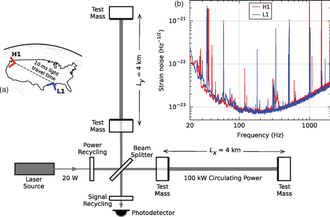
These improvements allow the detectors to operate across a frequency range that overlaps with human hearing, though the signals themselves are far too faint to be heard without the interferometer.
![Detector noise curves for Initial and Advanced LIGO as a function of frequency. They lie above the bands for space-borne detectors like the evolved Laser Interferometer Space Antenna (eLISA) and pulsar timing arrays such as the European Pulsar Timing Array (EPTA). The characteristic strains of potential astrophysical sources are also shown. To be detectable the characteristic strain of a signal must be above the noise curve.[59] These frequencies that aLIGO can detect are in the range of human hearing.](/images/1d/1b/1d1b190cde2fffb2c69e9aaeddd6b7b7f82de0b5a7e718008373c319f00a19ca.png)
![Design sensitivity of Advanced LIGO interferometer with major noise sources, maximum sensitivity is around 500 Hz[85]](/images/9a/8d/9a8df05c0844a1e753fe79087dd5c7105136109bcbc1a2f439c4e3991540f1b9.png)
Major Scientific Discoveries
The most landmark achievement occurred on September 14, 2015, when LIGO detected a signal from two black holes, each approximately 30 solar masses, merging about 1.3 billion light-years away. This provided the first direct evidence of gravitational waves and the existence of binary black hole systems.
Beyond black holes, the collaboration (including the Virgo interferometer in Italy) has detected the merger of binary neutron stars, events that produce both gravitational waves and light, enabling a new era of multi-messenger astronomy.
The Future of Gravitational Wave Astronomy
The field is expanding rapidly with several planned upgrades and new facilities:
- LIGO-India: A planned observatory in Maharashtra, India, to improve the localization of cosmic sources.
- A+: An ongoing upgrade to further enhance the sensitivity of existing detectors.
- LIGO Voyager: A future iteration designed for even deeper cosmic reach.
- Cosmic Explorer & Einstein Telescope: Proposed third-generation detectors (American and European, respectively) that will dwarf current facilities in size and sensitivity.
| Feature | Specification / Detail |
|---|---|
| Arm Length | 4,000 meters |
| Detection Range (Wavelength) | 43 km (7.0 kHz) to 10,000 km (30 Hz) |
| Primary Sites | Hanford, WA and Livingston, LA |
| Key Detection Event | Binary Black Hole Merger (Sept 2015) |
| Collaborating Partners | Virgo (Italy), KAGRA (Japan) |
Frequently Asked Questions
What exactly is a gravitational wave?
A gravitational wave is a ripple in the curvature of spacetime caused by the acceleration of massive objects, such as colliding black holes or neutron stars.
Why are there two LIGO detectors?
Having two separate locations allows scientists to rule out local noise. A true gravitational wave will hit both detectors with a slight time delay, whereas a local vibration will only affect one site.
How sensitive is LIGO?
LIGO is capable of detecting changes in distance that are thousands of times smaller than the nucleus of an atom over a 4-kilometer distance.
What is the difference between Initial and Advanced LIGO?
Advanced LIGO features higher laser power and better noise-reduction hardware, making it at least three times more sensitive than the original version.
What is the purpose of LIGO-India?
Adding a third detector in India will significantly improve the ability of the global network to pinpoint exactly where in the sky a gravitational wave signal is originating.