Leopard: The Versatile Apex Predator
The leopard (Panthera pardus) is one of the most adaptable and widely distributed large cats in the world. With a temporal range stretching from the Early Pleistocene to the present day, this resilient predator has successfully navigated diverse environments across Africa and Asia. Known for its strength, stealth, and solitary nature, the leopard remains a vital component of many ecosystems.
Key Facts
- Scientific Name: Panthera pardus
- Conservation Status: Vulnerable (IUCN 3.1)
- CITES Status: Appendix I
- Primary Habitat: Diverse environments including forests, grasslands, and mountains
- Temporal Range: Early Pleistocene to the present
Taxonomy and Evolution
Leopards belong to the kingdom Animalia, the phylum Chordata, and the class Mammalia. As members of the order Carnivora and the family Felidae, they are part of the genus Panthera, which includes other iconic big cats like lions and tigers.
![Two cladograms proposed for Panthera. The upper cladogram is based on the 2006[36] and 2009[37] studies, while the lower is based on the 2010[38] and 2011[39] studies.](/images/8a/9c/8a9ce42399e00b2d2cd71c7562f4d52f51bb79db9fdb6edd4518153a97c21816.webp)
The evolutionary history and classification of the genus Panthera have been the subject of various scientific studies. Different researchers have proposed different cladograms—diagrams showing the evolutionary relationships between species—based on molecular genetic variation and morphological studies conducted between 2006 and 2011.
Living Subspecies and Distribution
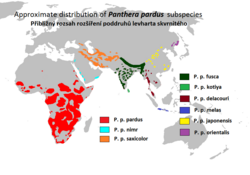
The leopard is not a single uniform entity but is divided into several recognized subspecies, each adapted to specific geographic regions. These subspecies vary in their physical characteristics and habitat preferences.
| Subspecies | Common Name | Primary Distribution |
|---|---|---|
| P. p. pardus | African leopard | Africa |
| P. p. fusca | Indian leopard | India |
| P. p. melas | Javan leopard | Java |
| P. p. nimr | Arabian leopard | Arabian Peninsula |
| P. p. tulliana | (Unspecified) | Caucasus/Adjacent areas |
| P. p. orientalis | Amur leopard | Far East |
| P. p. delacouri | Indochinese leopard | Southeast Asia |
| P. p. kotiya | Sri Lankan leopard | Sri Lanka |
Behavior and Ecology
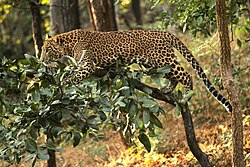
Leopards are highly skilled hunters and masters of their environment. They are known for their ability to climb trees, a behavior used both for safety and for caching food to protect it from competitors.
Hunting and Diet
As apex predators, leopards employ stalking techniques to approach prey. They are capable of applying a precise throat bite to secure their kill. Once a kill is made, they often drag the carcass into trees to hide it from other predators, such as lions or hyenas, which might attempt to steal the meal.
![A male leopard scent-marking his territory[113]](/images/3f/bd/3fbd1c38ec4ee26081ed632374b273ae4d36aea3461b775c6bba37b6c99c67b0.jpg)
Territoriality and Social Structure
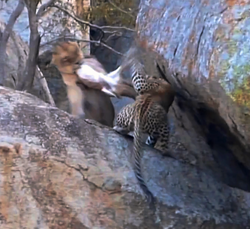
Leopards are generally solitary animals. Males maintain territories that they mark using scent to communicate their presence to other leopards. This territorial behavior is essential for managing mating opportunities and reducing direct conflict.
Conservation Status and Threats
Currently, the leopard is listed as Vulnerable by the IUCN. They are also protected under CITES Appendix I, which strictly regulates international trade to prevent the exploitation of the species. While they are highly adaptable, they face significant threats from human-wildlife conflict, habitat loss, and illegal trade.
Frequently Asked Questions
What is the scientific classification of a leopard?
The leopard is classified under the kingdom Animalia, phylum Chordata, class Mammalia, order Carnivora, family Felidae, and genus Panthera.
Are all leopards the same color?
While most leopards feature a pattern of rosettes, some individuals exhibit melanism, resulting in a black appearance often referred to as a black panther.
Why do leopards climb trees?
Leopards climb trees for several reasons: to hunt, to find safety from larger predators, and to cache their kills away from competitors.
What is the conservation status of the leopard?
The leopard is currently classified as Vulnerable by the IUCN and is protected under CITES Appendix I.
How many subspecies of leopards are there?
There are several recognized subspecies, including the African, Indian, Javan, Arabian, Amur, Indochinese, and Sri Lankan leopards, among others.