Indian Leopard: Ecology, Population Trends, and Conservation Challenges
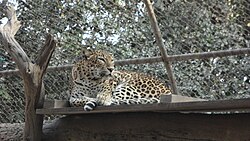
The Indian leopard (Panthera pardus fusca) is a highly adaptable and resilient predator that plays a vital role in the ecosystems of South Asia. Classified as Near Threatened by the IUCN, these big cats are found across diverse landscapes, from the high-altitude regions of Nepal to the dense forests and plains of India. Despite their ability to thrive in varied environments, they face significant pressures from human encroachment and illegal wildlife trade.
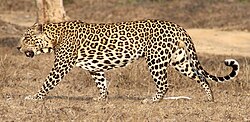
Key Facts
- Scientific Name: Panthera pardus fusca
- Conservation Status: Near Threatened (IUCN 3.1)
- Estimated Population (India, 2022): 13,874 individuals
- Primary Threats: Poaching and human-wildlife conflict
- Notable Feature: Presence of melanistic (black) individuals
Taxonomy and Characteristics
The Indian leopard belongs to the family Felidae and the genus Panthera. As a subspecies of the broader leopard species, it is specifically identified by the trinomial name Panthera pardus fusca. While most leopards exhibit the classic spotted coat, certain individuals exhibit melanism, a genetic condition resulting in a black coat.
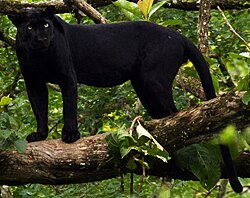
Leopards are known for their incredible range of movement. In Nepal's Kanchenjunga Conservation Area, camera traps have even documented melanistic leopards at elevations as high as 4,300 meters (14,100 ft).
Distribution and Habitat
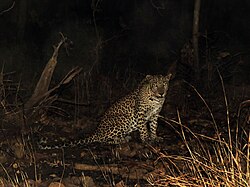
Leopards are remarkably versatile in their habitat selection. In India, they inhabit a wide array of landscapes, including the Shivalik Hills, the Gangetic plains, the Western and Eastern Ghats, and the Brahmaputra River basin. They are found at various elevations, often below 2,600 meters (8,500 ft), though they can adapt to much higher altitudes.
Population Trends in India
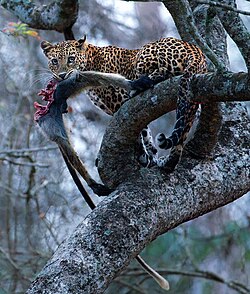
The leopard population in India has seen various estimates over the years. In 2015, estimates suggested between 12,000 and 14,000 leopards lived across the country. By 2020, surveys within forested tiger range landscapes estimated the population between 12,172 and 13,535. The most recent data from 2022 places the Indian leopard population at approximately 13,874 individuals.
| State | Leopard Count |
|---|---|
| Madhya Pradesh | 3,907 |
| Maharashtra | 1,985 |
| Karnataka | 1,879 |
| Tamil Nadu | 1,070 |
| Uttarakhand | 652 |
| Andhra Pradesh | 569 |
| Kerala | 570 |
| Rajasthan | 721 |
| Chhattisgarh | 722 |
Behaviour and Ecology
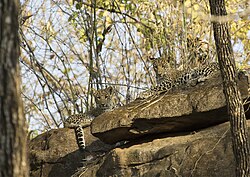
Leopards are solitary predators with specific territorial needs. Research in Nepal's Bardia National Park indicates that male home ranges (the area an animal traverses for resources) average about 48 km², while females average about 17 km². Interestingly, female home ranges shrink to between 5 and 7 km² when they are raising cubs.
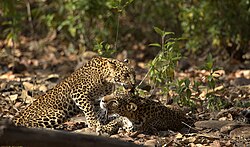
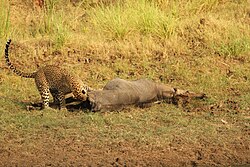
In Gir National Park, observations of radio-collared males showed home ranges of approximately 28.15 km². Their hunting patterns are also highly efficient; for instance, one recorded leopard was observed killing prey once every 3.7 days.
Threats and Conservation Challenges
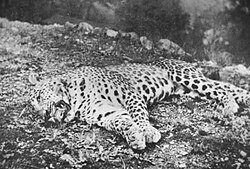
Despite their resilience, leopards face severe threats from poaching and human-leopard conflict. In India, leopards are estimated to be seven times more likely to be killed than Indian tigers. Reports indicate that more than 200 leopards are killed by humans annually in India, and in the period between 2002 and 2010, poachers were reportedly killing up to four leopards per week for the illegal trade.
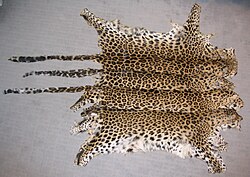
The illegal trade is driven by the demand for skins. Statistics suggest that for every tiger skin seized in a haul, there are at least seven leopard skins. Similar poaching pressures are seen in Nepal and China/Tibet, where hundreds of leopards are lost to illegal hunting each year.
Human-Leopard Conflict
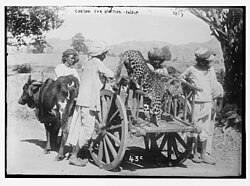
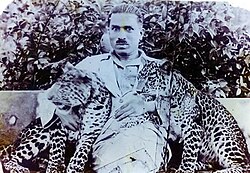
Conflict often arises when leopards enter human-dominated landscapes. While there is significant fear regarding "man-eaters," data shows that more leopards are killed by humans than humans are killed by leopards. For example, in the Shivalik hills of Himachal Pradesh, 68 leopards were killed by people between 2001 and 2013, but only 10 of those were classified as man-eaters.
Frequently Asked Questions
What is the scientific name of the Indian leopard?
The scientific name for the Indian leopard is Panthera pardus fusca.
Are all leopards spotted?
Most leopards have a spotted coat, but some individuals exhibit melanism, which results in a black appearance.
How many leopards live in India?
As of 2022, the estimated leopard population in India is 13,874 individuals.
What are the main threats to leopards?
The primary threats to leopards include poaching for the illegal skin trade and conflict with humans.
Do male and female leopards have the same territory size?
No, males typically have larger home ranges than females. In some regions, male ranges are significantly larger, and female ranges decrease further when they are caring for cubs.