Lemon: History, Cultivation, and Nutritional Value of Citrus × limon
The lemon (Citrus × limon) is one of the most versatile and widely used fruits in the world. Known for its vibrant yellow color and characteristic sour taste, the lemon is a hybrid of the citron and the bitter orange. From its role as a culinary staple to its historical importance in medicine, this citrus fruit continues to be a global commodity valued for its juice, pulp, and rind.
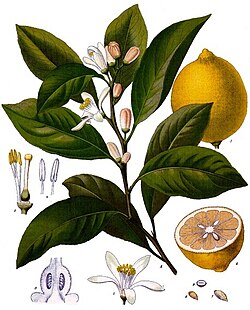
![The lemon is a hybrid of the citron and the bitter orange.[6]](/images/1b/50/1b50ade4c721d96b33dded912d392478768aa372956dc52caf44713160e50d08.webp)
Key Facts
- Scientific Name: Citrus × limon.
- Primary Component: Contains 5–6% citric acid, providing its signature sourness.
- Global Production: Approximately 23 million tonnes in 2024, led by India and Mexico.
- Nutritional Powerhouse: A rich source of vitamin C, providing 59% of the Daily Value per 100g.
- Origin: Entered Europe via southern Italy by the second century AD.
Botanical Description and Chemistry
Lemons are members of the Rutaceae family. Chemically, they are complex fruits containing various phytochemicals, including tannins, terpenes, and polyphenols. The most defining characteristic of the lemon is its high concentration of citric acid (approximately 47 g/L), which is slightly higher than that of lime juice, nearly double that of grapefruit juice, and roughly five times that of orange juice.
Historical Journey
The lemon's journey across the globe began early, reaching southern Italy by the second century AD during the Roman era. By 700 AD, they were introduced to Persia, Iraq, and Egypt. The first literary mention of the lemon appears in a 10th-century Arabic treatise on farming, where it was noted as an ornamental plant in early Islamic gardens.
Between 1000 and 1150, the Arab Agricultural Revolution spread the fruit throughout the Mediterranean and the Arab world. By the middle of the 15th century, substantial cultivation began in Genoa, Italy. In 1493, Christopher Columbus introduced lemon seeds to Hispaniola, facilitating the spread of the fruit across the Americas via the Spanish conquest.
Historically, lemons were used for medicine and ornamentation. In 1747, English physician James Lind used lemon juice to treat sailors suffering from scurvy, though the specific role of vitamin C was not understood at the time.
Cultivation and Production
Growing and Pruning
Lemon trees are sensitive to cold, requiring a minimum temperature of approximately 7 °C (45 °F). While they are not hardy year-round in temperate climates, they generally become more resilient as they mature. Proper maintenance involves minimal pruning to remove overcrowded branches and cutting back the tallest branches to encourage a bushier growth habit.
Gardeners often pinch back the tips of vigorous growth during the summer to develop a more abundant canopy. Additionally, "water shoots"—fast-growing, unwanted shoots—are typically removed from the middle or bottom of the main branches.
Global Production Statistics
In 2024, the combined production of lemons and limes reached 23 million tonnes. India and Mexico are the dominant producers, together accounting for 31% of the world's total. China and Argentina follow as secondary producers.
| Country | Production (Million Tonnes) |
|---|---|
| India | 3.8 |
| Mexico | 3.3 |
| China | 2.3 |
| Argentina | 2.2 |
| Brazil | 1.7 |
| Turkey | 1.7 |
| World Total | 23.2 |
Varieties and Other Citrus "Lemons"
The most common supermarket variety is the 'Eureka' lemon, also known as the "Four Seasons" lemon. Developed in 19th-century California from specimens brought by immigrants from Sicily and Naples, it is prized for its ability to produce flowers and fruit simultaneously throughout the year. A pink-fleshed version of the Eureka with variegated skin also exists.
Other citrus fruits are sometimes referred to as lemons despite being distinct hybrids:
- Meyer lemon: A cross between a citron and a mandarin/pomelo hybrid.
- Rough lemon: A cold-hardy citron-mandarin cross often used as rootstock.
- Volkamer lemon: Another citron-mandarin hybrid.
- Flat lemon: A hybrid of the mandarin.
Nutrition and Culinary Uses
Nutritional Profile
A raw lemon (excluding the peel) consists of 89% water, 9% carbohydrates, and 1% protein, with negligible fat. A 100g serving provides 29 calories and is particularly rich in vitamin C.
Culinary Applications
The high citric acid content makes lemon juice a primary ingredient for adding sourness to foods and drinks. Common uses include:
- Juice: Used in lemonade, cocktails, and as a seasoning.
- Rind and Zest: The grated outer rind (zest) adds intense flavor to baked goods, while slices serve as garnishes.
- Whole Fruit: Used to produce lemon curd, marmalade, and liqueurs like Limoncello.
Art and Cultural Significance
Lemons have long been subjects of artistic expression. They appear in a 15th-century BC Egyptian wall painting in the tomb of Nakht and in 17th-century still lifes by Giovanna Garzoni. Later, impressionist Édouard Manet and modern artist Arshile Gorky also featured lemons in their work.
In modern culture, the phrase "if you have a lemon, make a lemonade" (popularized by Dale Carnegie) encourages optimism. Conversely, in the 21st century, the term "lemon" is used to describe a defective machine, most commonly a car.
Frequently Asked Questions
What is the scientific name of the lemon?
The scientific name for the lemon is Citrus × limon.
Which countries produce the most lemons?
India and Mexico are the leading producers, together contributing 31% of the global production of 23 million tonnes in 2024.
Why is lemon juice sour?
Lemon juice is sour because it contains a high concentration of citric acid, typically between 5% and 6%.
What is a 'Eureka' lemon?
The 'Eureka' lemon is the common supermarket variety, also called the "Four Seasons" lemon because it can produce fruit and flowers year-round.
How much vitamin C is in a lemon?
A 100g serving of raw lemon provides approximately 59% of the Daily Value of vitamin C.