Le Corbusier's Modulor: Harmonizing Human Scale and Architecture
Architecture has long sought a mathematical bridge between the physical dimensions of the human body and the built environment. One of the most influential attempts to codify this relationship was the Modulor, a system of proportions developed by the visionary architect Le Corbusier. Designed as a universal scale, the Modulor aimed to ensure that buildings and mechanical objects were inherently harmonious and functional for the people using them.
The Philosophical Foundations
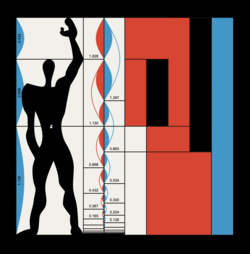
The Modulor did not emerge in a vacuum. Le Corbusier drew upon a rich lineage of thinkers who sought mathematical perfection in human anatomy, including the Roman architect Vitruvius, Leon Battista Alberti, and Leonardo da Vinci, whose famous Vitruvian Man explored similar themes. By combining these classical traditions with the golden ratio (a mathematical ratio commonly found in nature) and Fibonacci numbers (a sequence where each number is the sum of the two preceding ones), Le Corbusier created a range of measurements intended to be universally applicable.
Beyond aesthetics, the Modulor was a response to a practical conflict in measurement. Le Corbusier sought to unite the Anglo-Saxon system of feet and inches with the international metric system. While he admired ancient civilizations that used body-based measures—such as the cubit (elbow), digit (finger), and inch (thumb)—he found the metric system's definition of a meter (a forty-millionth part of the earth's meridian) to be too abstract and disconnected from human experience.
The Evolution of the Scale
The development of the Modulor began in 1943, prompted by the French National Organisation for Standardisation (AFNOR), which required the standardization of construction materials. Le Corbusier initially tasked an apprentice with creating a scale based on a man with his arm raised to a height of 2.20 meters. This first graphical representation was produced in August 1943.
The system underwent further refinement following a meeting on February 7, 1945, with the Dean of the Faculty of Sciences at the Sorbonne, which led to the integration of the golden section into the scale's geometry. Interestingly, the height of the "Modulor Man" also shifted. Originally based on the average French male height of 1.75 meters (5 ft 9 in), it was increased to 1.83 meters (6 ft) in 1946. Le Corbusier jokingly noted that in English detective novels, the handsome protagonists and policemen were always six feet tall.
The final dimensions were adjusted to provide round numbers, resulting in a total height of 2.26 meters (7 ft 5 in) when the arm was raised. Despite its focus on harmony, historian Robin Evans noted that the female body was only considered late in the process and was ultimately rejected as a source for these proportional harmonies.
Key Facts
- Purpose: To create a universal scale of harmonious measurements for architecture and mechanical design.
- Mathematical Basis: Inspired by the golden ratio, Fibonacci numbers, and human proportions.
- Goal: To bridge the gap between the metric system and the Anglo-Saxon foot/inch system.
- Final Height: The Modulor Man's raised arm reaches 2.26 meters (7 ft 5 in).
- Standard Height: The base height of the figure was set at 1.83 meters (6 ft).
Modulor Development Summary
| Date/Phase | Key Development | Dimension/Influence |
|---|---|---|
| August 1943 | First graphical representation | Raised arm at 2.20 m |
| February 1945 | Sorbonne consultation | Integration of the golden section |
| 1946 | Height adjustment | Increased to 1.83 m (6 ft) |
| Final Version | Refined for round numbers | Raised arm at 2.26 m |
Frequently Asked Questions
What is the Modulor?
The Modulor is a system of proportions developed by Le Corbusier that combines the human scale with the golden ratio and Fibonacci numbers to create a universal standard for architecture and design.
Why did Le Corbusier change the height of the Modulor Man?
The height was increased from the average French height of 1.75 meters to 1.83 meters (6 feet) because Le Corbusier observed that leading men in English detective novels were typically six feet tall.
Which mathematical concepts influenced the Modulor?
The system is primarily based on the golden ratio and the Fibonacci sequence, which are used to derive a series of harmonious measurements.
How does the Modulor relate to the metric and imperial systems?
Le Corbusier intended the Modulor to act as a visual bridge that could unite the incompatible Anglo-Saxon foot and inch system with the international metric system.
Was the female form used in the Modulor system?
No. Although the female body was considered later in the development process, it was ultimately rejected as a source for the system's proportional harmony.