Brutalist Architecture: The Raw Power of Concrete and Form
Characterized by massive forms, raw surfaces, and a bold rejection of ornament, Brutalist architecture stands as one of the most provocative movements in modern design. Emerging in the mid-20th century, it transformed city skylines and university campuses worldwide, leaving behind a legacy of "concrete giants" that continue to spark intense debate among critics and the public alike.
The Origins of the New Brutalism
The movement gained formal recognition through the work of British architectural historian Reyner Banham. In his influential 1955 essay, The New Brutalism, Banham defined the style not just as an aesthetic, but as an ethic. He linked the movement to art brut (raw art) and béton brut, a French term meaning "raw concrete."
While Banham highlighted the Soho house and Hunstanton as defining references, the proto-brutalist foundations were laid by the Swiss-French architect Le Corbusier. His landmark projects, such as the 1952 Unité d'habitation in Marseille, the Chandigarh Capitol Complex in India (1951–1961), and the church of Notre Dame du Haut in Ronchamp (1955), showcased the expressive potential of unfinished concrete.
Defining Motifs and Materials
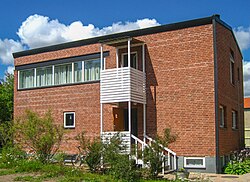
Although raw concrete is the hallmark of the style, Brutalism is not limited to a single material. A notable sub-genre known as brick brutalism (or "brickalism") utilizes brick as the primary structural element. This variation is evident in works ranging from the Smithsons' house in Soho (1952) to the British Library designed by Colin St John Wilson (1982–1998).
Brutalism on the Global Stage
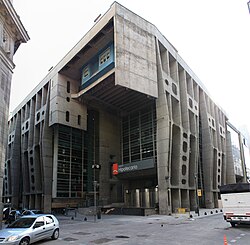
From the 1950s to the early 1980s, Brutalism became an international phenomenon, adopted for government buildings, social housing, and cultural centers.
North America and Beyond
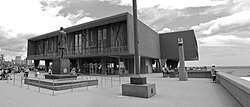
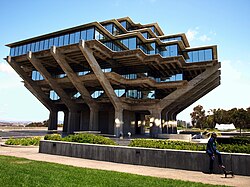
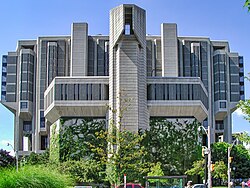
In Canada, the city of Winnipeg became a hub for the style, featuring the Winnipeg Civic Centre (1962–1963) and the Royal Manitoba Theatre Centre (1969–1970). In the United States, Eero Saarinen contributed the Milwaukee County War Memorial (1957), while other iconic structures include the Geisel Library in California and the Robarts Library in Toronto.
Europe and Asia
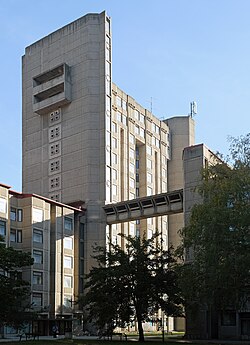
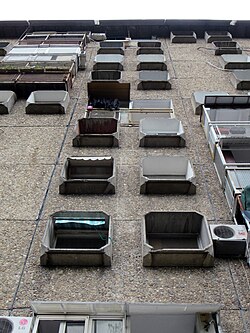
The style flourished in the UK, Serbia, and Vietnam. In Belgrade, Serbia, the "TV buildings" are famous for concrete window frames that resemble television screens. In North Macedonia, Georgi Konstantinovski designed striking student dormitories in Skopje.
The Academic Stronghold: University Campuses
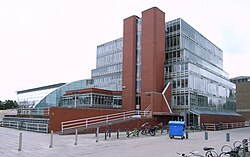
British universities in the 1960s provided a fertile ground for Brutalist experimentation. At the University of Cambridge, James Stirling's History Faculty Building (1968) represented a new approach to educational architecture.
Other significant academic examples include:
- University of Sussex: Basil Spence's Falmer House (1960–1962), which blends Arts and Crafts influences with modernism.
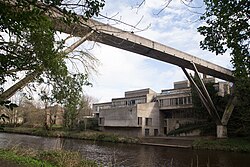
- Durham University: The Grade I-listed Kingsgate Bridge (1963) and the cascading Dunelm House (1966).
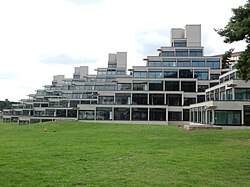
- University of East Anglia: Denys Lasdun's distinctive "ziggurats" (1968).
Reception and the Rise of Neobrutalism
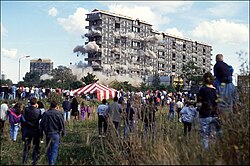
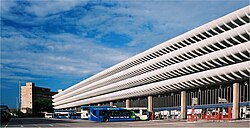
The reception of Brutalism has historically been polarized. While some admire its honesty and strength, others find it cold or oppressive. This led to the demolition of many structures, such as the Queen Elizabeth Square flats in Glasgow. Conversely, some buildings have fought for survival; the Preston bus station in Lancashire gained Grade II listed status in 2013 after surviving two demolition proposals.
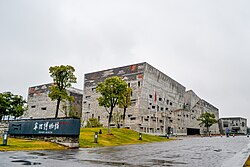
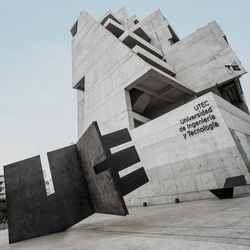
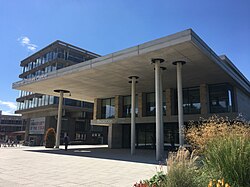
By the late 1970s, the original movement faded, replaced by deconstructivism and structural expressionism. However, since 2015, a resurgence of interest has emerged through new books and guides. This revival has sparked neobrutalism, a contemporary application of the style seen in projects like Wang Shu's Ningbo Museum (2008) and the Silberrad Student Centre (2015).
Key Facts
- Active Period: 1950s to early 1980s.
- Core Material: Primarily béton brut (raw concrete), though "brickalism" uses brick.
- Key Figure: Reyner Banham, who defined the "New Brutalism" as both an ethic and an aesthetic.
- Pioneer: Le Corbusier is credited with proto-brutalist works like the Unité d'habitation.
- Modern Trend: Neobrutalism is the 21st-century resurgence of the style.
| Building | Location | Architect/Designer | Year/Period |
|---|---|---|---|
| Unité d'habitation | Marseille, France | Le Corbusier | 1952 |
| Milwaukee County War Memorial | USA | Eero Saarinen | 1957 |
| Kingsgate Bridge | Durham, UK | Ove Arup | 1963 |
| Geisel Library | California, USA | William Pereira | 1970 |
| Ningbo Museum | China | Wang Shu | 2008 (Neobrutalist) |
Frequently Asked Questions
What does the word "Brutalism" actually mean?
The term is derived from the French béton brut, which translates to "raw concrete." It refers to the practice of leaving concrete unfinished after it is poured into molds, showcasing the texture of the material.
Is Brutalism only about concrete?
No. While concrete is the most common material, there is a sub-genre called "brick brutalism" or "brickalism" where brick is the dominant structural material, as seen in the British Library.
Why are so many Brutalist buildings being demolished?
Many people find the style's massive scale and raw surfaces to be aesthetically unpleasing or associated with urban decay. However, there is a growing movement to preserve these buildings as important historical markers.
What is neobrutalism?
Neobrutalism is the 21st-century resurgence of the Brutalist style. It involves new constructions that adopt the raw, bold, and geometric characteristics of the original movement, such as the Ningbo Museum.
Who were the most influential Brutalist architects?
Le Corbusier is considered a primary influence. Other key figures include Reyner Banham (as a theorist), James Stirling, Denys Lasdun, and Eero Saarinen.