Lawrence Weiner: The Evolution of Language as Sculpture
Lawrence Weiner is a pivotal figure in the transition from traditional physical art to conceptualism. Throughout the 1960s, Weiner navigated a complex relationship between the physical object and the underlying idea, eventually arriving at a revolutionary conclusion: that language itself could serve as a sculptural medium.
The Transition from Painting to Concept
In the early 1960s, Weiner's exploration began with two distinct series of paintings exhibited with Seth Siegelaub. The Propellor Paintings (1964–1966) and the Removal Paintings (1966–1968) were not intended as traditional images, but rather as explorations of the "idea of painting rather than a painting." Despite this conceptual lean, Weiner found himself grappling with a paradox: the work remained bound by the physical constraints of the object.
The Turning Point: Windham College
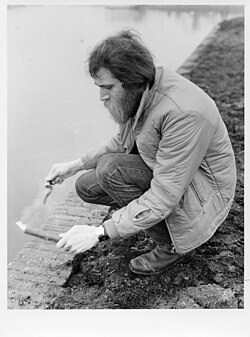
A defining moment in Weiner's career occurred in 1968 during an outdoor group exhibition at Windham College featuring Robert Barry, Carl Andre, and Weiner. He produced a sculpture titled STAPLES, STAKES, TWINE, TURF, which was subsequently destroyed by the students to whom the work was addressed. The students viewed the piece as an imposition on their space.
According to Alice Zimmerman Weiner, this event revealed that the work had trespassed a boundary of which the artist was unaware. This prompted Weiner to reflect on the implications of imposing physical structures on an unknown public. He concluded that prolonged negotiations with a non-accommodating structure were not the proper role of the artist or the art.
Language as a Primary Material
The destruction of his sculpture led Weiner to realize that art did not need to occupy physical space to be valid. He began utilizing language as his primary material, viewing the work as a manifestation of "language + the materials referred to." By shifting to language, Weiner felt he had escaped the "edge" of the picture, moving into a completely infinite realm.
Joseph Kosuth noted that this shift changed Weiner's notion of "place." He moved from the specific context of a canvas to a general context, while maintaining a deep concern for specific materials and processes.
The Declaration of Intent
Starting in 1968, Weiner's work was governed by the Declaration of Intent, first published in Art News and an exhibition catalog. This framework redefined the relationship between the artist, the artwork, and the owner (referred to as the "receiver").
The Declaration consists of three equal conditions:
- The artist may construct the piece.
- The piece may be fabricated.
- The piece need not be built.
Under these terms, the decision regarding which condition to apply rests entirely with the receiver—whether that be a collector, gallery, or museum. This tripartite framework remained the foundation of Weiner's practice until his death in 2021.
Key Facts
- Medium Shift: Transitioned from physical painting and sculpture to language-based conceptual art.
- Key Series: Produced Propellor Paintings (1964-1966) and Removal Paintings (1966-1968).
- Catalyst: The destruction of STAPLES, STAKES, TWINE, TURF at Windham College in 1968.
- Philosophy: Believed language provides an infinite space without the physical constraints of a canvas or object.
- Framework: The "Declaration of Intent" allowed works to be built by the artist, fabricated by others, or remain as ideas.
| Period/Work | Medium/Approach | Core Philosophy |
|---|---|---|
| 1964–1968 Paintings | Physical Canvas | The idea of painting over the object |
| 1968 Sculpture | Physical Materials | Imposition of structure on public space |
| 1968–2021 Work | Language | Infinite space; artist's intent over physical form |
Frequently Asked Questions
What were the Propellor and Removal Paintings?
These were two series of paintings produced between 1964 and 1968 that focused on the conceptual idea of painting rather than the creation of a traditional pictorial image.
Why did Lawrence Weiner stop making traditional sculptures?
After a sculpture at Windham College was destroyed by students who felt it imposed on their space, Weiner decided that art should not have to impose on physical space to exist.
What is the "Declaration of Intent"?
It is a three-part set of conditions stating that a work may be constructed by the artist, fabricated by someone else, or not built at all, with the decision left to the receiver.
Who is the "receiver" in Weiner's work?
The receiver is any individual, museum, gallery, or collector who takes ownership of the work and decides how (or if) it should be physically manifested.
How did language change the "place" of Weiner's art?
According to Joseph Kosuth, language allowed Weiner to move from the specific, limited context of a canvas to a general context that is infinite and not bound by physical edges.