Post-Impressionism: The Evolution of Modern French Art
Post-Impressionism was a pivotal art movement, predominantly based in France, that flourished between 1886 and 1905. Emerging as a reaction against the Impressionists' focus on the naturalistic depiction of light and color, this movement sought to move beyond the fleeting moment to explore more abstract qualities and symbolic content.
While the Impressionists captured the immediate sensory effect of a scene, Post-Impressionists felt this approach led to a loss of structure and a triviality of subject matter. By extending the use of vivid colors and painting from life, they introduced a new emphasis on geometric forms, expressive distortion, and the use of unnatural or modified colors to convey deeper meaning.
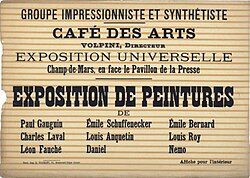
Key Facts
- Active Period: Roughly 1886 to 1905.
- Primary Location: France.
- Core Figures: Paul Cézanne, Vincent van Gogh, Paul Gauguin, and Georges Seurat.
- Key Innovations: Use of impasto (thick application of paint), geometric simplification, and symbolic color.
- Legacy: Directly influenced the birth of Fauvism and Expressionism.
The Diverse Approaches of Post-Impressionist Masters
Post-Impressionism was not a single, cohesive school of thought; rather, it was a collection of artists who shared a dissatisfaction with Impressionism but disagreed on the solution. Their diverse methods laid the groundwork for much of 20th-century modern art.
The Scientific Rigor of Georges Seurat
Georges Seurat and his followers developed pointillism, a systematic technique involving the application of tiny dots of pure color that the viewer's eye blends optically. This approach, also known as Divisionism or Neo-Impressionism, brought a meticulous, scientific precision to composition and color.
The Structural Vision of Paul Cézanne
Often regarded as the father of Post-Impressionism, Paul Cézanne aimed to make Impressionism "something solid and durable, like the art of the museums." He achieved this by reducing natural objects to their basic geometric shapes while maintaining the saturated color palette of his predecessors.
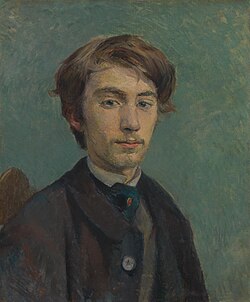
The Emotional Intensity of Vincent van Gogh
Vincent van Gogh utilized vibrant colors and conspicuous, swirling brushstrokes to communicate his internal emotional state and state of mind, moving art away from objective observation toward subjective expression.
The Symbolic Exploration of Paul Gauguin
Paul Gauguin moved toward Symbolism, emphasizing abstract harmony and structural arrangement over naturalism. His work often incorporated Synthetism, a style that emphasized two-dimensional flat patterns and bold colors.
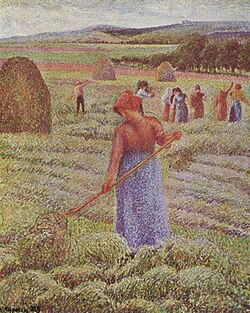
Defining the Movement
The term "Post-Impressionism" was not used by the artists themselves but was coined later by critics. Art critic Roger Fry first used the term in 1906 and later popularized it during his 1910 exhibition, Manet and the Post-Impressionists, in London. Fry described the term as a convenient way to categorize the development of French art following Édouard Manet.
Historian John Rewald further refined the scope of the movement, identifying several overlapping styles and schools:
- Neo-Impressionism: The scientific approach to color, including Pointillism.
- Cloisonnism: A style characterized by bold forms separated by dark contours, associated with Louis Anquetin and Émile Bernard.
- Synthetism: A method used by Gauguin and Bernard to distinguish their work from traditional Impressionism.
- The Pont-Aven School: A group of artists working in Brittany.
- Symbolism: An individualistic approach focusing on fantastic, esoteric, or non-realist subject matter.
Global Influence and Expansion
While rooted in France, the influence of Post-Impressionism spread internationally. In North America, the movement's impact is evident in the work of various artists between 1900 and 1918. In Canada, an offshoot of the movement emerged, featuring artists such as Emily Carr, Tom Thomson, and members of the Group of Seven, including A.Y. Jackson. Canadian artists like John Lyman, who studied under Matisse, helped define and defend the movement's principles in the region.
| Artist | Primary Style/Technique | Key Objective |
|---|---|---|
| Georges Seurat | Pointillism / Neo-Impressionism | Scientific application of color dots |
| Paul Cézanne | Geometric Simplification | Restoring order and structure to painting |
| Vincent van Gogh | Expressive Impasto | Conveying emotion and state of mind |
| Paul Gauguin | Synthetism / Symbolism | Abstract harmony and symbolic content |
Frequently Asked Questions
What is the difference between Impressionism and Post-Impressionism?
Impressionism focused on the naturalistic depiction of light and the immediate sensory effect of a scene. Post-Impressionism rejected these limitations, emphasizing geometric forms, symbolic content, and the use of unnatural colors to express emotion or structure.
Who is considered the father of Post-Impressionism?
Paul Cézanne is widely recognized as the father of the movement due to his efforts to bring a sense of permanence and structural order back to painting.
What is pointillism?
Pointillism is a technique developed by Georges Seurat that involves applying small, distinct dots of color to a canvas, which the viewer's eye then blends together from a distance.
When did the Post-Impressionist movement end?
While dates vary among historians, the movement is generally cited as ending around 1905 with the birth of Fauvism, though some scholars extend the period of influence up to the start of World War I in 1914.
How did Post-Impressionism influence later art?
By prioritizing subjective expression and abstract structure over naturalism, Post-Impressionism paved the way for several major 20th-century movements, including Fauvism, Expressionism, and Cubism.