Der Blaue Reiter: The Visionary Pioneers of German Expressionism
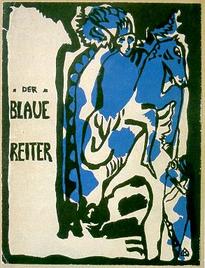
Der Blaue Reiter (English: The Blue Rider) was not a formal art school or a rigid organization, but rather a loose network of artists who fundamentally reshaped the trajectory of 20th-century modern art. Led by Wassily Kandinsky and Franz Marc, this collective sought to transcend the physical world, using art as a vehicle for spiritual expression. Their work is a cornerstone of German Expressionism, a movement characterized by emotional intensity and a departure from realistic representation.
Unlike other contemporary groups such as Die Brücke (The Bridge), Der Blaue Reiter functioned as a flexible association of like-minded creators. Their primary goal was to express spiritual truths through a spontaneous, intuitive approach to painting, often drawing connections between visual art and music.
Key Facts
- Founders: Wassily Kandinsky and Franz Marc.
- Active Period: 1911 to 1914.
- Core Philosophy: The expression of spiritual truths and the symbolic power of color.
- Key Publication: The Der Blaue Reiter Almanac (1912).
- Legacy: Paved the way for non-figurative abstract art.
- End of Group: Disbanded due to the outbreak of World War I.
The Origins of the Movement
The roots of The Blue Rider lie in the Neue Künstlervereinigung München (N.K.V.M: New Artists' Association Munich), co-founded in 1909 by Marianne von Werefkin, Alexej von Jawlensky, Adolf Erbslöh, and Oscar Wittenstein. Wassily Kandinsky served as the first chairman, but tensions soon arose between his increasingly abstract style and the more conservative members of the association.
The breaking point occurred in December 1911 when the N.K.V.M. jury rejected Kandinsky's work, Composition V. In a bold act of artistic defiance, Kandinsky, along with Gabriele Münter and Franz Marc, organized a parallel exhibition in rooms adjacent to the official show at the Thannhauser Gallery. This breakaway group officially adopted the name Der Blaue Reiter.
The Symbolism of the Blue Rider
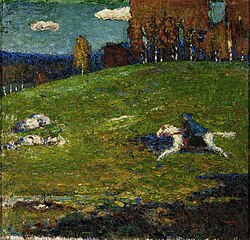
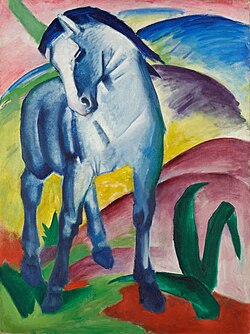
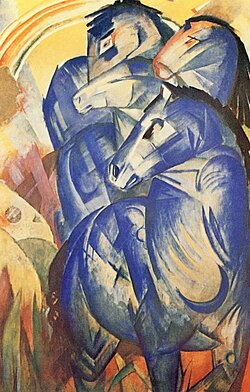
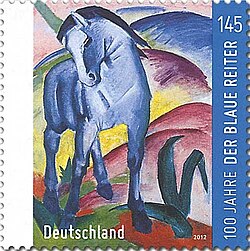
The name of the movement is linked to a 1903 painting by Kandinsky, though the artist later explained that the title reflected a shared passion: Franz Marc's love of horses and Kandinsky's affinity for riders. Central to this was the color blue. In his 1911 treatise On the Spiritual in Art, Kandinsky described blue as the color of spirituality, asserting that deeper shades of blue awaken a human desire for the eternal.
Artistic Philosophy and Influence
The artists of Der Blaue Reiter were deeply interested in primitivism (the influence of non-Western or prehistoric art) and European medieval art. They were also heavily influenced by the contemporary French scene, incorporating ideas from Cubism, Fauvism, and Rayonism. This synthesis of influences pushed the group toward total abstraction.
Their shared beliefs included:
- The promotion of modern, non-conventional art.
- The intrinsic link between visual art and musical composition.
- The use of color for its symbolic and spiritual associations rather than descriptive accuracy.
- An intuitive, spontaneous method of creation.
The Blue Rider Almanac and Exhibitions
In mid-May 1912, the group published the Der Blaue Reiter Almanac, edited by Kandinsky and Marc and funded by industrialist Bernhard Koehler. The publication was a manifesto of their global outlook, featuring over 140 artworks. Notably, it prioritized folk art, children's drawings, and primitive art from Africa and the South Pacific over traditional Eurocentric masterpieces.
The group organized two major exhibitions in Munich in 1911 and 1912. The first exhibition featured 43 works by 14 artists and subsequently toured various European cities, including Berlin, Budapest, Oslo, and Helsinki. A second exhibition in 1912 focused specifically on black-and-white works.
| Activity | Year(s) | Key Details |
|---|---|---|
| First Exhibition | 1911–1912 | 43 works by 14 artists; toured Europe. |
| Second Exhibition | 1912 | Focused on black-and-white works. |
| The Almanac | 1912 | 1,100 copies; featured primitive and children's art. |
| Herbstsalon | 1913 | Participation in the first German Autumn Salon. |
Dissolution and Aftermath
The group's activities were abruptly halted by the outbreak of World War I in 1914. The conflict proved tragic for the collective: Franz Marc and August Macke were both killed in combat. Other members were scattered, with Kandinsky returning to Russia and others fleeing to Switzerland.
During the Nazi era, the works of Der Blaue Reiter were targeted as degenerate art (Entartete Kunst), leading to many pieces being confiscated or destroyed. Paradoxically, those sold abroad helped the movement gain international fame. After 1945, their concepts influenced artists across Europe, including the CoBrA group in Denmark, Belgium, and the Netherlands.
In 1923, a later iteration called Die Blaue Vier (The Blue Four)—consisting of Kandinsky, Feininger, Klee, and Jawlensky—was formed to exhibit in the United States.
Frequently Asked Questions
What was the primary goal of Der Blaue Reiter?
The primary goal was to express spiritual truths through art, moving away from realistic representation toward abstraction and intuitive painting.
Why is the color blue significant to the group?
For Wassily Kandinsky, blue represented spirituality and the eternal. The group's name combined this color with a shared love for horses and riders.
How did the group differ from Die Brücke?
While Die Brücke was a more structured art group, Der Blaue Reiter was a loose network of relationships and a designation for specific exhibition and publication activities.
What was the significance of the Der Blaue Reiter Almanac?
The Almanac was a pivotal publication that challenged Eurocentric art standards by showcasing primitive, folk, and children's art alongside contemporary works.
What happened to the group during World War I?
The war disrupted the group entirely. Key members Franz Marc and August Macke were killed in action, and other members were forced to relocate to different countries.