Die Brücke: The Pioneers of German Expressionism
Formed in Dresden in 1905, Die Brücke (German for "The Bridge") was a seminal group of artists who fundamentally reshaped the trajectory of 20th-century modern art. By rejecting the rigid constraints of academic tradition, these visionaries sought to create a bridge between the artistic achievements of the past and the untapped potential of the future. Their work laid the groundwork for Expressionism, a movement characterized by the prioritization of emotional experience over physical reality.
The group's approach was defined by a raw, visceral energy. They utilized high-keyed, non-naturalistic colors and crude drawing techniques to convey extreme human emotion. While they shared similarities with the French Fauves—specifically an interest in primitivism and a shared dislike for complete abstraction—the Brücke artists were often more provocative. Their depictions of agitated city streets and sexually charged rural scenes possessed an intensity that made their French contemporaries appear tame by comparison.
Key Facts
- Founded: 1905 in Dresden, Germany.
- Founding Members: Fritz Bleyl, Erich Heckel, Ernst Ludwig Kirchner, and Karl Schmidt-Rottluff.
- Core Philosophy: To liberate art from established academic forces and express raw emotion.
- Key Techniques: Vivid colors, violent imagery, and a revival of woodcut prints.
- Innovation: The group is credited with inventing the linocut printmaking technique.
- Dissolution: The group effectively ended around 1913.
The Origins and Philosophy of the Group
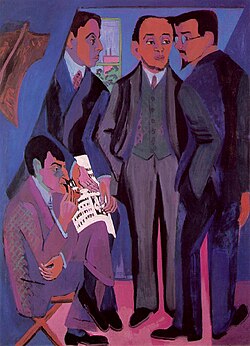
The foundation of Die Brücke was laid by four students of Jugendstil (Art Nouveau) architecture at the Royal Saxon Polytechnicum in Dresden. Ernst Ludwig Kirchner and Fritz Bleyl, who became close friends in 1901, were joined by Erich Heckel and Karl Schmidt-Rottluff. These young men shared a radical outlook and a passion for studying nature and art history.
To distance themselves from their bourgeois backgrounds, the artists established a studio in a working-class neighborhood of Dresden. Erich Heckel secured an empty butcher's shop on Berlinerstrasse, which became a bohemian hub of creativity. This space functioned as more than just a studio; it was a venue for overturning social conventions, where nudity and casual love-making were common, and life-drawing sessions utilized non-professional models to encourage spontaneity.
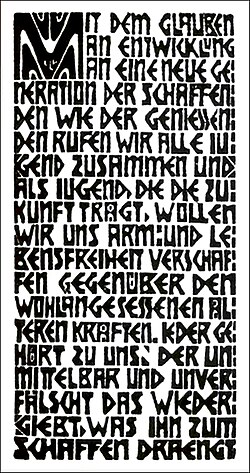
In 1906, the group published their manifesto, the Programm der Künstlergruppe Brücke. In this document, Kirchner called upon the youth to "wrest freedom for our actions and our lives from the older, comfortably established forces."
Membership and Structure
Die Brücke operated with a unique two-tiered membership system. The active members were the artists themselves, while passive members consisted of patrons and supporters, such as Professor Otto Gussmann. In exchange for annual contributions, passive members received membership cards and portfolios of original prints.
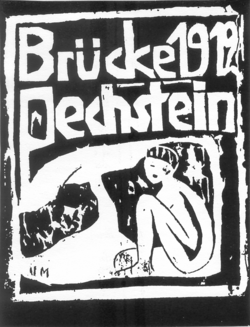
While the founding four led the movement, the group expanded to include Emil Nolde and Max Pechstein in 1906, and Otto Mueller in 1910. Fritz Bleyl left the group in 1907 to support his family after marrying.
Artistic Style and Innovation
The Brücke artists sought a new mode of expression by blending the influence of contemporary international avant-garde movements with the legacy of German masters like Albrecht Dürer, Matthias Grünewald, and Lucas Cranach the Elder. This synthesis resulted in a style defined by emotional tension and vivid, often jarring, colors.
A significant part of their national heritage affirmation was the revival of the woodcut. They pushed the boundaries of printmaking further by inventing the linocut, though they initially categorized these works as traditional woodcuts. Their subject matter evolved from exclusively urban scenes to include nudes and arcadian imagery, following expeditions to southern Germany arranged by Otto Mueller.
Kirchner, in particular, was deeply influenced by non-European art. His 1906 wood-carved manifesto figure was inspired by the craftsmanship of the Fungom region in Cameroon, a stylistic influence that persisted throughout his career.
The End of an Era and Lasting Legacy
The group's cohesion began to fade as members pursued individual paths. In 1911, Kirchner moved to Berlin to start the MIUM-Institut, a school for modern painting, though it closed within a year. The formal end of the group came around 1913, following Kirchner's writing of the Chronik der Brücke (Brücke chronicle).
Die Brücke remains one of the two pillars of German Expressionism, alongside the Munich-based Der Blaue Reiter (The Blue Rider). Their influence extended to artists who were never formal members, such as the Latvian painter Frédéric Fiebig. Today, their legacy is preserved at the Brücke Museum in Berlin.
| Category | Details |
|---|---|
| Founding Year | 1905 |
| Location | Dresden, Germany |
| Founding Members | Fritz Bleyl, Erich Heckel, Ernst Ludwig Kirchner, Karl Schmidt-Rottluff |
| Later Members | Emil Nolde, Max Pechstein, Otto Mueller |
| Key Mediums | Painting, Woodcut, Linocut |
| Dissolution | c. 1913 |
Frequently Asked Questions
What does "Die Brücke" mean and why was this name chosen?
Die Brücke means "The Bridge" in German. The name was chosen to symbolize the link the artists intended to form between the art of the past and the art of the future.
How did Die Brücke differ from the French Fauves?
While both groups used non-naturalistic colors and primitivist styles, Die Brücke artists focused on more emotionally agitated and sexually charged subject matter, making their work appear more intense and less "tame" than that of the Fauves.
What was the significance of the linocut in their work?
The Brücke artists are credited with inventing the linocut technique. This allowed them to explore bold, graphic imagery as part of their effort to revive and evolve traditional printmaking media.
Who were the active and passive members of the group?
Active members were the practicing artists who created the work. Passive members were patrons and supporters who provided financial contributions in exchange for perks like original print portfolios.
Where can the work of Die Brücke be seen today?
A dedicated institution, the Brücke Museum in Berlin, is named after the group and preserves their legacy.