Lucio Fontana: The Visionary Founder of Spatialism
Lucio Fontana was a pioneering Argentine-Italian sculptor, painter, and theorist who fundamentally altered the trajectory of modern art. He is most celebrated as the founder of Spatialism (Spazialismo), an artistic movement that sought to move beyond the traditional two-dimensional surface of the canvas to incorporate the physical dimension of space.
By treating the canvas not as a window to a scene, but as a physical object, Fontana introduced a revolutionary approach to abstraction. His work is characterized by a daring willingness to destroy the surface of his medium to reveal the void beneath, effectively creating an "art for the Space Age."
Key Facts
- Founder of Spatialism: Developed a theory that integrated matter, color, and sound in motion.
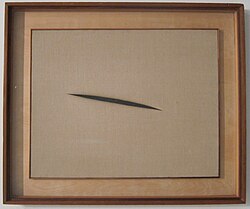
- Signature Technique: Famous for his Concetto spaziale (Spatial Concept) series, featuring holes (Buchi) and slashes (Tagli).
- Multidisciplinary Approach: Worked across painting, sculpture, ceramics, neon installations, and jewelry.
- Global Influence: His works are held in over 100 museums worldwide, including MoMA and the Centre Pompidou.
- Market Record: His work Concetto spaziale, la fine di dio (1964) sold for $29 million in 2015.
Early Life and Artistic Foundations
Born on February 19, 1899, in Rosario, Argentina, to Italian immigrant parents, Fontana was the son of sculptor Luigi Fontana. His early education and professional start were split between Argentina and Italy. After spending several years in Italy working with his father, he returned to Argentina in 1922 and participated in the Nexus exhibition in 1926, a collective of young Argentine artists.
Fontana's formal training took place at the Accademia di Brera in Milan from 1928 to 1930, where he studied under Adolfo Wildt. Throughout the 1930s, he immersed himself in the European avant-garde, joining the Abstraction-Création association in Paris and the Corrente group in Milan. During this period, he produced various expressionist sculptures in bronze and ceramic.
The Birth of Spatialism
The theoretical foundation of Fontana's most famous work began in Buenos Aires in 1946. He co-founded the Altamira academy and contributed to the White Manifesto, which argued that the simultaneous development of matter, color, and sound in motion constituted a new form of art. This evolved into Spatialism, detailed across five manifestos published between 1947 and 1952.
Upon returning to Italy, Fontana began experimenting with environments. In 1949, he exhibited his first Ambiente spaziale a luce nera (Spatial environment), a darkened room featuring a giant, neon-lit amoeba-like shape suspended in the void.
The Spatial Concept: Holes and Slashes
From 1949 onward, Fontana developed the Concetto spaziale (Spatial Concept) series. He moved away from traditional painting by physically puncturing or cutting the canvas. These works are generally categorized into two types:
- Buchi (Holes): Beginning in 1949, these punctures broke the two-dimensional membrane to highlight the space behind the picture.
- Tagli (Slashes): Introduced in the mid-1950s, these dramatic cuts rend the skin of the canvas.
To enhance the effect, Fontana often lined the back of his canvases with black gauze, creating a shimmering sense of depth and mystery within the cuts.
Expanding the Medium
Fontana's exploration of space extended beyond the canvas. He created Luce spaziale (Spatial Light), an elaborate neon ceiling for the 1951 Milan Triennale. He also produced the Pietre (stones) series, where he encrusted canvases with colored glass and heavy impasto, and the Nature series, featuring bronze-cast terracotta spheres with deep gashes.
Later Works and Global Recognition
In the 1960s, Fontana continued to evolve his style. In 1961, he created a series of 22 works for Venice, manipulating paint with his fingers and incorporating Murano glass. His subsequent visit to New York inspired a series of metal works (1961–1965) using scratched and pierced copper to mirror the verticality and industrial feel of New York's architecture.
His final years were marked by Teatrini (little theatres), which used frames and silhouettes to create shadow plays, and the Trinità (Trinity) installation. He remained dedicated to the idea of purity, often utilizing stark white canvases and immersive environments, such as the white labyrinth created for Documenta IV in 1968.
Summary of Lucio Fontana's Artistic Contributions
| Series/Concept | Primary Medium | Key Characteristic | Period |
|---|---|---|---|
| Buchi | Monochrome Canvas | Punctured holes to reveal space | From 1949 |
| Tagli | Monochrome Canvas | Slashes/cuts through the surface | Mid-1950s |
| Pietre | Canvas & Glass | Heavy impasto and colored glass | From 1952 |
| Luce spaziale | Neon | Light-based spatial structures | 1951 |
| Nature | Terracotta/Bronze | Gashed spheres | 1959 |
Frequently Asked Questions
What is Spatialism?
Spatialism (Spazialismo) is an art movement founded by Lucio Fontana that seeks to integrate art with space. It moves beyond the flat surface of a painting to incorporate the third dimension, often using punctures, cuts, or light to engage with the physical void.
What is the difference between the Buchi and Tagli series?
The Buchi series consists of holes punctured into the canvas to break the two-dimensional plane. The Tagli series consists of linear slashes or cuts made with a blade, which became his most iconic signature style in the mid-1950s.
Did Lucio Fontana work with materials other than canvas?
Yes. Fontana was highly versatile, working with ceramics, bronze, copper, neon lights, and even designing jewelry. He also collaborated with architects to create large-scale installations and building decorations.
How much are Lucio Fontana's works worth today?
His works are highly prized in the art market. For example, Concetto spaziale, la fine di dio (1964) set a record by selling for $29 million at Christie's in 2015.
Where can I see Lucio Fontana's work?
His works are in over 100 museums globally, including the Museum of Modern Art (MoMA) in New York, the Centre Pompidou in Paris, the Stedelijk Museum in Amsterdam, and the Peggy Guggenheim Collection in Venice.