Joan Miró: The Visionary Master of Surrealism
Joan Miró i Ferrà was a titan of 20th-century art, a Catalan painter, sculptor, and ceramicist whose work bridged the gap between the conscious and the subconscious. Born in Barcelona, Spain, Miró evolved from a student of traditional fine arts into a pioneer of Surrealism—an artistic movement that sought to release the creative potential of the unconscious mind, often by depicting dream-like imagery and irrational scenes.
His journey was one of constant experimentation, moving from the structured environments of his early education to the avant-garde circles of Paris, eventually creating a unique pictorial language that remains influential in the global art market today.
Key Facts
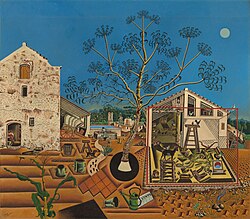
- Full Name: Joan Miró i Ferrà.
- Nationality: Catalan (Spanish).
- Primary Movement: Surrealism.
- Key Mediums: Painting, sculpture, murals, and ceramics.
- Major Awards: Venice Biennale Grand Prize (1954), Guggenheim International Award (1958), and the Gold Medal of Fine Arts, Spain (1980).
- Lifespan: April 20, 1893 – December 25, 1983.
Early Life and Artistic Foundations
Miró was born into a family of artisans; his father, Miquel Miró Adzerias, was a goldsmith and watchmaker. Growing up in the Barri Gòtic neighborhood of Barcelona, Miró's artistic inclinations appeared early. He began drawing classes at age seven in a private school on Carrer del Regomir. Despite his father's reservations, he enrolled in the fine art academy at La Llotja in 1907 and later studied at the Cercle Artístic de Sant Lluc.
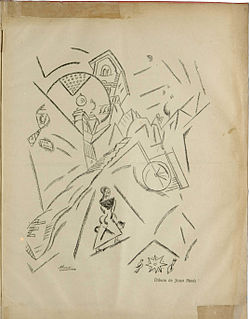
His early career was marked by a struggle for acceptance. His first solo exhibition in 1918 at the Galeries Dalmau was met with ridicule and defacement. However, the influence of Fauvism (a style characterized by strong, non-naturalistic colors) and Cubism pushed him toward the artistic hub of Montparnasse. In 1920, Miró moved to Paris, though he maintained a deep connection to his roots by spending his summers in Catalonia.
![Joan Miró, 1918, La casa de la palmera (The House with the Palm Tree), oil on canvas, 65 x 73 cm, Museo Nacional Centro de Arte Reina Sofía. Exhibited at Galerie La Licorne, Paris, 1921, reproduced in the catalogue[16]](/images/39/6a/396aa2f4e548546b01f007033f84d9a6f8090009cc3d8d2b1bdc3c92231472da.jpg)
The Transition to Surrealism
By 1924, Miró officially joined the Surrealist group. His work aligned perfectly with the concept of automatism—the practice of creating art without conscious thought to allow the subconscious to take over. During this period, Miró rejected traditional framing and experimented with collage, referring to his work ambiguously as "x" in letters to friends.
These "dream paintings" were not entirely random. While he employed automatic techniques, his sketches reveal a methodical process. He developed a symbolic, schematic language, most notably in his Head of a Catalan Peasant series (1924–1925), where he used simplified signs to represent complex figures.
![Joan Miró, 1920, Horse, Pipe and Red Flower, oil on canvas, 82.6 × 74.9 cm, Philadelphia Museum of Art. Exhibited Exposició d'Art francès d'Avantguarda, Galeries Dalmau, 26 October – 15 November 1920, reproduced in the catalogue[17]](/images/ca/49/ca499e435508184011e2257988103aad50bfef86f3810ee384988caf92bc943a.jpg)
The Evolution of Pictorial Signs
Miró's shift toward abstraction became prominent in the early 1920s. In works like The Tilled Field, he replaced realistic representations with abstracted pictorial signs. For example, in Catalan Landscape (The Hunter), a hunter is represented by a triangle for the head and curved lines for a moustache.
![Joan Miró, The Tilled Field, (1923-1924), Solomon R. Guggenheim Museum. This early painting, a complex arrangement of objects and figures, was Miró's first Surrealist masterpiece.[26]](/images/2b/38/2b38421c56822455cf853353ee20cc29e9f283d7f69c31d828ca8da83af46173.jpg)
This sign language matured in the mid-1920s, as seen in Harlequin's Carnival. Over time, his compositions became less cluttered, with foreground figures becoming increasingly simplified and symbolic.
Global Reach and Later Works
Miró's international fame grew significantly through his relationship with the Pierre Matisse Gallery in New York, which introduced his work to the American market starting in 1931. Throughout his life, he expanded his repertoire into sculpture, ceramics, and textiles.
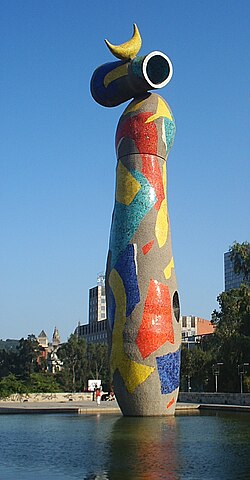
In the latter part of his career, Miró produced massive public works. One of his most famous is The Sun, the Moon and One Star (also known as Miró's Chicago), a large mixed-media sculpture unveiled in 1981 in downtown Chicago.
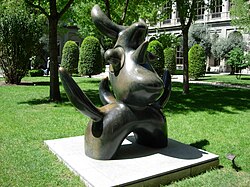
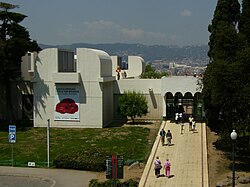
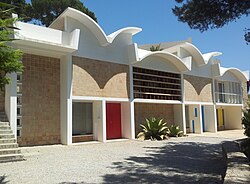
His legacy is preserved in institutions such as the Fundació Joan Miró in Barcelona, housed in a building designed by the rationalist architect Josep Lluís Sert, and the Pilar and Joan Miró Foundation in Mallorca.
Summary of Miró's Artistic Legacy
| Category | Details |
|---|---|
| Key Periods | Early Fauvist, Magical Realism, Surrealism, Abstract Sign Language |
| Notable Works | The Tilled Field, Harlequin's Carnival, The Sun, the Moon and One Star |
| Major Collaborations | Max Ernst (ballet designs), Fernand Mourlot (lithography) |
| Auction Records | Works have sold for as much as $26.6 million (Painting-Poem, 2012) |
| Final Years | Died in Palma de Mallorca (1983) due to heart failure |
Frequently Asked Questions
What is the meaning of the name "Joan Miró i Ferrà"?
In Catalan naming customs, "Miró" is the paternal surname and "Ferrà" is the maternal family name, typically joined by the conjunction "i".
How did Miró contribute to the Surrealist movement?
Miró contributed by integrating automatism and a unique system of pictorial signs into his work, creating "dream paintings" that balanced subconscious exploration with a methodical, symbolic language.
Where can I see Joan Miró's work today?
His works are housed in major museums worldwide, including the Fundació Joan Miró in Barcelona, the Museo Nacional Centro de Arte Reina Sofía in Madrid, the Guggenheim Museum, and the National Gallery of Art in Washington, D.C.
What was Miró's approach to painting in the 1920s?
Miró adopted an antagonistic attitude toward traditional painting, experimenting with collage and rejecting standard framing to create a more fluid, poetic, and symbolic style.
Did Miró work in mediums other than painting?
Yes, Miró was a prolific sculptor, ceramicist, and printmaker. He produced over one thousand lithographic editions through his collaboration with Fernand Mourlot.