Antoni Tàpies: The Master of Matter and Catalan Identity
Antoni Tàpies i Puig was more than a painter; he was a philosopher of materials and a symbol of Catalan resilience. As a leading figure of the 20th-century avant-garde, Tàpies transformed the canvas from a window into a physical wall, blending art, politics, and spirituality. From his early days in Barcelona to his international acclaim in Paris and New York, his work challenged the boundaries of traditional painting by introducing the raw, tactile reality of the physical world.
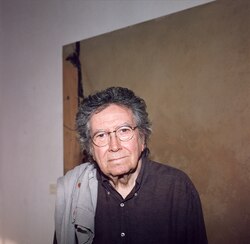
Key Facts
- Born: December 13, 1923, in Barcelona, Spain.
- Died: February 6, 2012, in Barcelona, Spain.
- Primary Movement: Art Informel (a European style of abstract art emphasizing spontaneous, non-geometric forms).
- Signature Style: Pintura matèrica, incorporating non-artistic materials like marble dust, clay, and rags.
- Major Honor: Created the 1st Marquess of Tàpies hereditary title in 2010.
- Legacy: Founded the Fundació Antoni Tàpies in 1984.
Early Life and Formative Influences
Born to Josep Tàpies i Mestre, a lawyer and Catalan nationalist, and Maria Puig i Guerra, Antoni grew up in a household steeped in republicanism and cultural activism. This environment fostered a lifelong connection between his art and his political identity. His introduction to modernism came early; in 1934, while in secondary school, he discovered the works of Pablo Picasso, Wassily Kandinsky, Georges Braque, and Marcel Duchamp through the magazine D’ací i d’allà.
A pivotal moment occurred at age 17 when a near-fatal heart attack caused by tuberculosis forced Tàpies into a two-year convalescence in the mountains. During this period of isolation, he read extensively and deepened his commitment to art. Although he studied law for three years at the German School of Barcelona, by 1943 he abandoned legal studies to devote himself entirely to painting.
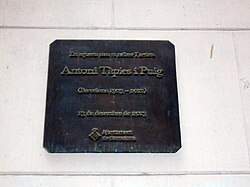
The Evolution of a Style: From Surrealism to Matter
In 1948, Tàpies co-founded Dau al Set, the first post-war artistic movement in Spain. Led by poet Joan Brossa and connected to Dadaism and Surrealism, the group sought to break away from academic constraints. While Tàpies' early works were influenced by Joan Miró and Paul Klee, he soon transitioned toward Art Informel.
The Innovation of Pintura Matèrica
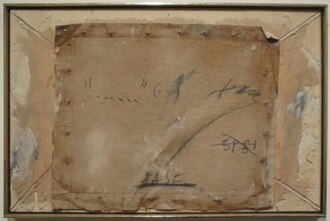
Tàpies' most significant contribution to art was the development of pintura matèrica (matter painting). Starting around 1953, he began experimenting with mixed media, treating the canvas as a physical object rather than a surface for representation. He incorporated clay, marble dust, waste paper, string, and rags into his compositions to create rich, tactile textures.
International Recognition and Political Symbolism
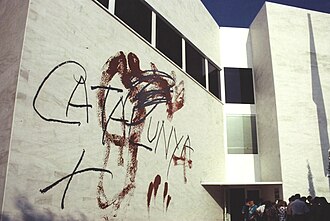
By the late 1950s, Tàpies had achieved global fame, supported by the influential French critic Michel Tapié. His work became associated with Tachisme and Abstract Expressionism. However, his art remained deeply tied to his homeland. In the early 1970s, his work frequently featured symbols of Catalan identity, which were viewed as subversive by the Franco regime. This political tension culminated in his 1966 arrest at a clandestine assembly at the University of Barcelona.
Later Works and Intellectual Pursuits
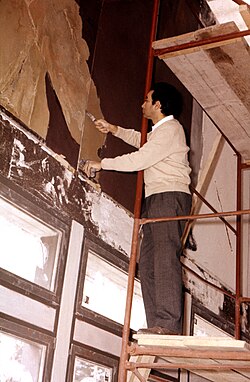
As his career progressed, Tàpies integrated larger objects—such as furniture—into his paintings, reflecting the influence of Pop Art. In the 1970s and 80s, his aesthetic shifted toward a "meditative emptiness," utilizing spray-painted canvases and linear elements reminiscent of Oriental calligraphy. This period reflected his deep interest in Eastern thought and the philosophy of Jean-Paul Sartre.
Beyond the studio, Tàpies was a prolific writer and graphic artist. He collaborated with numerous poets and writers to produce collector's books and authored several essays reflecting on the social role of the artist and the intersection of art and politics. His written works include La pràctica de l’art (1970) and Valor de l’art (1993).
Summary of Artistic Career
| Period/Phase | Key Characteristics | Influences/Movements |
|---|---|---|
| 1940s | Early exploration, surrealist leanings | Dau al Set, Miró, Klee |
| 1950s - 1960s | Mixed media, tactile surfaces, marble dust | Art Informel, Pintura Matèrica |
| 1970s - 1980s | Incorporation of furniture, calligraphic lines | Pop Art, Eastern Philosophy |
| Late Career | Meditative emptiness, abstract idioms | Zen, Minimalist abstraction |
Legacy and Recognition
Tàpies' impact is preserved through the Fundació Antoni Tàpies, a museum and cultural center he established in Barcelona in 1984. The foundation serves as a forum for the study of modern art and houses one of the most extensive collections of his work.
Throughout his life, he received numerous accolades, including the Praemium Imperiale, the Rubens Prize (1972), and Spain's prestigious Velázquez prize (2003). In 2010, King Juan Carlos I granted him the hereditary title of Marquess of Tàpies.
Frequently Asked Questions
What is "pintura matèrica"?
Pintura matèrica, or "matter painting," is a style pioneered by Tàpies where non-artistic materials—such as clay, marble dust, rags, and string—are mixed into paint or adhered to the canvas to create a three-dimensional, tactile surface.
What was the Dau al Set movement?
Dau al Set was the first post-war avant-garde movement in Spain, co-founded by Tàpies and poet Joan Brossa in 1948. It was heavily influenced by Surrealism and Dadaism.
How did politics influence Tàpies' art?
Tàpies' work often reflected his Catalan identity and republican beliefs. During the Franco era, he used symbols of Catalanism in his art, which led to political friction and his arrest in 1966.
What is the purpose of the Fundació Antoni Tàpies?
Established by the artist in 1984, the foundation is a museum and cultural center in Barcelona dedicated to promoting the knowledge of modern and contemporary art and preserving Tàpies' extensive body of work.
Which other artists are linked to Tàpies' style?
Tàpies is often linked to the American painter Julian Schnabel due to their shared connection to "Matter" painting, as well as other Spanish Informalist artists like Manolo Millares and Antonio Saura.