Latvian Language: History, Dialects, and Evolution
Latvian (latviešu valoda), also known as Lettish, is a vibrant East Baltic language and a member of the broader Indo-European language family. As the official language of Latvia and one of the official languages of the European Union, it serves as a primary cultural pillar for the Latvian people. With approximately 1.5 million native speakers in Latvia and another 100,000 worldwide, the language remains a resilient symbol of national identity.
While it is the dominant language in most Latvian towns and villages—exceeding 90% usage in many areas—the linguistic landscape is diverse. In 2011, census data indicated that roughly 62% of the total population used Latvian as their primary language at home, reflecting the complex demographic history of the region.
Key Facts
- Family: Indo-European > Balto-Slavic > Baltic > East Baltic.
- Speakers: Approximately 1.6 million native speakers globally.
- Official Status: Official language of Latvia and the European Union.
- Writing System: Latin alphabet (Latvian alphabet) and Latvian Braille.
- Dialects: Livonic, Central (Middle), and High Latvian.
Historical Evolution
Origins and Early Divergence
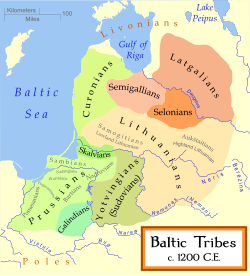
Linguistic research suggests that East Baltic languages split from West Baltic (or a hypothetical proto-Baltic ancestor) between 400 and 600 CE. The specific differentiation between Latvian and Lithuanian began later, after 800 CE. Transitional dialects continued to exist between these two languages until at least the 14th or 15th century, and potentially as late as the 17th century.
The 16th to 19th Centuries
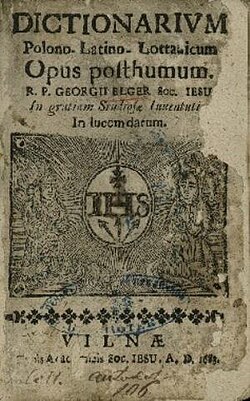
The formalization of written Latvian saw significant milestones between the 16th and 18th centuries. Johann Ernst Glück was the first to translate the Bible into Latvian, completing the New Testament in 1685 and the Old Testament in 1691. Later, Gotthard Friedrich Stender, a Lutheran pastor, laid the groundwork for secular literature by producing the first illustrated alphabet book (1787), a comprehensive encyclopedia on nature and the world (1774), and various grammar books and dictionaries.
By the late 19th century, Latvian was the dominant linguistic group in the region. The 1897 Imperial Russian Census recorded 505,994 speakers (75.1%) in the Governorate of Courland and 563,829 speakers (43.4%) in the Governorate of Livonia.
The 20th Century and Soviet Influence
The 20th century brought significant challenges. During the Soviet occupation, policies of Russification aimed to diminish the role of the Latvian language. This was compounded by the NKVD's "Latvian Operation" of 1937–1938, which resulted in the execution of at least 16,573 ethnic Latvians and nationals. Mass deportations in 1941 and 1949, followed by colonization efforts from other Soviet republics, shifted the demographics; the ethnic Latvian population dropped from 80% in 1935 to 52% by 1989.
In the post-Soviet era, the Latvian government has implemented policies to restore the language's primacy. Since 2004, public secondary schools must conduct at least 60% of class work in Latvian, and by 2019, Parliament transitioned primary education for ethnic minorities to be exclusively in Latvian to ensure professional and academic integration.
Dialects and Linguistic Variation
Latvian is categorized into three primary dialect groups: the Livonic, Central (Middle), and High Latvian dialects. These variations reflect the geographical and historical influences across the Baltic territory.
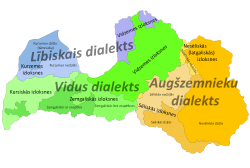
The High Latvian dialect includes the Latgalian variety, which is mutually intelligible with other dialects but maintains distinct characteristics. Historically, the Kursenieki—a Latvian-speaking group—settled as far as Danzig (Gdańsk) and Memel (Klaipėda) by 1649.
![In 1649[citation needed] settlement of the Latvian speaking Kursenieki spanned from Memel (Klaipėda) to Danzig (Gdańsk).](/images/f0/fd/f0fd97f76bdf25c636d5b56a02cda9cb13dcd83a3ba328a8c645f29b31149388.png)
Orthography and Writing System
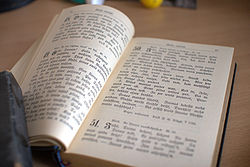
Modern standard Latvian uses a 33-character Latin-based alphabet. The system is highly phonetic, meaning there is a nearly one-to-one correspondence between letters (graphemes) and sounds (phonemes).
Phonetic Nuances
There are a few exceptions to this consistency. The letters ⟨e⟩ and ⟨ē⟩ each represent two sounds, and the letter ⟨o⟩ is used for three different sounds: a short [ɔ], a long [ɔ], and the diphthong [uɔ]. While some advocate for the Latgalian system (using ⟨ō⟩ and ⟨uo⟩) to resolve this, grammarians argue that ⟨o⟩ and ⟨ō⟩ appear primarily in loanwords.
Computing and Modern Usage
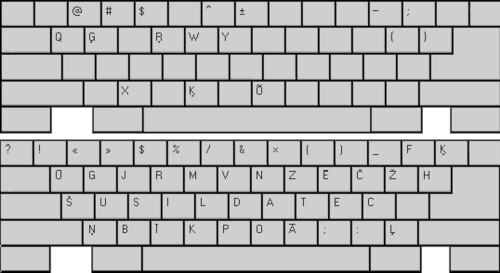
In the 1990s, standards like LVS 8-92 and LVS 24-93 were established to integrate Latvian into computing. While an ergonomic keyboard layout (LVS 23-93) was developed, it never gained widespread popularity due to the requirement for specialized hardware.
Language Summary Table
| Feature | Details |
|---|---|
| Language Family | Indo-European (East Baltic) |
| Native Speakers | ~1.5 Million (Latvia) + 100,000 (Abroad) |
| Official Status | Latvia, European Union |
| Alphabet | Latin (33 characters) |
| Main Dialects | Livonic, Central, High Latvian |
Frequently Asked Questions
How does Latvian relate to Lithuanian?
Both are East Baltic languages within the Indo-European family. They share a common ancestor but began to diverge as distinct languages after 800 CE.
What is the "Word of the Year" contest?
Organized by the Riga Latvian Society since 2003, this annual contest promotes correct language use. It features categories like "Best word" and "Worst word," reflecting current linguistic trends (e.g., klausiņas for wireless headphones was named Best Word in 2025).
Is Latvian difficult to pronounce?
For those familiar with the alphabet, Latvian is relatively straightforward because its orthography is almost entirely phonetic, meaning words are generally pronounced exactly as they are written.
What happened to the old orthography?
Over time, the language was streamlined. For example, the digraph ⟨ch⟩ was discarded in 1957, and letters like ⟨ō⟩ and ⟨ŗ⟩ ceased official use in 1946, though they are still used by some diaspora communities and in specific varieties.
How is Latvian taught to non-native speakers in Latvia?
The state encourages proficiency through second-language instruction in the early stages of schooling. Since 2004, a significant portion of secondary education is mandated in Latvian to facilitate academic and professional success for all residents.