Language Homelands: Tracing the Origins of the World's Proto-Languages
In the field of historical linguistics, researchers often seek to identify the Urheimat—a German term meaning "original home." This refers to the specific geographic region where a proto-language was spoken before it split into various descendant, or "daughter," languages. A proto-language is the reconstructed or historically documented parent language that serves as the common ancestor for a group of genetically related languages.
Determining these origins is a complex task. For language families with more recent histories, migrations may be known with near-certainty. However, for families dating back to deep prehistory, the location of the homeland remains highly uncertain. To solve these mysteries, linguists combine internal linguistic evidence with insights from archaeology and archaeogenetics (the study of ancient DNA to track human movement).
Key Facts
- Urheimat is the linguistic term for the original homeland of a proto-language.
- Reconstructing homelands requires interdisciplinary work involving linguistics, archaeology, and genetics.
- The certainty of a language's origin depends on how far back in prehistory the language family dates.
- Major language families like Indo-European and Niger-Congo have widely studied, though sometimes debated, ancestral regions.
Regional Language Family Homelands
Western and Central Eurasia
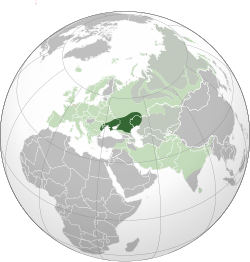
The Indo-European language family is one of the most extensively studied. While various theories exist, researchers use linguistic and archaeological data to map its expansion across Eurasia.
Other significant families in this region include the Caucasian, Dravidian, Turkic, and Uralic languages. For instance, recent genetic studies have helped reveal the demographic history of Uralic-speaking populations and their connections to Siberian ancestry.
Eastern Eurasia
In Eastern Eurasia, the origins of the Japonic language family are linked to the movement of people. Most scholars believe Japonic was brought to northern Kyushu from the Korean Peninsula around 700 to 300 BCE by wet-rice farmers of the Yayoi culture. From there, it spread throughout the Japanese archipelago and later to the Ryukyu Islands.
Other major families in this region include Koreanic, Sino-Tibetan, Hmong–Mien, Kra–Dai, and Austroasiatic. Evidence suggests that Sino-Tibetan may have originated in northern China during the Late Neolithic period.
North and South America
In North America, language families such as Eskimo–Aleut, Na-Dené and Yeniseian, Algic, and Uto-Aztecan represent diverse ancestral paths. Regarding the Uto-Aztecan family, some authorities place the homeland in the border region of the USA and Mexico (the Sonoran Desert area), spoken by foragers roughly 5,000 years ago. However, other scholars propose a southern homeland in Mesoamerica, suggesting the speakers were maize cultivators who moved north between 4,500 and 3,000 years ago.
South American linguistic history includes the Tupian family.
Africa and the Middle East
The Afroasiatic family is believed to have its homeland in northeast Africa, as Semitic is the only branch found outside the continent. Another theory suggests a Neolithic expansion from the Middle East. Proto-Afroasiatic is estimated to have begun breaking up in the 8th millennium BCE, with Proto-Semitic spoken in the Near East between 4400 and 7400 BCE.
The Niger–Congo family, which includes over 1,000 languages, is thought to have originated in the savanna belt of West Africa. A major movement known as the Bantu expansion through the Central African rainforests began around 3000 BCE. Additionally, the Mande homeland is placed in Southern Sahara (modern-day Mauritania or southern Western Sahara) during the second half of the 4th millennium BCE.
Summary of Major Language Families and Proposed Origins
| Language Family | Likely/Proposed Homeland Region | Key Context/Notes |
|---|---|---|
| Indo-European | Eurasia | Extensively studied via archaeology and genetics. |
| Japonic | Korean Peninsula | Spread via Yayoi culture rice farmers (700–300 BCE). |
| Uto-Aztecan | USA/Mexico Border | Debated between Sonoran Desert foragers and Mesoamerican cultivators. |
| Afroasiatic | Northeast Africa | Possible Neolithic expansion from the Middle East. |
| Niger–Congo | West African Savanna | Includes the Bantu expansion starting ~3000 BCE. |
| Mande | Southern Sahara | Located in modern Mauritania/Western Sahara. |
Frequently Asked Questions
What is a proto-language?
A proto-language is a reconstructed or historically documented ancestral language that serves as the common parent to a group of genetically related daughter languages.
What does the term Urheimat mean?
Urheimat is a German term meaning "original home," used in linguistics to describe the geographic region where a proto-language was originally spoken.
How do linguists find the homeland of an ancient language?
Linguists use internal linguistic evidence and collaborate with experts in archaeology and archaeogenetics to reconstruct prehistoric movements and locations.
Why is it difficult to pinpoint language homelands?
While recent migrations are easier to track, languages from deep prehistory are much harder to locate because the evidence is often fragmentary and requires complex interdisciplinary reconstruction.
What role did agriculture play in language spread?
Agriculture often drives language expansion; for example, the spread of Japonic languages is linked to wet-rice farmers, and some theories suggest Uto-Aztecan spread was tied to maize cultivation.