Lancers: The History and Evolution of Lance-Armed Cavalry
A lancer is a specialized cavalryman trained to fight with a lance, a long thrusting weapon designed for mounted combat. While often associated with the colorful uniforms of the 19th century, the use of lances dates back to antiquity, appearing in Assyria as early as 700 BC and later utilized by the military forces of India, Egypt, China, Persia, Greece, and Rome.
Throughout the Middle Ages and the Renaissance, heavy cavalry across Eurasia relied heavily on the lance. However, the weapon fell out of general favor by the late 16th century, only to experience a significant revival among light cavalry in the early 19th century. This resurgence kept the lance in an active combat role until the early 20th century and the first stages of World War I.
Key Facts
- Ancient Origins: Used in mounted warfare as early as 700 BC in Assyria.
- Napoleonic Impact: Regained prominence during the Napoleonic Wars due to their effectiveness in shock tactics.
- Weapon Specs: French lances at Waterloo were approximately 3 meters long and weighed about 3 kilograms.
- Tactical Role: Lances provided initial shock impact, while sabres were used for close-quarters mêlées.
- Modern Status: Now primarily used for ceremonial purposes, though many units retain the "Lancer" designation.
Lancers from the 17th to 19th Centuries
Between the 17th and 19th centuries, lancers—known as uhlans in Polish, German, and French contexts—became staples of European, Ottoman, and Indian cavalry. To increase mobility, most nations discarded heavy armor, with the exception of Ottoman troops and the famous Polish "winged" hussars, who were among the last Europeans to abandon armor.
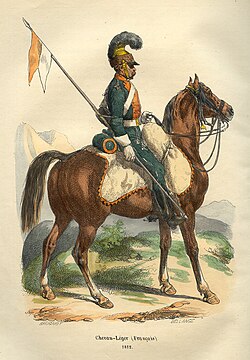
The true value of the lancer was reaffirmed during the Napoleonic Wars. Polish lancers, in particular, were highly sought after and served in the Austrian, Prussian, Russian, and French armies. The most prestigious of these was the 1 Régiment de Chevau-Légers-Lanciers de la Garde Impériale within Napoleon's Imperial Guard.
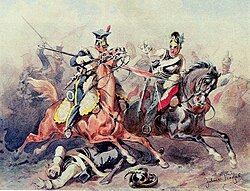
Historian Alessandro Barbero notes that at the Battle of Waterloo, French lances—consisting of a steel point on a wooden staff—were "terrifyingly efficient." General Durutte, observing the battle, remarked on the clear superiority of the lance over the sword in specific combat scenarios.
Tactical Advantages and Vulnerabilities
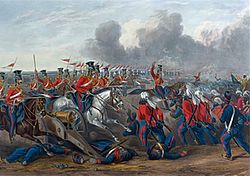
While devastating during a charge, the lance was cumbersome in a mêlée (a confused, hand-to-hand fight). In close-quarters combat, the long weapon was easily deflected by sabres. To counter this, many Eurasian armies adopted a tiered formation: the front rank carried lances for the initial shock, while the second rank carried sabres to handle the ensuing close combat.
Equipment and Appearance
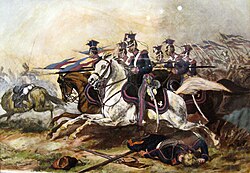
Lancers were characterized by a distinct uniform, typically featuring a kurtka (double-breasted jacket) with a plastron (colored front panel), a sash, and a czapka (square-topped cap). The lance itself often featured a pennon—a small, swallow-tailed flag located just below the head.
Because the lance and pennon created a high visual profile, lancers became easy targets for infantry armed with muskets and rifles. To mitigate this, troopers were trained to lower their lances when scouting on hilltops to avoid detection.
The Transition into the 20th Century
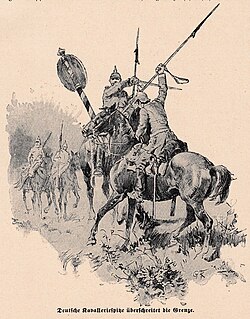
By 1914, lances were still active in numerous armies, including those of Britain, France, Germany, Russia, Italy, Japan, and several South American and Asian nations. German cavalry utilized the Stahlrohrlanze (steel tube lance), measuring 3.2 meters. In Russia, half of the regular cavalry and all Cossacks carried lances into active service.
The British experience was more volatile; they abandoned the lance after the Second Boer War in 1903, only to reintroduce bamboo and ash wood lances from 1909 to 1928. Meanwhile, the French utilized 2.97-meter steel lances for their dragoon regiments, having found British bamboo versions too fragile for high-impact encounters.
The End of the Combat Lance
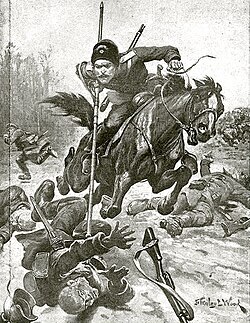
The advent of modern firearms and artillery eventually rendered the armes blanche (melee weapons) obsolete. While lances saw limited use on the Eastern Front during World War I, they were largely absent from the Western Front after 1914. Most armies phased out the lance for active service by the late 1920s, though Poland continued using them for training and ceremony until the late 1930s.
Modern Ceremonial Units
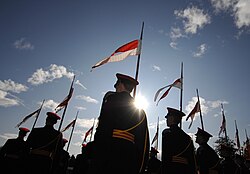
Today, the lance is purely ceremonial, but the title of "Lancer" is preserved in many prestigious armored cavalry units worldwide for historical reasons.
| Country | Notable Lancer Units |
|---|---|
| United Kingdom | Royal Lancers |
| Italy | Lancieri di Novara, Lancieri di Aosta, Lancieri di Montebello |
| Spain | King's Lancers Troop, Bourbon's Lancers Group |
| India | 2nd Lancers (Gardner's Horse), 20th Lancers |
| Australia | 12th/16th Hunter River Lancers, 1st/15th Royal NSW Lancers |
| Canada | Lord Strathcona's Horse |
| USA | National Lancers (Massachusetts Organized Militia) |
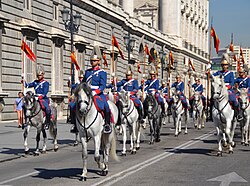
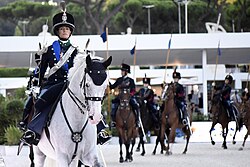
In countries like Chile, Argentina, Bolivia, and Peru, as well as within the Portuguese National Republican Guard, lances are still carried during mounted parades to honor military tradition.
Frequently Asked Questions
Why were lances considered superior to swords in a charge?
Lances provided a significant reach advantage, allowing the rider to strike the enemy before the enemy's sword could reach them, creating a powerful shock effect during the initial impact of a cavalry charge.
What were the main weaknesses of the lance?
The primary weakness was its lack of maneuverability in close-quarters combat (mêlées), where it became clumsy and easily deflected by shorter weapons like sabres. Additionally, the weapon's height made the rider a conspicuous target for infantry.
What is a 'czapka'?
A czapka is a traditional square-topped cap worn by lancers, particularly associated with Polish cavalry traditions.
When did lances stop being used as active combat weapons?
Most armies ceased active service use of the lance during the 1920s and 1930s. For example, the British stopped in 1928, the Germans in 1927, and the Polish army between 1934 and 1937.
What is the difference between a lancer and a hussar?
While both are cavalry, lancers are specifically defined by their use of the lance as a primary weapon. Hussars were traditionally light cavalry focused on scouting and skirmishing, though some, like the Polish winged hussars, did utilize lances.