Lancelets: The Evolutionary Bridge to Vertebrates
The lancelet, also known as amphioxus, is a small, translucent, fish-like marine animal. While it may appear simple, it holds a position of immense importance in biological science as one of the closest living invertebrate relatives of the vertebrates. Belonging to the subphylum Cephalochordata, these creatures provide a living window into the early evolution of the chordate body plan.
Unlike most vertebrates, lancelets lack a bony skeleton or a complex brain, yet they possess the fundamental characteristics that define the phylum Chordata. Their unique anatomy makes them an invaluable model organism for researchers studying how the complex systems of humans and other vertebrates first emerged.
![The lancelet is a small, translucent, fish-like animal that is one of the closest living invertebrate relatives of the vertebrates.[81][82]](/images/f4/e0/f4e04e7b1e3ed9e183d8c016ea01b7c0004eca3a6ffc00f36701c63ac393204b.png)
Key Facts
- Classification: Subphylum Cephalochordata, Class Leptocardii.
- Defining Feature: Possession of a notochord (a flexible rod supporting the body) that persists throughout adulthood.
- Diet: Filter feeders that trap suspended particles from the water.
- Biological Significance: Used as a model organism to study the evolution of the vertebrate immune system, cartilage, and nervous system.
- Unique Trait: Some species produce endogenous green fluorescent proteins (GFP).
Anatomy and Biological Systems
The Notochord and Nervous System
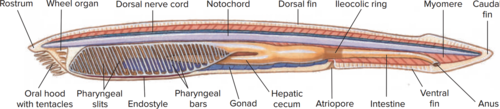
The most striking feature of the lancelet is the notochord, a longitudinal skeletal element that provides structural support. In Cephalochordates, this rod extends from the tail to the very tip of the head (hence the name "Cephalo-chordata"). Their nervous system is relatively simple compared to vertebrates, consisting of a neural tube that lacks the complex regionalization of a modern brain, though it provides critical insights into the origin of the vertebrate central nervous system.
Visual and Sensory Organs
Lancelets do not have complex eyes. Instead, they utilize a frontal eye and other light-sensing organs. Their visual system relies on melanopsin-expressing photoreceptors to detect light changes. Additionally, they possess specialized sensory structures known as Hesse organs and Joseph cells, which assist in navigating their aquatic environment.
Fluorescent Proteins
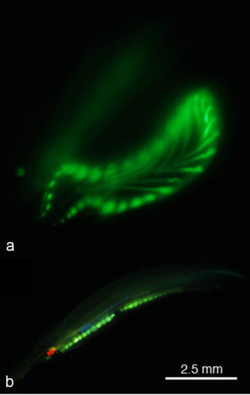
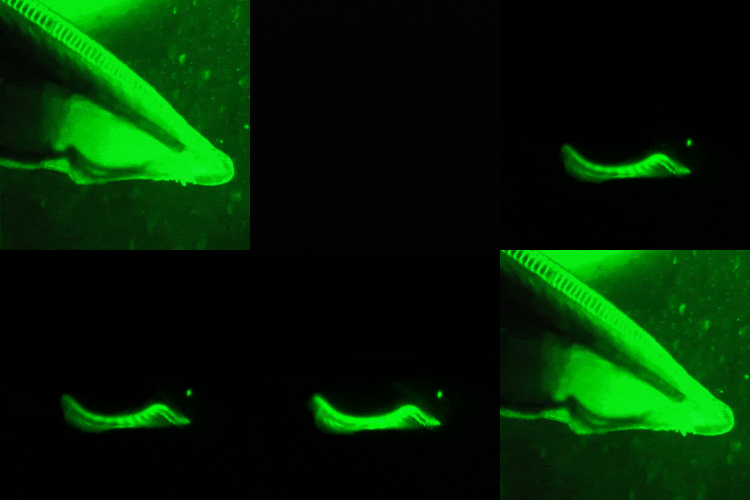
Interestingly, certain lancelets exhibit natural fluorescence. Research has identified endogenous Green Fluorescent Protein (GFP) in species such as Branchiostoma floridae, where it is found near the eye spot and oral tentacles, and in Asymmetron lucayanum, where it appears in the gonads.
Ecology and Life History
Habitat and Feeding
Lancelets are typically found buried in sandy sea floors, where they leave only their anterior ends exposed to the water column. They are filter feeders, using oral tentacles to trap organic particles and plankton from the water, which are then processed through a complex digestive system.
Reproduction
Reproduction occurs through spawning. While patterns vary by species—some exhibit year-round reproduction while others are seasonal—they generally release gametes into the water for external fertilization.
Taxonomy and Classification
The classification of lancelets is centered around the class Leptocardii and the family Branchiostomatidae. They are divided into three primary genera: Branchiostoma (the most diverse), Asymmetron, and Epigonichthys.
| Genus | Notable Species | Common Name / Region |
|---|---|---|
| Branchiostoma | B. lanceolatum | European lancelet |
| Branchiostoma | B. floridae | Florida lancelet |
| Asymmetron | A. lucayanum | Sharptail lancelet |
| Epigonichthys | E. hectori | Hector's lancelet |
Frequently Asked Questions
Are lancelets fish?
No, lancelets are not fish. While they look fish-like, they are invertebrates. They lack a backbone (vertebrae) and a true jaw, placing them in the subphylum Cephalochordata rather than Vertebrata.
Why are lancelets important to science?
They serve as a critical model organism for evolutionary biology. Because they possess a notochord and a dorsal nerve cord but lack the complexity of vertebrates, they help scientists understand how the vertebrate body plan, including the brain and immune system, evolved.
What is a notochord?
A notochord is a flexible, rod-like structure that provides skeletal support. In vertebrates, it is largely replaced by the spinal column during development, but in lancelets, it persists throughout their entire lives.
Do lancelets have eyes?
They do not have complex eyes like humans. Instead, they have simple light-sensing organs, including a frontal eye, which allow them to detect light and dark to help with orientation.
Can lancelets be eaten by humans?
The source mentions lancelets as human food, though they are primarily studied for their scientific value rather than as a commercial food source.