Branchiostoma lanceolatum: The Evolutionary Bridge Between Invertebrates and Vertebrates
The Branchiostoma lanceolatum, commonly known as the European lancelet or Mediterranean amphioxus, is a fascinating marine invertebrate that occupies a unique position in the animal kingdom. Belonging to the subphylum Cephalochordata, this creature possesses a notochord—a flexible, rod-like structure—but lacks a true backbone. Because of these characteristics, it serves as a critical model organism for scientists studying the evolutionary development of vertebrates.
Key Facts
- Scientific Name: Branchiostoma lanceolatum
- Common Names: European lancelet, Mediterranean amphioxus
- Defining Feature: Possesses a notochord throughout its entire life but no vertebral column.
- Maximum Size: Up to 6 cm (2.5 in) in length.
- Habitat: Shallow seas from the North-east Atlantic to the Black Sea and parts of the Indian Ocean.
- Research Value: Used to study the genetic and anatomical origins of vertebrates.
Anatomy and Physical Characteristics
The Branchiostoma lanceolatum is characterized by an elongated, pearly white body that is flattened laterally and pointed at both ends. Its semi-transparent skin allows researchers to observe its internal organs without invasive procedures, giving it the appearance of a "primitive fish."
The most significant anatomical feature is the notochord, a stiffening rod of tightly packed cells that extends the full length of the body. Unlike in vertebrates, where the notochord is largely replaced by a spine, it persists in the adult lancelet. Above the notochord lies a simple dorsal neural tube, which is slightly thickened at the anterior end to form the cerebral vesicle, accompanied by a nerve cord and a single frontal eye.
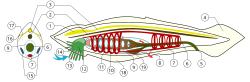
The mouth is located on the underside of the body, surrounded by 20 to 30 cirri (slender sensory appendages). The digestive tract runs just below the notochord, leading to an anus located in front of the tail. The tail itself is surrounded by a vertical, flap-like fin. For respiration, the animal utilizes gill slits in the mid-region for gas exchange, with segmented gonads positioned immediately behind them.
Distribution and Habitat
This species is primarily found in the shallow waters of the north-east Atlantic Ocean, ranging from Norway (67°N) south to the Mediterranean Sea and east to the Black Sea. Interestingly, its range has expanded into the northerly parts of the Indian Ocean and the coasts of East Africa via the Suez Canal.
The lancelet is a burrowing organism, preferring soft substrates such as gravel, sand, and shell fragments. It is highly selective regarding particle size and typically inhabits depths from the low tide mark down to approximately 40 metres (130 ft).
Biology and Life Cycle
In the North Sea, breeding typically occurs during June and July. Mature adults, usually between 2 and 3 years old, gather in masses on the sea floor. The species is dioecious, meaning individuals are either male or female, and they spawn once annually through external fertilization.
The life cycle begins with larvae that initially stay within the substrate before becoming pelagic (living in the open ocean). These larvae exhibit a vertical daily migration: they rise to the sea surface every evening and sink through the water column each morning, feeding on detritus, copepods, and phytoplankton. The larval stage can last up to 200 days, during which the number of gill slits increases from 6 to 19.
Immune System Insights
Research into the lancelet's innate immune response has highlighted the role of Toll-like receptors (TLRs), which mediate inflammatory pathways. Evidence suggests that amphioxus TLRs maintain a protein structure similar to those found in vertebrates, while also sharing features with invertebrates, suggesting a paraphyletic relationship between the two lineages.
Scientific Research and Taxonomy
Because of its simple yet chordate-like structure, Branchiostoma lanceolatum is an essential tool for evolutionary biology. Sequencing of its mitochondrial genome has revealed that the organization of its two rRNA genes and coding genes mirrors that of the sea lamprey (Petromyzon marinus), reinforcing the close relationship between lancelets and vertebrates.
To facilitate global research, the Amphiencode consortium was established in 2015, providing a centralized, public platform for genomic data. In laboratory settings, adults can be induced to spawn via thermal shock, with metamorphosis occurring within one to three months.
Molecular Taxonomy
Recent multilocus molecular studies have clarified the species' taxonomy. By comparing populations across Europe, researchers confirmed that the Atlantic Branchiostoma lanceolatum and the Mediterranean Branchiostoma lubricum are actually a single species. This lack of geographic structuring is likely due to a low mutation rate and a prolonged larval phase that allows for wide dispersal.
| Feature | Detail |
|---|---|
| Phylum | Chordata |
| Subphylum | Cephalochordata |
| Max Length | 6 cm |
| Depth Range | Low tide to 40 metres |
| Larval Duration | Up to 200 days |
| Key Anatomical Feature | Persistent notochord |
Frequently Asked Questions
Is the European lancelet a fish?
No, while it looks like a "primitive fish," it is a marine invertebrate. It belongs to the subphylum Cephalochordata and lacks a backbone, although it does possess a notochord.
Why is Branchiostoma lanceolatum important for science?
It serves as a model organism for studying the evolution of vertebrates because it shares fundamental chordate characteristics (like the notochord and dorsal nerve cord) but maintains a simpler body plan.
Where can this species be found in the wild?
It is found in shallow seas of the North-east Atlantic, the Mediterranean, and the Black Sea, and has expanded into the East African coast and the northern Indian Ocean.
How do the larvae feed and move?
Larvae are pelagic and perform a vertical daily migration, rising to the surface at night and sinking during the day while feeding on phytoplankton, copepods, and detritus.
What is the Amphiencode consortium?
Established in 2015, it is a collaborative effort between various laboratories to provide a centralized, publicly accessible platform for the genomic data of the amphioxus.