Lamia: A Journey Through the Strategic History of Central Greece
Nestled in a position of immense strategic importance, Lamia has served as a gateway between southern Greece and the northern regions of Thessaly and the Balkans for millennia. From its origins in the Bronze Age to its role as a border city in the modern era, Lamia's story is one of resilience, shifting borders, and constant adaptation to its changing geography.
Ancient Foundations and Strategic Importance
Archaeological evidence confirms that Lamia has been inhabited since at least the 3rd millennium BC. In antiquity, the city's value lay in its control over the narrow coastal plain above Thermopylae, a critical passage for any army moving north or south.
Interestingly, the ancient city was located closer to the sea than it is today. This is evidenced by the nearby temple dedicated to Poseidon, the god of the sea. Over time, the flow of the Spercheios river altered the terrain, pushing the shoreline further into the Malian Gulf and changing the geography of the Thermopylae straits.
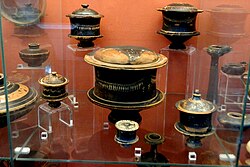
The Rise of the Polis
By the 5th century BC, Lamia had established itself as a polis (a Greek city-state) and constructed fortifications to protect its interests. For centuries, it was a point of contention between the Macedonians, Thessalians, and Aetolians. One of its most significant historical moments occurred during the Lamian War (323–322 BC), following the death of Alexander the Great. Antipatros, the regent of Macedon, used Lamia's strong walls as a refuge during the conflict, which only ended when a Macedonian army of 20,000 arrived and the Athenian general Leosthenes was killed.
While the city prospered during the 3rd century BC as part of the Aetolian League, this era of growth ended abruptly in 190 BC when the Roman general Manius Acilius Glabrio sacked the city.
From Late Antiquity to the Byzantine Era
Following the Roman conquest, Lamia entered a period of relative obscurity. By 431 AD, it served as the seat of a bishop under the jurisdiction of Larissa, though it was notably absent from the 5th-century Tabula Peutingeriana (an ancient map of the Roman road network). Despite this, archaeological finds at the city's ancient acropolis—the Castle—reveal the presence of a basilica, marble inscriptions, and coins. It is believed that Emperor Justinian I rebuilt the Castle walls in the 6th century.
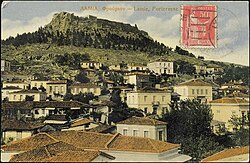
The Transition to Zetounion
After a period of Slavic occupation in the 7th century, the city reappeared in historical records around 869/70 AD under the name Zetounion, a name likely derived from a Slavic word for "grain." Its strategic location near Thermopylae ensured it remained central to the Byzantine–Bulgarian wars. In 997 AD, the Byzantine general Nikephoros Ouranos achieved a decisive victory over Tsar Samuel of Bulgaria at the nearby Battle of Spercheios.
The city continued to attract high-profile visitors, including Emperor Basil II in 1018. By 1165, the Jewish traveler Benjamin of Tudela noted the presence of 50 Jewish families living in the city, though he also mentioned raids by neighboring Vlachs.
Crusaders, Catalans, and Ottoman Rule
The Fourth Crusade in 1204 brought a wave of Western influence. The city was captured by Frankish crusaders and initially granted as a fief to the Knights Templar, who reinforced the fortress. However, the Templars were evicted in 1209–10 for supporting a rebellion, and the city became an imperial domain under Latin Emperor Henry of Flanders.
The ownership of Lamia shifted frequently over the next two centuries:
- Epirote Greeks: Captured the city around 1218/20.
- Duchy of Athens: Regained control in 1275 via the dowry of Helena Angelina Komnene.
- Catalans: Held the city from 1318 until 1391.
- Acciaioli Dukes: Controlled the city briefly until 1394.
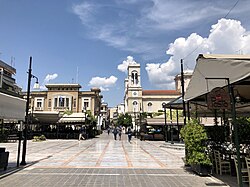
The Ottoman Period and Modern Independence
The Ottoman era began with the destruction of the fortress by Sultan Bayezid I in 1394. Although the Byzantines briefly regained control after the Battle of Ankara in 1402 and successfully resisted a two-year siege before 1415, the Turks ultimately reconquered the city between 1424 and 1426. Aside from a plundering raid by the Despotate of the Morea in 1444, Lamia remained under Ottoman rule for centuries.
Lamia finally became part of the independent Kingdom of Greece in 1832. It served as a border city—with the boundary set at "Taratsa" just to the north—until the annexation of Thessaly in 1881.
Key Facts
- Ancient Origins: Inhabited since the Bronze Age (3rd millennium BC).
- Geological Shift: The shoreline moved inland due to the Spercheios river, moving the city away from the sea.
- Military Significance: A key stronghold during the Lamian War (323–322 BC) and the Byzantine–Bulgarian wars.
- Name Change: Known as Zetounion from the 9th century, likely meaning "grain."
- Diverse Rule: Governed by Greeks, Romans, Slavs, Byzantines, Franks, Catalans, and Ottomans.
- Modern Integration: Joined the Kingdom of Greece in 1832 and ceased being a border city in 1881.
| Period | Ruling Power / Influence | Key Event |
|---|---|---|
| Bronze Age - 2nd Century BC | Ancient Greek Polis | Lamian War (323–322 BC) |
| 2nd Century BC - 7th Century AD | Roman / Early Byzantine | Rebuilding of walls under Justinian I |
| 7th Century - 1204 AD | Slavic / Byzantine | Battle of Spercheios (997 AD) |
| 1204 - 1394 AD | Frankish / Epirote / Catalan | Templar fortification of the castle |
| 1394 - 1832 AD | Ottoman Empire | Fortress razed by Bayezid I (1394) |
| 1832 - Present | Kingdom of Greece | Annexation of Thessaly (1881) |
Frequently Asked Questions
Why was Lamia strategically important in antiquity?
Lamia controlled the narrow coastal plain above Thermopylae, which was the primary land connection between southern Greece and Thessaly/the Balkans.
What caused the city to move away from the coastline?
The flow of the Spercheios river caused a geological phenomenon that pushed the sealine further into the Malian Gulf, moving the coast away from the city center.
What does the name "Zetounion" mean?
The name Zetounion, which appeared around 869/70 AD, is believed to derive from a Slavic word meaning "grain."
Who were the different foreign powers that ruled Lamia during the Middle Ages?
During the Middle Ages, Lamia was ruled by the Byzantines, Frankish crusaders (including the Knights Templar), Epirote Greeks, Catalans, and the Acciaioli Dukes of Athens before falling to the Ottomans.
When did Lamia stop being a border city?
Lamia served as a border city from 1832 until 1881, when the region of Thessaly was annexed into the Kingdom of Greece.