Lafayette Square: A Historic Landmark of New Orleans
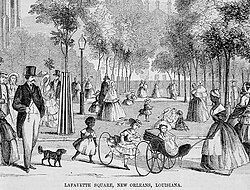
Located in the heart of the present-day Central Business District, Lafayette Square stands as the second-oldest public park in New Orleans, Louisiana, surpassed only by Jackson Square. Once part of a residential area known as Faubourg Sainte Marie (St. Mary Suburb) during the late 18th century, the square has evolved from a colonial residential hub into a premier urban space for civic engagement and leisure.
The park was designed in 1788 by Charles Laveau Trudeau, also known as Don Carlos Trudeau. Trudeau served as the Surveyor General of Louisiana under the Spanish government and later became the acting mayor of New Orleans in 1812 following Louisiana's transition to statehood.
Key Facts
- Established: Designed in 1788.
- Namesake: Named after the Marquis de Lafayette, a French aristocrat and general in the American Revolutionary War.
- Location: Central Business District, New Orleans.
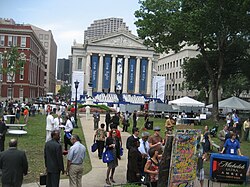
- Key Landmarks: Gallier Hall and various historical statues.
- Management: Supported by the Lafayette Square Conservancy.
Civic Importance and Architecture
Lafayette Square has long been a focal point for the city's political and social life. Facing the square on St. Charles Avenue is Gallier Hall, the former City Hall of New Orleans. While the city government has since relocated, the square remains a vital venue for civic events, inaugurations, and live musical performances.
Historical Monuments
The square is adorned with tributes to significant historical figures. A bronze statue of Henry Clay occupies the center of the park, while a statue of Benjamin Franklin is located on Camp Street. Notably, a statue of John McDonogh on St. Charles Avenue was removed in July 2020.
A Legacy of Conflict and Resilience
From 1834 to 1938, the Western side of the square was occupied by the First Presbyterian Church of New Orleans. At the time, its steeple was the tallest in the city. This landmark played a role during the American Civil War occupation of New Orleans (1862–1865), when General Benjamin Butler used the church bell to ring the city's curfew.
Following the church's relocation to the corner of South Claiborne and Jefferson Avenues, most of its architectural elements, including the historic bell, were moved to the new site.
Modern Restoration
The park faced a significant crisis following Hurricane Katrina, which severely damaged the trees and left the area unsafe due to debris and broken glass from surrounding buildings. In response, a group of downtown workers and neighborhood residents established the Lafayette Square Conservancy, a charitable organization dedicated to restoring the park into a premier urban space.
Lafayette Square Summary
| Feature | Details |
|---|---|
| Designer | Charles Laveau Trudeau (Don Carlos Trudeau) |
| Year Designed | 1788 |
| Former Neighborhood | Faubourg Sainte Marie |
| Adjacent Landmark | Gallier Hall |
| Current Status | Public park and civic event space |
Frequently Asked Questions
Who is Lafayette Square named after?
The square is named after Gilbert du Motier, the Marquis de Lafayette, a French aristocrat and general who fought alongside the Americans during the American Revolutionary War.
What is the significance of Gallier Hall?
Gallier Hall is the former City Hall of New Orleans. Although it no longer houses the city government, it remains a landmark facing the square and is associated with the area's use for inaugurations.
What happened to the First Presbyterian Church steeple?
The church occupied the western side of the square until 1938. Its architectural elements, including the bell used by General Benjamin Butler during the Civil War, were moved to a new location at South Claiborne and Jefferson Avenues.
How was the park restored after Hurricane Katrina?
After the storm left the park unsafe and damaged, the Lafayette Square Conservancy—a charitable organization formed by local residents and workers—was created to transform the area back into a premier urban space.
Which statues are currently in the park?
The park currently features a bronze statue of Henry Clay in the center and a statue of Benjamin Franklin on Camp Street.