Canal Street: The Historic Heart and Cultural Divide of New Orleans
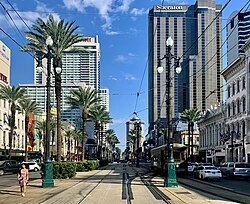
Stretching 3.6 miles through the vibrant landscape of New Orleans, Canal Street (French: Rue du Canal) is more than just a thoroughfare; it is a living timeline of the city's evolution. Known as one of America's widest main streets, it serves as the definitive boundary between the colonial charm of the French Quarter and the modern energy of the Central Business District (CBD).
Historically, Canal Street acted as a cultural frontier. In the early 1800s, the French Quarter (Vieux Carré) was primarily inhabited by Creoles. Following the 1803 Louisiana Purchase, an influx of Americans from Kentucky and the Midwest settled uptown. To separate these two distinct cultures, a canal was planned. Although the water feature was never actually constructed, the street that replaced it kept the name, and its median became known as the neutral ground—a term still used today in New Orleans to describe any street median.
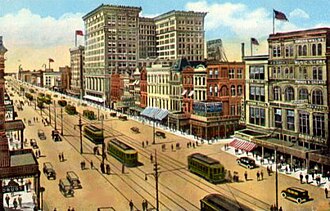
Key Facts
- Total Length: 3.6 miles (5.8 km).
- Width: 171 feet (52 m).
- Cultural Significance: Historically divided the colonial French Quarter from the American Sector (CBD).
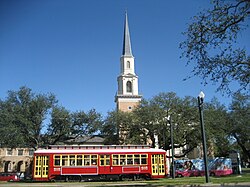
- Transit Hub: Home to the Canal Streetcar Line and a major hub for the Regional Transit Authority (RTA).
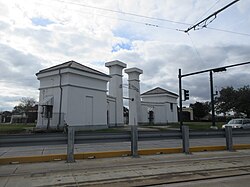
- Termini: Extends from the Canal Street Ferry Terminal at the Mississippi River to a group of cemeteries in Mid-City.
A History of Land and Law
The origins of Canal Street are rooted in the expansions of the Faubourg Sainte Marie. In the late 18th and early 19th centuries, Jean Gravier allotted land for a canal and a turning basin, which he named "Place Gravier." This land later became the center of a protracted legal battle between the city of New Orleans and the New Orleans and Carrollton Railroad.
Over several decades, the Supreme Court of the Territory of Orleans and the Supreme Court of Louisiana issued conflicting rulings on the ownership of the basin. Eventually, a dispute involving Philip Werlein reached the U.S. Supreme Court, which ruled in Werlein's favor. Today, the site of that contested land is occupied by the Hotel de Soto.
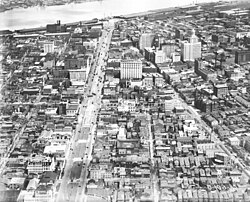
The Golden Age of Retail and Entertainment
For over a century, Canal Street was the premier shopping destination for the Greater New Orleans region. It was anchored by legendary department stores such as Maison Blanche, D. H. Holmes, Godchaux's, and Gus Mayer. These establishments evolved from simple fabric and notion shops into elegant multi-floor palaces featuring the latest elevators and escalators.
Parallel to its retail success, the street became a beacon of entertainment. In 1896, Canal Street hosted "Vitascope Hall," widely considered the world's first movie theater dedicated to showing films for profit. By the 1910s, the area was illuminated by the neon marquees of the Saenger, Orpheum, and Joy theaters, creating a vibrant nightlife district.
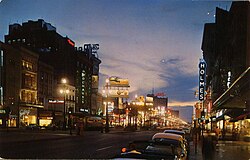
Hospitality and Modern Evolution
The street's role as a commercial hub naturally led to a boom in hospitality. Early 19th-century landmarks like the Union and Planters hotels gave way to mid-century giants like the Jung Hotel and the Marriott, the latter of which opened in 1972 as the city's tallest hotel. Interestingly, the city's retail history has merged with its hotel industry; the former D. H. Holmes is now the Hyatt Centric French Quarter, and the Maison Blanche building houses the Ritz-Carlton.
While the "Oil Bust" of the mid-1980s and national retail trends led to a decline in traditional department stores, the street has seen a modern resurgence. The development of One Canal Place introduced high-end retail and a Class A office tower, while the 2004 Canal Street Vision and Development Strategy encouraged new luxury apartments and the rehabilitation of historic sites like the Joy Theater.
The BioDistrict and Future Growth
Beyond the downtown core, Canal Street passes through Mid-City, where it now anchors the BioDistrict New Orleans. This state-chartered economic zone focuses on biomedical growth, highlighted by a $2 billion investment in new teaching hospitals, including the University Medical Center and a U.S. Department of Veterans Affairs facility.
Efforts to further revitalize the thoroughfare continue into the present day, with the 2024 formation of the "Celebrate Canal" coalition dedicated to the street's ongoing redevelopment.
| Feature | Details |
|---|---|
| East End | Canal Street Ferry Terminal (Mississippi River) |
| West End | City Park Avenue / Mid-City neighborhood line |
| Major Junctions | US 90 and I-10 |
| Transport | 3 lanes each way, center streetcar tracks |
| Key Landmarks | Saks Fifth Avenue, Ritz-Carlton, BioDistrict |
Frequently Asked Questions
Why is the median of Canal Street called the "neutral ground"?
The term originates from the street's history as a dividing line between the Creole population of the French Quarter and the American settlers of the uptown sector. The median served as a literal and figurative neutral space between these two cultures.
Is Canal Street really the widest main street in America?
It is often described as such because it is one of the widest roadways in the United States to be designated as a "street" rather than an "avenue" or "boulevard."
What is the significance of the Canal Street Ferry?
Located at the "head" of the street at the riverfront, the ferry provides a vital transportation link between the Central Business District and the Algiers Point neighborhood.
What happened to the famous department stores on Canal Street?
Many closed due to the 1980s economic depression and shifts in shopping habits. Some have been repurposed; for example, the Maison Blanche and D. H. Holmes buildings are now luxury hotels.
What is the BioDistrict New Orleans?
It is a state-chartered economic development district located along the Mid-City stretch of Canal Street, designed to foster growth in the biomedical sector through facilities like the University Medical Center.