Kurt Gödel: The Logician Who Redefined Mathematical Truth
Kurt Gödel was a titan of 20th-century thought—a logician, mathematician, cosmologist, and philosopher whose work fundamentally altered our understanding of logic and the foundations of mathematics. Alongside Aristotle and Gottlob Frege, Gödel is regarded as one of the most significant logicians in history. His insights challenged the prevailing beliefs of his era, specifically the efforts of Bertrand Russell, Alfred North Whitehead, and David Hilbert to establish a complete and consistent set of axioms for all mathematics.
Key Facts
- Major Contribution: Developed the incompleteness theorems, proving that in any consistent formal system, there are true statements that cannot be proven within that system.
- Academic Pedigree: Earned his doctorate from the University of Vienna in 1930 under the supervision of Hans Hahn.
- Career Peak: Spent much of his later career as a professor at the Institute for Advanced Study in Princeton.
- Interdisciplinary Reach: Contributed significantly to general relativity, set theory, and the philosophy of religion.
- Honors: Recipient of the first Albert Einstein Award (1951) and the National Medal of Science (1974).
Early Life and Academic Foundation
Born in Brünn, Austria-Hungary, in 1906, Gödel's early life was marked by the geopolitical instability of Europe. He held citizenships in Czechoslovakia, Austria, Germany, and eventually the United States. As a student, he was a high achiever in mathematics, languages, and religion, earning the nickname "Mr. Why" from his family due to his relentless curiosity.
Gödel's formal journey into higher mathematics began at the University of Vienna. In 1929, at the age of 23, he completed his doctoral dissertation, Über die Vollständigkeit des Logikkalküls. This work established the completeness theorem for first-order logic, a foundational result that earned him his doctorate in 1930.
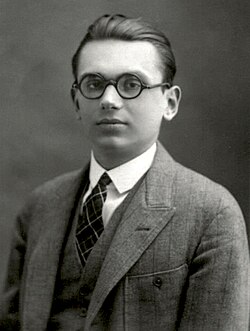
The Incompleteness Theorems and Career Milestones
While the completeness theorem was a major achievement, Gödel is most famous for his incompleteness theorems. These theorems demonstrated that no consistent system of axioms can prove every truth about the arithmetic of natural numbers, effectively ending the quest for a complete and consistent foundation for all of mathematics.
Gödel's career was not without personal turmoil. In the mid-1930s, the rise of the Nazi party in Germany and the subsequent murder of his mentor, Moritz Schlick, triggered a severe nervous crisis. He began suffering from paranoid symptoms, specifically a pervasive fear of being poisoned, which would haunt him for the rest of his life.
![Plaque to Gödel at 43-45 Josefstädter Straße [de], Vienna, where he discovered his incompleteness theorems](/images/b7/da/b7da659b4a8ecb41afc0bb0570c05ad74f17760b9f3f11909fe63b9598bc1fe8.jpg)
The Princeton Years and Einstein
In 1946, Gödel became a permanent member of the Institute for Advanced Study in Princeton, where he developed a close friendship with Albert Einstein. Beyond pure logic, Gödel applied his genius to physics, introducing the Gödel metric, which describes a rotating universe containing closed timelike curves—theoretical paths that would allow for time travel.
During a productive summer in 1942 at Blue Hill, Maine, Gödel is believed to have discovered a proof for the independence of the axiom of choice from finite type theory, a weakened form of set theory.
Philosophical Contributions and Legacy
Gödel's interests extended far beyond equations. He was a proponent of analytic philosophy and explored the philosophy of religion, including the development of an ontological proof for the existence of God. He remained a theist throughout his life, maintaining a distinction between organized religions and the concept of religion itself.
His legacy continues to influence modern science and culture. His work is a cornerstone of computer science, as the incompleteness theorem applies to any Turing-complete computational system. This connection was famously explored in Douglas Hofstadter's 1979 book, Gödel, Escher, Bach: an Eternal Golden Braid.
Personal Struggles and Final Years
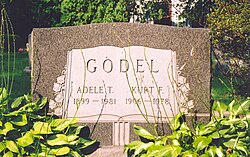
Gödel's mental health declined significantly in his later years. His obsessive fear of poisoning meant he would only eat food prepared by his wife, Adele. When Adele was hospitalized following a stroke in 1977, Gödel refused to eat. He died of starvation and malnutrition on January 14, 1978, weighing only 29 kilograms (65 lb).
| Category | Details |
|---|---|
| Born/Died | April 28, 1906 – January 14, 1978 |
| Primary Fields | Mathematics, Mathematical Logic, Physics, Philosophy |
| Key Theorems | Completeness Theorem, Incompleteness Theorems |
| Key Institutions | University of Vienna, Institute for Advanced Study (Princeton) |
| Major Awards | Albert Einstein Award, National Medal of Science, ForMemRS |
Frequently Asked Questions
What are Gödel's incompleteness theorems?
These theorems prove that in any consistent formal system capable of performing basic arithmetic, there are statements that are true but cannot be proven using the rules of that system.
How did Gödel contribute to physics?
Gödel developed a solution to Einstein's field equations of gravitation that describes a rotating universe, which theoretically allows for the existence of closed timelike curves (time travel).
What was the "Gödel numbering" technique?
Gödel numbering is a method of assigning a unique natural number to each symbol and formula in a formal language, allowing the system to make statements about its own structure.
What caused Kurt Gödel's death?
Gödel died of starvation and malnutrition resulting from a persecutory delusion; he refused to eat any food not prepared by his wife, Adele, who was hospitalized at the time.
What is the relationship between Gödel and the Turing-complete system?
Gödel's incompleteness theorems can be applied to any Turing-complete computational system, suggesting inherent limits to what can be computed or proven by such systems, including potentially the human brain.