Hermann Weyl: The Architect of Gauge Theory and Mathematical Physics
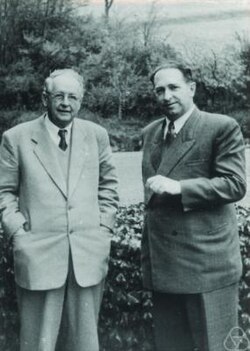
Hermann Weyl was a towering figure of the 20th century, bridging the gap between pure mathematics, theoretical physics, and philosophy. A polymath in the truest sense, Weyl's work provided the mathematical scaffolding for some of the most profound discoveries in modern science, from the nature of spacetime to the behavior of subatomic particles. Associated with the prestigious University of Göttingen tradition—alongside giants like Carl Friedrich Gauss and David Hilbert—Weyl's intellectual journey took him from Germany to Switzerland and eventually to the United States.
Key Facts
- Primary Fields: Pure mathematics, mathematical physics, and the foundations of mathematics.
- Major Innovation: Introduced the concept of gauge in 1918, laying the groundwork for gauge theory.
- Academic Pedigree: Studied under David Hilbert at the University of Göttingen.
- Key Institutions: ETH Zurich, University of Göttingen, and the Institute for Advanced Study (IAS) in Princeton.
- Notable Awards: Fellow of the Royal Society and recipient of the Lobachevsky Prize (1927).
Life and Academic Journey
Born in Elmshorn, German Empire, in 1885, Hermann Weyl's early academic life was defined by his relationship with David Hilbert. After completing his doctoral thesis on singular integral equations in 1908, Weyl's career expanded across Europe. In 1913, he moved to Zurich to take the chair of mathematics at ETH Zurich. It was here that he became a colleague of Albert Einstein, whose work on general relativity deeply influenced Weyl's fascination with mathematical physics.
Weyl's personal life was equally intertwined with intellectual pursuits. His first wife, Helene Joseph, was a philosopher and translator who introduced him to the thought of phenomenologist Edmund Husserl. Later, Weyl developed a close friendship with physicist Erwin Schrödinger. In 1930, Weyl returned to Göttingen to succeed Hilbert, but the rise of the Nazi regime in 1933 forced him to emigrate, as his wife was Jewish. He eventually accepted a faculty position at the Institute for Advanced Study in Princeton, New Jersey, where he remained until his retirement in 1951.
Scientific Contributions and Legacy
Weyl's contributions span a vast array of disciplines, often synthesizing complex geometry with physical reality.
Geometric Foundations and Gauge Theory
In 1918, Weyl introduced the notion of gauge. While his initial attempt to model electromagnetic and gravitational fields as geometrical properties of spacetime was not successful, it birthed gauge theory, which remains fundamental to modern physics. He also contributed the Weyl tensor to Riemannian geometry, a critical tool for understanding conformal geometry.
Quantum Mechanics and Group Theory
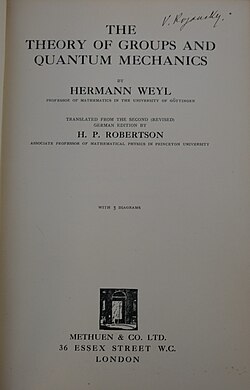
Weyl played a pivotal role in applying group theory to quantum mechanics. His work on the representation of continuous groups helped physicists understand the symmetries of the physical universe. His influential text, The Theory of Groups and Quantum Mechanics, remains a landmark in the field.
Foundations of Mathematics and Philosophy
Beyond physics, Weyl was a logician and philosopher. He explored the foundations of mathematics and the nature of infinity. A pantheist in his personal beliefs, Weyl often reflected on the relationship between the human mind and the infinite, as seen in his work The Open World.
Summary of Weyl's Academic Profile
| Category | Details |
|---|---|
| Alma Mater | Ludwig-Maximilians-Universität München, University of Göttingen |
| Doctoral Advisor | David Hilbert |
| Key Publications | Space, Time, Matter (1918), Symmetry (1952) |
| Major Concepts | Weyl Fermion, Weyl Tensor, Weyl Equation, Gauge Theory |
| Final Residence | Zurich, Switzerland |
Frequently Asked Questions
What is a Weyl fermion?
A Weyl fermion is a massless particle that is a solution to the Weyl equation, a relativistic wave equation. In recent years, these have been observed as quasiparticles in certain materials known as Weyl semimetals.
How did Hermann Weyl contribute to general relativity?
Weyl tracked the development of relativity in his work Space, Time, Matter and introduced the Weyl tensor, which is essential for understanding the curvature of spacetime in Riemannian geometry.
Why did Weyl leave Germany in 1933?
Weyl left the University of Göttingen when the Nazis assumed power, primarily because his wife, Helene, was Jewish, making it impossible for them to remain safely in Germany.
What is the significance of the Weyl tensor?
The Weyl tensor is a part of the curvature of spacetime that represents the gravitational field in regions where there is no matter (vacuum), playing a major role in the study of conformal geometry.
Who were some of Weyl's most notable students?
Among his notable students and associates was the influential mathematician Saunders Mac Lane.