Knights Templar: The Rise and Fall of the Poor Fellow-Soldiers of Christ
Founded around 1118, the Knights Templar—officially known as the Poor Fellow-Soldiers of Christ and of the Temple of Solomon—were a Latin Catholic military order that became one of the most powerful and mysterious institutions of the Middle Ages. Originally established to protect Christian pilgrims traveling to Jerusalem, they evolved into an elite military force and a sophisticated financial network, closely tied to the Crusades.
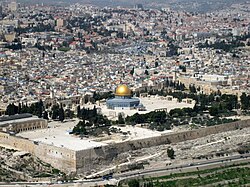
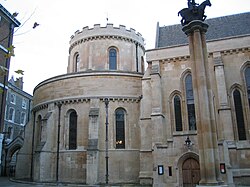
The order operated under the direct allegiance of the Pope and was headquartered on the Temple Mount in Jerusalem. Their identity was deeply rooted in their location, which the Crusaders believed to be the site of the Temple of Solomon.
Key Facts
- Active Period: c. 1118 to March 22, 1312.
- Peak Membership: Estimated between 15,000 and 20,000 members.
- Primary Role: Protection of pilgrims and serving as shock troops in the Crusades.
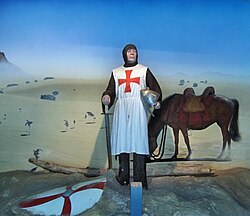
- Distinctive Attire: A white mantle featuring a red cross pattée.
- Final Grand Master: Jacques de Molay.
- Motto: Non nobis, Domine, non nobis, sed Nomini tuo da gloriam ("Not to us, O Lord, not to us, but to Thy name give the glory").
The Rise of the Order
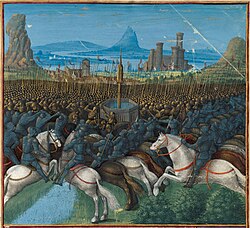
The Templars grew rapidly due to a clear mission and significant resources. They became renowned as shock troops, utilizing heavily armored knights on warhorses to charge enemy lines ahead of the main army. A defining moment of their military prowess occurred in 1177 at the Battle of Montgisard, where approximately 500 Templar knights and several thousand infantry defeated Saladin's army of over 26,000 soldiers.
Expansion of Military Operations
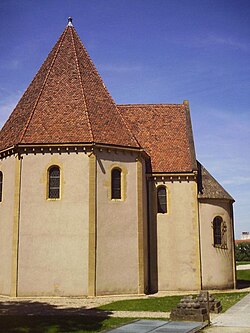
While their initial focus was the pilgrim road from Jaffa to Jerusalem, the Order soon expanded into regular military campaigns. By 1131 or 1137, they were granted the mountainous border region between Antioch and Cilician Armenia, including the castle of Bagras. Their influence extended beyond the Holy Land; in 1143, they began participating in the Reconquista (the Christian effort to reclaim the Iberian Peninsula from Muslim rule) at the request of the count of Barcelona.
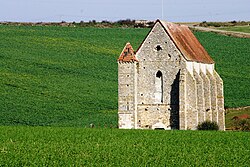
![Convent of Christ Castle, Tomar, Portugal. Built in 1160 as a stronghold for the Knights Templar and besieged in 1190 by the Almohads, it became the headquarters of the renamed Order of Christ. In 1983, it was named a UNESCO World Heritage Site.[63]](/images/07/c0/07c046903e8c32d741ff7c84b99817a8070813dc81edaa49de5c3af25587e582.jpg)
The Second Crusade and Papal Recognition
During the Second Crusade in 1147, a force of Templars from France, Spain, and England joined King Louis VII. On April 27, 1147, Pope Eugenius III granted them permission to wear the red cross on their uniforms. Throughout the journey through Anatolia, the Templars provided critical security against Turkish raids. Although the subsequent siege of Damascus in 1148 failed, the Order continued to gain territory, such as receiving one-fifth of the city of Tortosa in Spain following a successful siege.
![A Seal of the Knights Templar[18][19]](/images/f7/a1/f7a104b1ad9602489423c87060a508edfa87d509659c0e842cfa9907e36ef3d7.jpg)
Organization and Hierarchy
The Order was structured with a strict threefold division of ranks, each with specific roles and attire. While all members wore the red cross, their mantles differed by rank.
| Rank | Social Status | Mantle Color | Role |
|---|---|---|---|
| Knight Brothers | Noble | White | Elite cavalry and leadership |
| Sergeant Brothers | Non-noble | Black or Brown | Support and infantry |
| Chaplain Brothers | Clerical | Varies | Spiritual guidance |
The highest authority was the Grand Master, a lifelong appointment. Due to the dangerous nature of their work, many Grand Masters died in office. For instance, Bernard de Tremelay was beheaded during the Siege of Ascalon in 1153, and Gérard de Ridefort was beheaded by Saladin in 1189 during the Siege of Acre.
Customs and Symbols
Beyond their uniforms, the Templars were often recognized by their long, prominent beards, a custom described by Alberic of Trois-Fontaines around 1240. In battle, they carried the Beauséant, a sacred banner that was white with a black chief (top section).
![Depiction of two Templars seated on a horse (emphasising poverty), with Beauséant, the "sacred banner" (or gonfanon) of the Templars, argent a chief sable (Matthew Paris, c. 1250)[110]](/images/ba/33/ba3317fff1dcdc22fbd8a7f14ced36ca1eeb466ae3f42e7ccb764b2836f440c8.jpg)
The Fall of the Templars
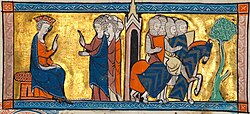
The decline of the Order began as they lost their holdings in the Holy Land. In 1305, Pope Clement V suggested merging the Templars with the Hospitallers, but the Grand Master, Jacques de Molay, was not amenable. This tension coincided with the interests of King Philip IV of France, who was heavily in debt to the Order.
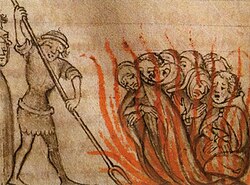
In 1307, King Philip IV ordered the arrest of Templars across France. Members were tortured into providing false confessions of heresy. Under pressure from the French King, Pope Clement V officially disbanded the order in 1312.
Legacy and Successor Orders
Despite the official dissolution, the Templars did not vanish entirely. In Portugal, King Denis refused to persecute the knights, recognizing their aid during the Reconquista. Between 1317 and 1319, many Templar assets and knights were absorbed into the Order of Christ, which was formally recognized by a papal bull on March 14, 1319.
The abrupt end of the original Order gave rise to centuries of speculation and legends, ensuring the "Templar" name persists in popular culture and various self-styled modern organizations.
Frequently Asked Questions
Why were the Knights Templar disbanded?
The Order was disbanded in 1312 by Pope Clement V following pressure from King Philip IV of France. Philip, who owed the Templars significant debts, used false accusations of heresy and torture-induced confessions to justify the arrests and seizure of their assets.
What was the primary mission of the Templars?
Their original mission was the protection of Christian pilgrims traveling to the Holy Land, specifically in the region of Jerusalem. Over time, this expanded into full-scale military participation in the Crusades and the Reconquista.
How many members did the Order have at its peak?
It is estimated that at their peak, the Order consisted of 15,000 to 20,000 members, though only about 10% of these were actual knights; the rest were sergeants and chaplains.
Did the Templars survive after 1312?
While the original Order was dissolved, many of its members and properties in Portugal were absorbed into the Order of Christ in 1319, which continued the Templar legacy under the protection of the Portuguese crown.
What did the Templar uniform symbolize?
The knights wore white mantles to symbolize purity and chastity, while all ranks wore a red cross to signify their devotion to Christ and their role as soldiers of the faith.