Kingdom of Saxony
The Kingdom of Saxony (German: Königreich Sachsen) was a prominent German monarchy located in Central Europe from 1806 to 1918. Emerging as the successor to the Electorate of Saxony, it navigated the turbulent waters of the Napoleonic Wars and the unification of Germany to become one of the most industrialised regions in Europe. With its capital in Dresden, the kingdom served as a vital political and economic hub until it was transformed into a free state of the Weimar Republic following World War I.
Key Facts
- Duration: 1806–1918.
- Capital: Dresden.
- Dynasty: House of Wettin.
- Economic Status: Most industrialised state in Europe by 1871 (second only to Belgium).
- Religion: Lutheran state religion, though the monarchs were Catholic.
- Final Monarch: King Frederick Augustus III, who abdicated in 1918.
The Napoleonic Era and Territorial Shifts
Before 1806, Saxony existed as an Electorate within the highly decentralised Holy Roman Empire. The dissolution of this empire in August 1806, following Napoleon's victory at the Battle of Austerlitz, rendered Saxony an independent state. Shortly after, Saxony joined the Confederation of the Rhine—a league of German puppet states under Napoleon's influence. On December 20, 1806, Frederick Augustus III transitioned from Elector to King Frederick Augustus I.
During this period, the Treaties of Tilsit (1807) expanded Saxon influence by adding the Lordship of Cottbus and establishing a personal union with the Polish Duchy of Warsaw. However, this alliance with France proved costly. After Napoleon's defeat at the Battle of Leipzig in 1813, Saxony was occupied by Prussia.
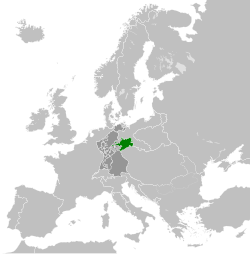
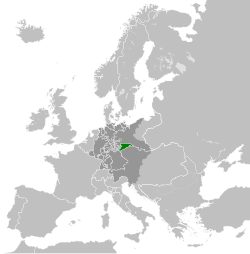
The subsequent Congress of Vienna in 1815 resulted in a severe territorial reduction. Prussia annexed approximately 60% of the kingdom's land, including the historic center of the Protestant Reformation, Wittenberg. Despite losing 40% of its population, the remaining kingdom, which retained Dresden and Leipzig, joined the German Confederation.
Integration into the German Empire
Saxony's political survival was tested again during the 1866 Austro-Prussian War. Although Saxony sided with Austria, its military effectiveness helped it avoid the total annexation suffered by other allies, such as the Kingdom of Hanover. By 1867, Saxony joined the Prussian-led North German Confederation, and in 1871, it became a federal state of the German Empire under Emperor Wilhelm I.
By the time of the Empire's founding, Saxony was a demographic and industrial powerhouse. It was the most densely populated state in Europe, with a staggering 52% of its population employed in industry and crafts by 1871. This economic engine made it the third largest German kingdom by population.
Governance and the 1831 Constitution
The governance of Saxony shifted from an absolute monarchy to a constitutional monarchy in 1831. This new framework established a parliamentary system and a comprehensive Bill of Rights.
The Bill of Rights
The 1831 Constitution introduced several progressive protections, including:
- Personal Liberty: Protection of person and property, with limits only as dictated by law.
- Professional Freedom: The right to choose a lawful profession and the right to emigrate.
- Religious Freedom: Liberty of conscience, though state recognition was limited to Christian churches.
- Legal Protections: Freedom from arbitrary arrest and the right to be informed of arrest reasons within 24 hours.
The Legislature (Landtag)
The legislature was divided into two equal chambers. The Upper Chamber consisted of princes of the blood, representatives of the church, university professors from Leipzig, and wealthy manorial proprietors. The Lower Chamber was composed of deputies from towns, peasants, and representatives of trades and factories, elected every nine years.
Administrative Structure
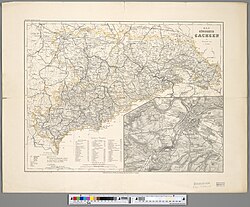
In 1835, the state established district directorates known as Kreisdirektionen (later Kreishauptmannschafts). Initially, there were four districts: Bautzen, Dresden, Leipzig, and Zwickau, with Chemnitz added in 1900.
The End of the Monarchy
The collapse of the German Empire at the end of World War I triggered a revolution. As workers' and soldiers' councils formed in major cities like Chemnitz and Leipzig, King Frederick Augustus III abdicated on November 13, 1918. On November 1, 1920, the former kingdom was officially reorganized as the Free State of Saxony within the Weimar Republic.
Summary of the Kingdom of Saxony
| Category | Details |
|---|---|
| Capital | Dresden |
| Government Type | Absolute (until 1831), then Constitutional Monarchy |
| Key Currencies | Saxon thaler, Saxon vereinsthaler, Gold mark, Papiermark |
| Primary Languages | Standard German, Upper Saxon German, Upper Sorbian |
| Industrial Rank | Most industrialised state in Europe (1871), 2nd after Belgium |
Frequently Asked Questions
Why did the King of Saxony remain Catholic while the population was Protestant?
Starting in 1697, the Electors of Saxony converted to Catholicism to accept the crowns of Poland-Lithuania, which they held until 1763. The royal family maintained this faith despite ruling a population that was approximately 95% Protestant.
How did Saxony lose so much territory in 1815?
Because Saxony remained an ally of Napoleon until the Battle of Leipzig in 1813, the victorious allies—particularly Prussia—viewed the kingdom as having forfeited its throne. This led to the annexation of about 60% of its land during the Congress of Vienna.
What was the significance of the 1831 Constitution?
The 1831 Constitution transformed Saxony into a parliamentary monarchy, introducing a bicameral legislature (the Landtag) and a Bill of Rights that protected personal liberties, property, and freedom of conscience.
How did Saxony's economy compare to other European states?
By 1871, Saxony was the most industrialised state in Europe, surpassed only by Belgium. It was also the most densely populated state in Europe at the time, with a very small percentage of its workforce remaining in agriculture.
What happened to the Kingdom after World War I?
Following the abdication of King Frederick Augustus III in 1918 amid revolutionary unrest, the kingdom was dissolved and became the Free State of Saxony within the Weimar Republic in 1920.