King Jangsu: The Architect of Goguryeo's Golden Age
During the 5th century, the Korean peninsula and Northeast Asia witnessed the rise of a formidable empire. At the center of this era was King Jangsu, the 20th monarch of Goguryeo. His 79-year reign transformed his kingdom into one of the great powers of East Asia, marking a period of unprecedented territorial expansion, cultural prosperity, and diplomatic sophistication.
Born in 394 as the eldest son of the legendary Gwanggaeto the Great, Jangsu ascended to the throne in 412 at the age of 18. While his father had laid the groundwork through massive conquests, Jangsu's genius lay in his ability to stabilize the empire and refine its political and economic institutions.
Key Facts
- Reign: 412–491 (79 years)
- Lifespan: 394–491 (died at age 96 or 97)
- Predecessor: Gwanggaeto the Great
- Major Achievement: Moved the capital to Pyongyang in 427
- Legacy: His posthumous name means "Long Life," reflecting the longest reign in East Asian history.
The Expansion and Stabilization of an Empire
In the early years of his rule, Jangsu focused on consolidating the rapid growth achieved by his father. One of his most enduring tributes was the construction of a magnificent tomb for Gwanggaeto the Great, accompanied by the Gwanggaeto Stele—a massive 6-meter-tall stone monument engraved with his father's achievements.
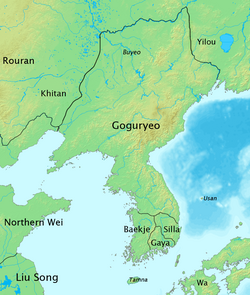
A pivotal moment in Goguryeo's history occurred in 427 when Jangsu transferred the official capital from Gungnae Fortress (modern-day Ji'an, China) to Pyongyang. This move to the fertile Taedong River basin allowed the kingdom to transition from a primarily military-focused state into a thriving metropolitan center of commerce and culture.
The Evolution of a Name
It was during Jangsu's reign that the official name of the kingdom was shortened from Koguryŏ to Goryeo (Koryŏ). This linguistic shift is historically significant, as it serves as the linguistic root for the modern name "Korea."
Masterful Diplomacy in a Divided China
Jangsu was a master of realpolitik, the practice of politics based on practical objectives rather than ideals. As the Chinese mainland transitioned from a period of chaos to the unification of the north by the Northern Wei dynasty, Jangsu skillfully manipulated the rivalries between the Northern and Southern Chinese dynasties to ensure Goguryeo's security.
His diplomatic strategies included:
- Playing both sides: He maintained formal relations with Northern Wei while simultaneously sending delegates and gifts to the Southern Qi dynasty.
- Strategic alliances: He established ties with the Rouran Khaganate to keep Northern Wei in check.
- Resource management: When the Liu Song dynasty threatened war after Jangsu executed the ruler of Northern Yan, he neutralized the conflict by sending 800 horses as a gift, allowing him to focus military efforts elsewhere.
Military Campaigns in the Korean Peninsula
While diplomacy kept the northern borders stable, Jangsu exerted significant pressure on the southern Korean kingdoms of Baekje and Silla.
The Fall of Baekje's Dominance
In a sophisticated campaign of subversion, Jangsu utilized a Buddhist monk named Dorim to infiltrate the court of Baekje. By encouraging King Gaero to spend the national treasury on massive construction projects, Dorim weakened the kingdom from within. In 475, Jangsu launched a massive land and sea invasion, capturing the capital of Wiryeseong and forcing Baekje to relocate its capital to the mountainous region of Ungjin.
Pressure on Silla
Jangsu also maintained a firm grip on Silla, which had been a de facto protectorate of Goguryeo since 400. Following a break in relations in 454, Jangsu launched invasions in 468 and 489, expanding Goguryeo's territory into parts of modern-day Gangwon and North Gyeongsang Provinces. To commemorate these victories, he erected a stone monument in Chungju, which remains the only surviving Goguryeo stele on the Korean peninsula.
Summary of King Jangsu's Reign
| Category | Details |
|---|---|
| Total Reign Duration | 79 Years |
| Capital Relocation | Gungnae Fortress to Pyongyang (427) |
| Primary Diplomatic Strategy | Balancing Northern and Southern Chinese Dynasties |
| Key Military Victories | Baekje (475) and Silla expansions |
| Cultural Legacy | Shortened name to "Goryeo" |
Frequently Asked Questions
Why is King Jangsu's name associated with "Long Life"?
His posthumous name, Jangsuwang, translates to "Long Life" because he reigned for 79 years and lived to be approximately 96 or 97 years old, which was the longest reign in East Asian history.
Where is King Jangsu buried?
There is a historical debate regarding his final resting place. Some Chinese scholars believe the "Tomb of the General" in Ji'an, China, belongs to him and his consort, while many Korean scholars argue his tomb is located in Pyongyang, where he moved the capital.
How did Jangsu influence the name "Korea"?
During his reign, he changed the official name of the kingdom from Koguryŏ to the shortened version, Goryeo. This name eventually evolved into the modern "Korea."
What was the significance of the move to Pyongyang?
Moving the capital to Pyongyang allowed Goguryeo to move away from a purely military encampment style of governance toward a more prosperous, metropolitan center located in a fertile river basin.
How did Jangsu manage the powerful Chinese dynasties?
He used a strategy of maximizing the power struggles between the Northern and Southern dynasties. By maintaining ties with both, he ensured that neither could fully focus their strength against Goguryeo.