Kim Tu-bong: The Linguist, Revolutionary, and Early Leader of North Korea
Kim Tu-bong was a multifaceted figure in Korean history, serving as a scholar, a revolutionary, and a high-ranking politician. While he is remembered in South Korea as a foundational figure in the study of Hangul—the Korean phonetic alphabet—his political career saw him ascend to the highest levels of the early North Korean government. From his early work in linguistics to his leadership in the provisional government-in-exile, Kim's life spanned the most turbulent eras of modern Korean history.
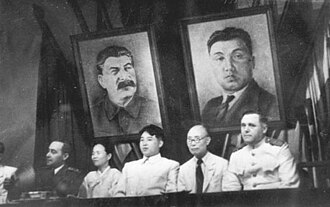
Key Facts
- Born: 16 February 1889, in Busan, Joseon.
- Linguistic Legacy: Contributed significantly to the study of Hangul and worked on the first Korean dictionary, MalMoi.
- Political Roles: First Chairman of the Workers' Party of North Korea (1946–1949) and Chairman of the Standing Committee of the Supreme People's Assembly (1948–1957).
- Exile Leadership: Member of the provisional government in Shanghai and a key figure in the Yan'an faction.
- Death: Disappeared following a political purge; believed to have died between 1958 and 1960.
Early Life and Linguistic Contributions
Born in South Gyeongsang Province near modern-day Busan, Kim Tu-bong was homeschooled during the period of imperial rule. He later moved to Seoul to pursue higher education, attending Geho School and Baechae School, eventually graduating from Bogo High School in 1908. During his time in Seoul, he became active in the Korea Youth organization and served as an editor for So nyoun magazine.
Kim's academic interests were deeply rooted in the preservation of Korean identity through language. Working closely with Professor Chu Sigyŏng, he dedicated much of his early career to the study of Hangul. In 1916, he devoted significant effort to the compilation of MalMoi, which stands as the first Korean dictionary. His scholarly work, often written under the pen name Baekyeon, helped establish the field of Korean historical linguistics.
The Independence Movement and Exile in China
The 1919 March First Movement served as a turning point in Kim's life. Following the movement, he joined other independence leaders in fleeing to China, where they established a provisional government in Shanghai in April 1919. It was during this period of exile that Kim was first exposed to communist ideology, eventually embracing it in 1920 after previously supporting the Democratic Party.
As the Japanese military expanded its presence in China, the Korean government-in-exile moved to Yan'an, the headquarters of the Chinese Communist Party. Kim became a prominent member of the Yan'an faction, playing a vital role in bridging the gap between democratic and communist perspectives within the independence movement.
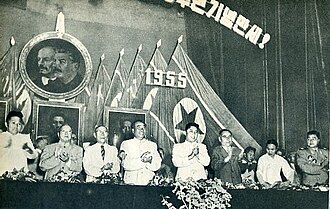
Rise to Political Power in North Korea
Following the surrender of Japan in August 1945, Kim Tu-bong returned to the Korean Peninsula. Settling in the northern region under Soviet occupation, he became a central figure in the formation of the new political order. In February 1946, he became the chairman of the New People's Party, which merged with the Workers' Party of South Korea later that year to form the Workers' Party of North Korea. Kim was appointed as its first Chairman.
In 1948, Kim assumed the role of Chairman of the Standing Committee of the Supreme People's Assembly, making him the first head of state of North Korea. However, despite his high-ranking titles, the practical political power was increasingly concentrated in the hands of Premier Kim Il Sung. When the various parties merged in 1949 to form the modern Workers' Party of Korea, Kim Il Sung assumed the chairmanship, solidifying his absolute leadership.
Political Purge and Disappearance
The stability of Kim Tu-bong's position eroded following the Korean War. As Kim Il Sung consolidated power, many political figures from the Yan'an faction were viewed as potential threats. In 1957, Kim Tu-bong was purged from the government, officially accused of involvement in the 1956 August Faction Incident. Some historians suggest personal scandals may have also played a role in his downfall.
Following his purge, Kim Tu-bong disappeared from public life. There are no official records detailing his final years, though it is widely believed he was either executed or died in detention sometime between 1958 and the 1960s.
Summary of Political Career
| Period | Organization/Office | Role |
|---|---|---|
| 1937–1945 | Chinese Communist Party | Member/Revolutionary |
| 1946 | New People's Party of Korea | Chairman |
| 1946–1949 | Workers' Party of North Korea | Chairman |
| 1948–1957 | Supreme People's Assembly | Chairman of the Standing Committee |
Frequently Asked Questions
What was Kim Tu-bong's contribution to the Korean language?
Kim Tu-bong was a pioneering linguist who worked extensively on the study of Hangul. He was also a key contributor to the compilation of MalMoi, the first dictionary of the Korean language.
Who was the Yan'an faction?
The Yan'an faction refers to Korean independence activists and politicians who lived and worked in Yan'an, China, alongside the Chinese Communist Party during the period of Japanese occupation.
What happened to Kim Tu-bong after 1957?
Kim Tu-bong was purged from his positions in 1957 and accused of involvement in the August Faction Incident. He disappeared from the public record and is believed to have died in detention or via execution between 1958 and the 1960s.
Was Kim Tu-bong the leader of North Korea?
While Kim Tu-bong served as the first Chairman of the Standing Committee of the Supreme People's Assembly (the head of state) and the first Chairman of the Workers' Party of North Korea, the primary political power was held by Kim Il Sung.
What was his pen name?
Kim Tu-bong used the art name or pen name Baekyeon.