Jost Winteler: The Mentor Who Shaped a Young Albert Einstein
While history remembers Albert Einstein as the definitive genius of the 20th century, his path to greatness was not without obstacles. In 1895, a teenage Einstein found himself at a crossroads after failing the general-education portion of the entrance exam for the Swiss Federal Polytechnical School in Zürich. It was during this pivotal year that he came under the wing of Jost Winteler, a Swiss polymath whose influence extended far beyond the classroom.
Jost Winteler was a man of immense intellectual breadth. A professor of Greek and history, he was also a recognized philologist (a student of language in written historical sources), an ornithologist, a journalist, and a published poet. For one transformative year, Winteler provided not only a room for Einstein to board but also a stable, intellectual environment that served as a bridge to the physicist's future academic success.
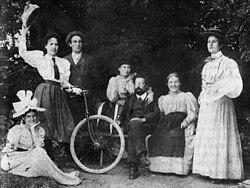
Key Facts
- Role: Professor of Greek and history at the Kantonsschule Aarau.
- Relationship to Einstein: Boarding house host and mentor from October 1895 to October 1896.
- Academic Expertise: Philology, history, and linguistics; author of the poetry collection Tycho Pantander.
- Impact: Helped Einstein obtain his Matura (graduation certificate), enabling entry into the Zürich Polytechnic.
- Personal Philosophy: Encouraged Einstein to view himself as a "citizen of the world."
Early Life and Academic Career
Born on November 21, 1846, in Filzbach, Glarus, Jost Winteler was the son of a secondary school teacher. This upbringing fostered an early love for learning, leading him to study history and German at the University of Zürich, where he earned his Diplom in 1870. He furthered his expertise in philology at the University of Jena, completing a doctoral thesis on the Kerenzer dialect of the Canton of Glarus in 1876.
Winteler's teaching career spanned several Swiss cantons. After early posts in Romanshorn and Burgdorf, he served as the director of the gymnasium in Murten. However, ideological conflicts with "hardline" ultramontanist governors (supporters of strong papal authority) led to his resignation in 1884. He subsequently spent the next twenty-five years teaching at the Aargau Kantonsschule.
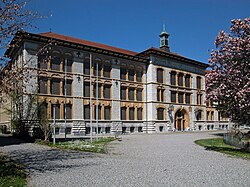
The Year in Aarau: Mentoring Einstein
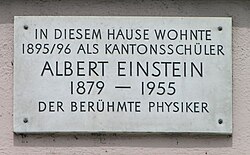
In October 1895, 16-year-old Albert Einstein arrived in Aarau to complete his secondary education. He boarded at Winteler's home, known as Rößligut, located conveniently across from the technical school Einstein attended. Although Einstein was not officially a student in Winteler's Greek or history classes, the two formed a deep bond.
Winteler provided the "exquisite care" that Einstein's parents, Pauline and Hermann, praised in their correspondence. Beyond academic support, Winteler introduced Einstein to a broader worldview. He encouraged the young man to think of himself as a global citizen, a perspective that may have influenced Einstein's later decision to relinquish his German citizenship.
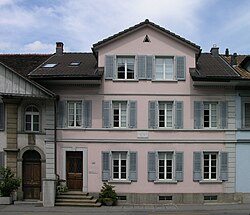
Academic Success and Graduation
The primary goal of Einstein's stay was to obtain his Matura, the certificate required for university entrance. By focusing on the general education subjects he had previously neglected—including natural sciences, political history, and literary history—Einstein successfully graduated on October 3, 1896.
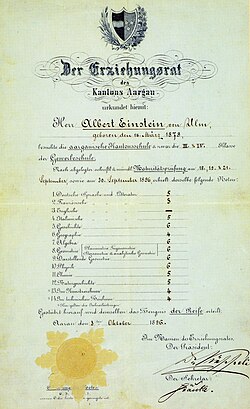
This achievement allowed him to enter the Zürich Polytechnic without retaking the entrance exam. During this time, Einstein also developed a romantic interest in Winteler's daughter, Marie, and expressed great admiration for Winteler's published poetry, Tycho Pantander.
A Lifelong Bond and Later Years
The relationship between the mentor and the student persisted long after 1896. Winteler continued to support Einstein, even assisting him in his search for employment in 1901. Decades later, in 1924, Einstein reminisced about the "fine, quiet walks near Aarau" and the wisdom Winteler had shared with him.
Einstein also credited Winteler with a prophetic understanding of politics. Years after Winteler's death, Einstein noted the "prophetic accuracy" of Winteler's distrust of imperial Germany, particularly in light of the rise of Hitler and World War II.
Family Tragedy and Retirement
Winteler's later life was marked by a profound tragedy. On November 1, 1906, his son Julius, suffering from severe mental illness after returning from America, killed Winteler's wife, Pauline, and son-in-law, Ernst Bandi, before committing suicide. Einstein sent a letter of deep grief and sympathy to his former mentor following this event.
Winteler eventually retired from teaching in 1914 and moved to Krummenau. He passed away on February 23, 1929, in Wattwil at the age of 82.
Summary of Jost Winteler's Life
| Category | Details |
|---|---|
| Lifespan | 1846 – 1929 |
| Primary Profession | Professor of Greek and History |
| Key Institutions | University of Zürich, University of Jena, Kantonsschule Aarau |
| Notable Publication | Tycho Pantander (1890) |
| Famous Houseguest | Albert Einstein (1895–1896) |
Frequently Asked Questions
Did Jost Winteler teach Albert Einstein in a classroom?
No. While Winteler taught at the Kantonsschule Aarau, Einstein attended the technical school (Gewerbeschule). Their relationship was that of a landlord, mentor, and father figure rather than a formal teacher and student.
How did Winteler help Einstein's academic career?
Winteler provided the stable environment and guidance Einstein needed to complete his general education requirements and earn his Matura, which was the prerequisite for his admission to the Zürich Polytechnic.
What was the nature of Winteler's political views?
Winteler held a strong distrust of imperial Germany and encouraged a cosmopolitan, "citizen of the world" philosophy. Einstein later described these views as having "prophetic accuracy" regarding the future of Germany.
How is Jost Winteler remembered today?
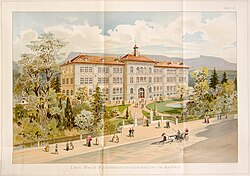
His former home in Aarau features a commemorative plaque honoring Albert Einstein's residence there. Additionally, a building at the Alte Kantonsschule Aarau was renamed the "Albert-Einstein-Haus" in 2006.
Was Winteler's life portrayed in popular media?
Yes, he was portrayed by actor Nicholas Rowe in the National Geographic series Genius (2017), which was based on Walter Isaacson's biography of Einstein.