Joseon Navy: The Maritime Might of Korea's Golden Age
The history of the Joseon Navy is a saga of strategic evolution, technological innovation, and heroic defense. From the early raids against pirates to the legendary naval victories of the Imjin War, the Korean maritime forces played a pivotal role in securing the peninsula's sovereignty. While periods of peace led to a gradual decline in military readiness, the navy's ability to reinvent itself through superior ship design and advanced gunpowder weaponry remains a cornerstone of Korean military heritage.
Key Facts
- Peak Strength: Approximately 737 ships and 48,800 personnel.
- Signature Vessels: The Panokseon (multideck warship) and the Kobukson (Turtle Ship).
- Legendary Leader: Admiral Yi Sun-sin, who secured sea control during the Imjin War.
- Technological Edge: Early use of advanced cannons, rocket-propelled arrows (hwacha), and the world's first armor-plated warship.
- Organizational Structure: A sophisticated provincial defense system known as the Jingwan system.
Historical Evolution and the Imjin War
The early Joseon maritime strategy was shaped by the need to combat Wokou (Japanese pirates). In 1419, King Sejong dispatched Yi Chongmu with 227 ships and 17,000 soldiers to Tsushima Island to suppress these raids. This successful operation led to diplomatic agreements where the So clan of Tsushima was permitted to trade with Korea on the condition that they suppress piracy.
As the Joseon dynasty progressed, a focus on agriculture and Confucian ideals led to a period of relative peace, during which the navy and military were often neglected. However, this changed drastically during the Imjin War (1592–1598). Under the brilliant leadership of Admiral Yi Sun-sin, the navy achieved decisive victories that turned the tide of the invasion. Admiral Yi's success was driven by his mastery of the sea, the deployment of the revolutionary Turtle Ship, and the use of heavy cannons.
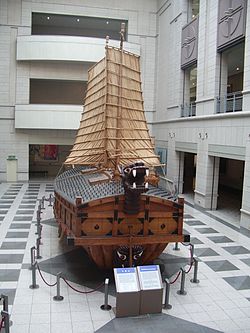
Advanced Naval Engineering: Panokseons and Turtle Ships
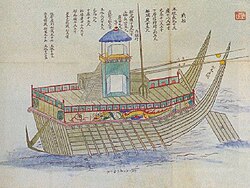
The backbone of the Joseon fleet was the Panokseon, a sturdy, multideck warship. These vessels featured a broad, flat deck ideal for mounting heavy cannons, ranging from 26 to 50 guns. The design provided a significant tactical advantage: rowers were protected on the lower deck, while marines on the upper deck could fire down upon enemy vessels, making boarding attempts difficult.
Perhaps the most famous vessel in naval history is the Kobukson, or Turtle Ship. Based on older designs, it is recognized as the world's first armor-plated warship. These ships were instrumental in breaking Japanese naval formations and protecting the Korean fleet during intense combat.
Ship Classification and Crewing
The navy utilized a structured system of ships categorized by size and purpose. According to the Gyeongguk Daejeon, the fleet was divided into large, medium, and small "fierce ships" (Maengseon).
| Ship Type | Quantity | Crew Size |
|---|---|---|
| Large Fierce Ship (Daemengseon) | 81 | 80 |
| Medium Fierce Ship (Jungmengseon) | 195 | 60 |
| Small Fierce Ship (Somengseon) | 461 | 30 |
The total crew for these 737 ships was approximately 24,400. This number represented exactly half of the total naval force of 48,800, allowing for a highly efficient two-shift rotation system to ensure constant readiness.

Military Organization and Defense Systems
To manage coastal security, the Joseon government implemented the Jingwan system. This provincial defense structure established a hierarchy of fortresses: Jujin (main garrisons), Geojin (medium-sized local units), and Jejin (small local garrisons). This system allowed local commanders to utilize their knowledge of regional topography to defend their specific provinces.
Naval ranks were clearly defined, ranging from the Commander of the Three Provinces (Samdo Sugun Tongjesa) down to specialized roles like the Gunnery Master (Hwapo-jang) and the Oarsmen (Neungnogun). On a Panokseon, the 80 rowers were organized into groups of five, led by a single leader, to ensure synchronized movement.
Weaponry and Combat Technology
The Joseon Navy possessed a formidable array of projectile and melee weapons. Archers were highly skilled, utilizing the Gakgung (standard bow) which had a range of 450 meters. They also employed the pyeonjeon, a short arrow capable of high velocity and penetrating power.

For heavy bombardment, the navy used various cannons, including the Seungja Chongtong (the world's first handgun, introduced in 1432) and the Hwacha. The Hwacha was a two-wheeled cart capable of firing up to 200 singijeon (rocket-propelled arrows) simultaneously, providing devastating area-of-effect fire against enemy fleets.

In close-quarters combat, soldiers relied on traditional weapons such as the Hwando (standard sword), the Dangpa (polearm), and the Deungpae (rattan shield). This combination of long-range rocket artillery, heavy ship-mounted cannons, and disciplined melee combat made the Joseon Navy a formidable force on the high seas.
Frequently Asked Questions
What was the primary advantage of the Panokseon ship?
The Panokseon's multideck design allowed for a separation of roles: rowers were protected on the lower level, while marines on the upper deck gained a height advantage for firing cannons and arrows, effectively preventing enemy boarding.
Who was the most significant figure in the Joseon Navy?
Admiral Yi Sun-sin is the most prominent figure. His leadership and tactical innovations during the Imjin War were instrumental in securing Korean sea lanes and defeating Japanese naval forces.
What made the Turtle Ship unique?
The Turtle Ship (Kobukson) is distinguished as the world's first armor-plated warship, designed to provide superior protection and offensive capabilities during naval engagements.
How did the Joseon Navy manage its personnel?
The navy utilized a two-shift rotation system. With a total force of 48,800 and a ship-based crew requirement of 24,400, the rotation ensured that half the force was active while the other half remained in reserve or training.
What was the Hwacha used for?
The Hwacha was a mobile artillery unit that could fire multiple rocket-propelled arrows (singijeon) at once, used by the navy to attack enemy ships from a distance.