Johnson Grass (Sorghum halepense)
Johnson grass, scientifically known as Sorghum halepense, is a resilient member of the Poaceae (grass) family. Originally native to Asia and northern Africa, this species has successfully established itself on every continent except Antarctica, as well as most major islands and archipelagos. While it has been utilized for erosion control and livestock forage, its aggressive growth patterns and chemical properties have led it to be classified as one of the ten worst weeds globally.
Key Facts
- Scientific Name: Sorghum halepense
- Origin: Native to Asia and northern Africa.
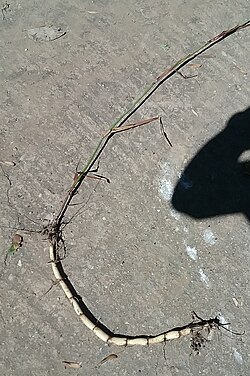
- Reproduction: Spreads via both seeds and rhizomes (underground horizontal stems).
- Toxicity: Can produce hydrogen cyanide when wilted and cause nitrate-induced bloat in livestock.
- Status: Listed as a noxious or quarantined weed in 19 US states.
- Resistance: Glyphosate-resistant strains have been identified in the US and Argentina.
Botanical Classification and Growth
Johnson grass belongs to the order Poales and the subfamily Panicoideae. It is a strong, erect-growing species that typically reaches heights between two and ten feet. When young, the plant is succulent and highly productive, making it an attractive option for cattle runs, though it is less preferred by sheep.
The plant's ability to dominate landscapes stems from its dual reproduction method. It produces a high volume of seeds and utilizes a network of rhizomes to spread rapidly underground, allowing it to "choke out" competing cash crops and native vegetation.
Environmental Impact and Agricultural Challenges
Johnson grass thrives in open, disturbed, and rich bottom ground, frequently appearing in cultivated fields, pastures, forest edges, rights-of-way, and along streambanks. Because of its rapid spread, it is often viewed as a significant agricultural pest.
Livestock Risks
While generally edible, the plant poses two primary risks to herbivores such as cattle and horses:
- Hydrogen Cyanide: Foliage that has wilted due to frost or hot, dry weather can contain lethal levels of hydrogen cyanide if consumed in large quantities.
- Nitrate Bloat: The accumulation of excessive nitrates in the foliage can cause "bloat," a potentially fatal condition in livestock.
Herbicide Resistance
Management of the species has become increasingly difficult due to the emergence of resistance to glyphosate, a common broad-spectrum herbicide. These resistant populations have been specifically documented in the United States and Argentina.
History and Distribution in the United States
The plant is named after Colonel William Johnson, an Alabama plantation owner who sowed the seeds on river-bottom farmland around 1840. However, the species had already appeared in several US states a decade prior, likely introduced as a seedlot contaminant or as a prospective forage crop.
Genetic research using microsatellite markers (sequences used to identify genetic variations) indicates that the weed was primarily introduced to the US through Alabama and North Carolina, with a separate, independent introduction occurring in Arizona. Following the construction of the trans-continental railroad, these distinct populations intermixed around Texas, shifting the genetic diversity of the species across the country.
Summary of Sorghum halepense Characteristics
| Feature | Details |
|---|---|
| Native Range | Asia and Northern Africa |
| Height | 2 to 10 feet |
| Reproduction | Seeds and Rhizomes |
| Primary Habitats | Cultivated fields, streambanks, disturbed rich soil |
| Key Risks | Hydrogen cyanide toxicity, nitrate bloat, crop competition |
Frequently Asked Questions
Why is Johnson grass considered one of the worst weeds in the world?
It is considered highly invasive due to its ability to spread rapidly via both seeds and rhizomes, its capacity to outcompete cash crops, and the development of resistance to common herbicides like glyphosate.
Can livestock safely eat Johnson grass?
While it is generally edible and can be a productive forage, it becomes dangerous when wilted by frost or drought, as it can then contain toxic levels of hydrogen cyanide or cause nitrate-induced bloat.
How did Johnson grass spread across the United States?
It was introduced via Alabama, North Carolina, and Arizona. The populations later intermixed in Texas, a process facilitated by the expansion of the trans-continental railroad.
What is the relationship between Johnson grass and Sorghum x almum?
Sorghum halepense, along with Sorghum bicolor, is a parent of Sorghum × almum, which is used as a forage crop but is also regarded as a weed in certain regions.