Downy Mildew: Identification, Impact, and Management of Plant Oomycetes
Downy mildew is a term used to describe several types of oomycete microbes—water molds that function as obligate parasites of plants. Unlike true fungi, these pathogens belong exclusively to the Peronosporaceae family. They pose a significant threat to commercial agriculture, particularly for growers of crucifers, grapes, and vine-growing vegetables.
A primary example is Peronospora farinosa. In the northern United States, this pathogen does not produce survival structures, instead overwintering as live colonies in Gulf Coast states before migrating northward each spring alongside cucurbit production. In these crops, the disease primarily affects the leaves; however, the resulting canopy collapse can lead to fruit sunburn and secondary soft rots, causing substantial yield loss.
Key Facts
- Causal Agents: Oomycetes of the Peronosporaceae family.
- Primary Symptoms: Angular yellow patches on upper leaf surfaces and purple-brown mold on the underside.
- Environmental Triggers: Cool nights and long periods of dew facilitate rapid spread.
- Host Range: Wide variety including basil, grapes, hops, soybeans, and sunflowers.
- Control Methods: Humidity reduction, resistant cultivars, and specific fungicides like oxathiapiprolin.
Identifying Symptoms
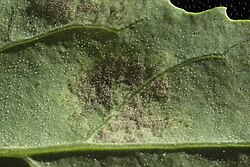
The onset of downy mildew is typically marked by large, angular, or blocky yellow areas on the upper surface of the leaf. These sporadic yellow patches expand rapidly as the lesion matures, eventually turning brown. The underside of the leaf often appears watersoaked.
Upon closer inspection, a purple-brown mold consisting of conidiophores (specialized hyphae that produce spores) becomes visible. Using a 10x hand lens, one can observe small, football-shaped spores within this mold. If the infection spreads unchecked, the entire leaf may take on a blighted appearance. Under favorable conditions—specifically cool nights with prolonged dew—the disease can destroy leaf tissue rapidly without affecting the petioles or stems.
Floricolous Downy Mildews
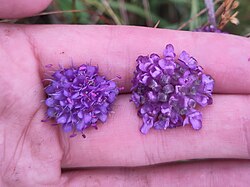
A specific monophyletic clade of Peronospora is known as floricolous downy mildews. Unlike other varieties, these exclusively target the flowers of their hosts. The infection is systemic, with hyphae produced at low densities within the host's xylem. This group affects plants in the Asteraceae, Campanulaceae, Dipsacaceae, Lamiaceae, and Orobanchaceae families.
For example, Peronospora violacea affects Succisa pratensis. Depending on the report, this can cause the host to produce longer, pinker petals and abort its anthers, or cause the corollas to appear brownish and dead.
Plant-Specific Impacts
Downy mildew manifests differently across various species, with some pathogens being highly host-specific:
- Basil: Caused by Peronospora belbahrii, this has become a major economic issue since its report in Italy (2004) and the U.S. (2007-2008). Sweet basil (O. basilicum) is the most susceptible, while spice-type basils (O. americanum) show the most resistance. Peak occurrence happens around 68°F (20°C).
- Cucurbitaceae: Pseudoperonospora cubensis affects cantaloupe, cucumber, pumpkin, squash, and watermelon, making it one of the most significant cucurbit diseases globally.
- Hops: Pseudoperonospora humuli is devastating in the moist climates of the Western U.S. It creates "basal spikes"—stunted, thickened clusters of pale curled leaves with silvery upper surfaces and blackened undersides.
- Soybeans: Peronospora manshurica reduces yield and quality. It is identified by grayish to pale sporangiophores on the leaf undersides and thrives between 20 and 22°C.
- Other Ornamentals: Peronospora sparsa attacks rose bushes and Rubus species, while a highly aggressive form of mildew now threatens ornamental impatiens in the U.S.
- Sunflowers and Spinach: Plasmopara halstedii (sunflowers) produces oospores that can remain dormant in soil for years, while Peronospora effusa challenges global spinach production.
Treatment and Management
Cultural and Organic Control
Since some pathogens do not overwinter in certain regions (like the Midwest), tillage and crop rotation may be ineffective. Instead, planting early-season varieties can reduce risk. General best practices include removing and destroying symptomatic plants.
Organic management focuses on moisture control. Reducing humidity in greenhouses and using drip irrigation to water from below prevents leaf wetness. Selective pruning is also recommended to improve air circulation.
Chemical Control and Resistance
Broad-spectrum protectant fungicides such as mancozeb, chlorothalonil, and fixed copper provide some protection. Systemic fungicides are available but should only be used after a confirmed diagnosis. In the U.S., the EPA has approved oxathiapiprolin, while Canada has registered a zoxamide and mancozeb mixture (Gavel).
Breeding programs and genetic modification are also used to develop resistant cultivars. In basil, researchers have worked to transfer resistance from wild varieties to sweet basil.
| Pathogen | Primary Host(s) | Key Characteristic |
|---|---|---|
| Peronospora belbahrii | Basil | High impact on sweet basil; peaks at 20°C |
| Pseudoperonospora cubensis | Cucurbits | Global significance for gourds/melons |
| Plasmopara viticola | Grapes | Causal agent of grapevine downy mildew |
| Pseudoperonospora humuli | Hops | Creates "basal spikes" in moist climates |
| Peronospora manshurica | Soybeans | Grayish sporangiophores on leaf undersides |
| Plasmopara halstedii | Sunflowers | Soil-borne dormant oospores |
Frequently Asked Questions
How can I tell the difference between downy mildew and other leaf spots?
Downy mildew is typically characterized by angular or blocky yellow patches on the upper leaf surface and the presence of purple-brown mold (conidiophores) on the underside during humid conditions.
Does crop rotation prevent downy mildew?
In some regions, such as the American Midwest, the pathogen does not overwinter in the field, meaning crop rotation and tillage practices may not affect the development of the disease.
What is the best way to prevent downy mildew organically?
The most effective organic methods involve eliminating excess moisture. Use drip irrigation to avoid wetting leaves, prune plants to increase airflow, and reduce humidity in enclosed growing environments.
Which basil variety is most resistant to downy mildew?
Spice-type basils, such as Ocimum americanum and Ocimum basilicum var. americanum, are the most resistant, while sweet basil (O. basilicum) is the most susceptible.
Can downy mildew affect the stems of a plant?
Generally, downy mildew destroys leaf tissue and does not affect the stems or petioles, although it can lead to canopy collapse.