Oomycetes: The Biology and Impact of Water Molds
Oomycetes, also known as Oomycota, are a distinct lineage of fungus-like eukaryotic microorganisms. While they were historically classified as fungi due to their filamentous growth and heterotrophic nature (obtaining carbon from organic sources), modern molecular and phylogenetic research has repositioned them within the Stramenopiles. This group also includes brown algae and diatoms, highlighting a biological relationship far removed from true fungi.
Commonly referred to as "water molds," these organisms are not exclusively aquatic. While basal taxa prefer high humidity and running water, many species have evolved into devastating terrestrial pathogens that impact global agriculture and natural ecosystems.
Key Facts
- Classification: Part of the Stramenopiles clade, not true fungi.
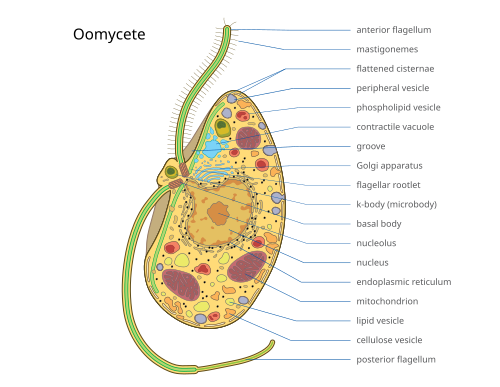
- Cell Wall Composition: Made of cellulose, whereas true fungi use chitin.
- Genetics: Possess diploid nuclei in their vegetative state.
- Reproduction: Utilize both asexual zoospores and sexual oospores.
- Economic Impact: Responsible for late blight in potatoes and sudden oak death.
- Motility: Produce zoospores with two distinct flagella (one whiplash, one tinsel).
Morphology and Cellular Structure
Oomycetes are characterized by their filamentous and branching structures. Unlike many fungi, they rarely possess septa (internal cross-walls), though these may occasionally appear at the base of sporangia or in older filaments. Depending on the species, they may exist as unicellular organisms or as complex branching networks.
At a cellular level, oomycetes differ significantly from fungi. Their mitochondrial cristae (the folds of the inner mitochondrial membrane) are tubular, whereas fungi have flattened cristae. Furthermore, they utilize different metabolic pathways for synthesizing the amino acid lysine.
![Simplified phylogeny.[citation needed]](/images/25/26/2526fa95b4060223d6d3c6e4f165126c83921547c173ef12e992074556ad53c7.png)
Reproduction and Life Cycle
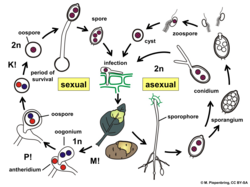
Oomycetes employ two primary methods of reproduction to ensure survival and dispersal:
Asexual Reproduction
The primary means of dispersal is through zoospores—motile spores capable of chemotaxis, which is the movement toward or away from chemical signals released by food sources. These are typically produced within structures called sporangia. Some species also produce chlamydospores or aerial spores distributed by wind.
![Asexual structures (sporangia) in Saprolegniales, Albuginales and Peronosporales[citation needed]](/images/c0/da/c0da3c5d7f474b0c6c073859127432df56c8e1a545a5ec101a6beaa587836ac8.png)
Sexual Reproduction
Sexual reproduction occurs when the hyphae of male antheridia make contact with female oogonia. This process results in the creation of oospores. These double-walled, spherical resting spores are translucent and designed to survive adverse environmental conditions, allowing the organism to overwinter.
![Sexual structures (only oogonia, antheridia not shown) of Saprolegnia.[citation needed]](/images/7f/be/7fbe9bbd1c89924ee700b0b905f4e19f4eea3a6f682b249b03a61f7ccd591674.jpg)
Classification and Diversity
The classification of Oomycota has expanded over time. While previously divided into six main orders, modern taxonomy recognizes a broader array of groups. Key orders include:
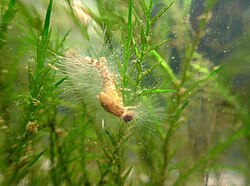
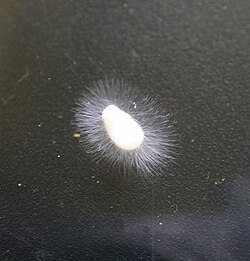
- Saprolegniales: The most widespread group, consisting of both decomposers of decaying matter and parasites.
- Peronosporales: A group containing many of the most damaging agricultural parasites.
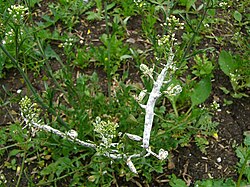
- Albuginales: Known as white blister rusts, these are obligate biotrophs (organisms that require a living host to survive).
- Lagenidiales: Considered the most primitive group, containing both unicellular and filamentous parasitic forms.
- Rhipidiales: Organisms that use rhizoids to attach to the beds of stagnant or polluted water.
- Leptomitales: Characterized by wall thickenings that mimic septation.
Below is a summary of the primary pathogenic groups within the Oomycetes:
| Group | Key Characteristics | Notable Diseases/Impacts |
|---|---|---|
| Phytophthora | Paraphyletic genus; aggressive plant pathogens | Late blight (potato), Sudden Oak Death, Ink disease (chestnut) |
| Pythium | Broad host range; some are mycoparasites | Damping off in seedlings, Pythiosis in mammals |
| Downy Mildews | Produce white, brown, or olive mildew on leaf undersides | Various plant foliage infections |
| White Blister Rusts | Obligate biotrophs; sporulate beneath the epidermis | White blister disease on flowering plants |
Ecological Impact and Pathogenicity
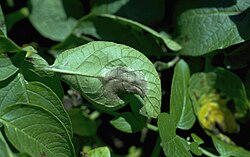
Oomycetes play diverse roles in nature. While many are saprophytic (feeding on dead matter), others are notorious pathogens. Phytophthora infestans is perhaps the most famous, as it caused the Great Famine of the 1840s in Ireland and Europe through the late blight of potatoes.
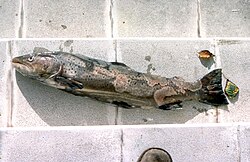
In addition to plants, some oomycetes affect animals. Pythium insidiosum can cause pythiosis in mammals, and various species are known to infect fish.
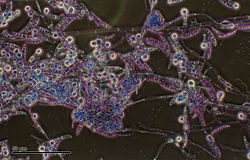
Interestingly, not all oomycetes are harmful. The mycoparasite Pythium oligandrum attacks other plant-pathogenic fungi and is utilized as a biocontrol agent to protect crops.
Frequently Asked Questions
Are oomycetes a type of fungus?
No. Although they look and behave like fungi, they are phylogenetically distinct and belong to the Stramenopiles clade, making them more closely related to brown algae and diatoms.
What is the difference between a zoospore and an oospore?
Zoospores are asexual, motile spores used for rapid dispersal and infection. Oospores are sexual, thick-walled resting spores used for survival during harsh environmental conditions.
Why are they called "water molds"?
The name stems from their preference for high humidity and running water, which is a characteristic of the more basal taxa in the group.
What makes oomycete cell walls different from fungal cell walls?
Oomycete cell walls are composed primarily of cellulose, whereas true fungal cell walls are composed of chitin.
What is an obligate biotroph?
An obligate biotroph is an organism, such as the white blister rusts, that cannot survive or complete its life cycle without a living host organism.