Chromista: The Complex Evolutionary History of Red Algal-Derived Plastids
In the vast and intricate tree of life, few groups spark as much scientific debate as the Chromista. This proposed biological kingdom consists of a diverse array of single-celled and multicellular eukaryotic species. While their outward appearances vary wildly—ranging from microscopic marine algae to notorious parasites—they are linked by a specific biological signature: the presence of plastids (specialized organelles used for photosynthesis) containing chlorophyll c.
The classification of Chromista has undergone significant revision since its inception. Originally proposed by British biologist Thomas Cavalier-Smith in 1981, the group has been a focal point for understanding how complex cells acquire the ability to harness sunlight through secondary endosymbiosis—a process where one eukaryote engulfs another to gain a new function.
Key Facts
- Defining Feature: Plastids containing chlorophyll c, typically surrounded by four membranes.
- Origin Theory: Most members are thought to have acquired plastids by "enslaving" a red alga.
- Diversity: Includes everything from diatoms and brown algae to the malaria parasite Plasmodium.
- Scientific Status: The kingdom is considered controversial and its monophyly (a single common ancestor) is heavily debated.
- Key Taxa: Includes major groups such as Stramenopiles, Alveolata, and Rhizaria.
The Biology of Chromists
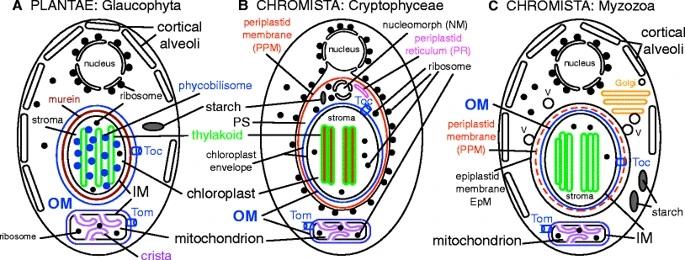
The defining characteristic of Chromista is the unique structure of their photosynthetic organelles. Unlike plants, which acquired plastids through primary endosymbiosis (engulfing a cyanobacterium), chromists are believed to have undergone secondary symbiogenesis. This means their ancestors engulfed a red alga, resulting in a complex four-membrane envelope around the plastid.
These extra membranes, known as the periplastid membrane, reside within the lumen of the rough endoplasmic reticulum. This unique topology allows for specialized protein transport mechanisms. While many chromists are autotrophic (capable of photosynthesis), others have transitioned to a heterotrophic lifestyle, meaning they have secondarily lost their ability to photosynthesize while retaining the complex membrane structures.
Evolutionary Debates: Monophyly vs. Serial Endosymbiosis
One of the most significant tensions in modern biology is whether Chromista is a monophyletic group (descended from a single common ancestor) or a polyphyletic group (composed of lineages that evolved similar traits independently).
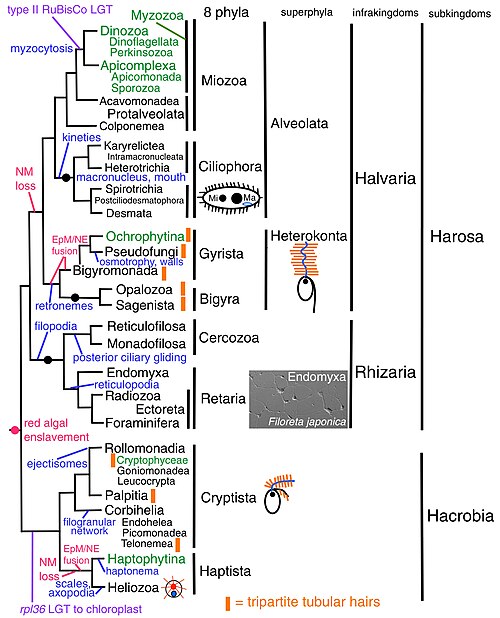
Cavalier-Smith argued for a single origin, citing unique enzymes like fructose-1,6-bisphosphate aldolase (FBA) and specific gene sequences as evidence. However, many contemporary phylogenetic analyses suggest that the host lineages are not closely related. This has led to the serial endosymbiosis hypothesis.
Under this model, rather than one single event, red plastids were passed between different groups over time. Recent modeling suggests this was chronologically possible during the Mesoproterozoic and Neoproterozoic eras. Potential pathways include:
- Model 1: Rhodophyta → Cryptophyta → Ochrophyta → Haptophyta (with Myzozoa branching from Ochrophyta).
- Model 2: Rhodophyta → Cryptophyta → Ochrophyta, with Haptophyta later passing plastids to Myzozoa.
Classification and Taxonomic History
The taxonomy of Chromista has shifted through several iterations. Early definitions, such as the Chromophyceae or Chromophyta, focused heavily on algae with chlorophyll c. As the field progressed, researchers began incorporating more diverse organisms, including protozoa.
In 2010, Cavalier-Smith reorganized the kingdom to include the SAR supergroup (Stramenopiles, Alveolata, and Rhizaria) and Hacrobia (Haptista and Cryptista). While the Chromalveolata hypothesis was once popular, it was found to be non-monophyletic in 2008, leading to the more nuanced classifications used today.
| Group/Supergroup | Notable Members | Key Characteristics |
|---|---|---|
| Stramenopiles | Brown algae, diatoms, water moulds | Heterokonts; diverse ecological roles |
| Alveolata | Dinoflagellates, Plasmodium, Paramecium | Includes both algae and parasites |
| Rhizaria | Cercozoa, Retaria | Diverse single-celled eukaryotes |
| Hacrobia | Cryptista, Haptista | Includes cryptomonads and haptophytes |
Frequently Asked Questions
What is the main difference between plant plastids and chromist plastids?
Plant plastids are the result of primary endosymbiosis and are typically surrounded by two membranes. Chromist plastids are the result of secondary endosymbiosis (engulfing a red alga) and are typically surrounded by four membranes.
Are all members of Chromista photosynthetic?
No. While many are photosynthetic algae, the group also includes many heterotrophic organisms, such as the malaria parasite Plasmodium and various protozoa, which have lost their photosynthetic capabilities.
Why is the classification of Chromista controversial?
The controversy stems from whether the group shares a single common ancestor (monophyly) or if they acquired their similar plastids through multiple, separate endosymbiotic events (polyphyly/serial endosymbiosis).
What are the most famous members of this group?
Notable members include diatoms (essential marine algae), brown algae (like kelp), the brain parasite Toxoplasma, and the malarial parasite Plasmodium.
What does "chlorophyll c" signify in this context?
Chlorophyll c is a specific type of photosynthetic pigment. Its presence in the plastids of these organisms is a primary criterion used to group them within the proposed Chromista kingdom.