Exploring the Genus Ribes: Currants, Gooseberries, and Their Botanical Wonders
From the tart burst of a redcurrant to the sweet tang of a gooseberry, the genus Ribes is well-known in gardens and kitchens worldwide. These versatile flowering plants are more than just sources of delicious fruit; they are complex botanical subjects with a fascinating relationship with their environment, ranging from hummingbird pollination to a challenging role in forest pathology.
Key Facts
- Genus: Ribes (the sole genus in the family Grossulariaceae).
- Species: Approximately 200 known species.
- Common Names: Includes redcurrants, blackcurrants, whitecurrants, and gooseberries.
- Distribution: Primarily native to temperate regions of the Northern Hemisphere, extending into the mountains of South America.
- Ecological Role: Acts as the primary alternate host for white pine blister rust.
Botanical Description and Characteristics
Plants within the Ribes genus are typically medium-sized shrubs. They exhibit significant diversity in their floral and fruit structures, though they share several defining traits. Their leaves are either compound or palmately lobed (meaning the lobes radiate from a single point, similar to the fingers of a hand), and some species possess thorns for protection.
The flowers of Ribes are bisexual and grow on racemes (unbranched flower clusters). Depending on the species, flower colors vary from green and yellow to red. A distinct feature of these flowers is that the sepals are larger than the petals and fuse together to form a saucer-shaped tube. Once pollinated, the inferior ovary matures into a berry containing numerous seeds.
Taxonomy and Classification
Ribes is the only genus in the family Grossulariaceae. While it was once grouped within the broader Saxifragaceae family, it is now recognized as a sister group to Saxifragaceae sensu stricto (in the strict sense).
The classification of the genus has been a subject of ongoing scientific revision. While some botanists previously treated currants and gooseberries as two separate genera (Ribes and Grossularia), the current consensus is to maintain them as a single genus divided into subgenera. The two primary divisions are subgenus Ribes (the currants) and subgenus Grossularia (the gooseberries). Molecular studies have further refined these groups, identifying monophyletic lineages—groups consisting of an ancestor and all its descendants—such as Calobotrya, Parilla, and Symphocalyx.
Distribution and Ecology
Ribes species are widely distributed across the Northern Hemisphere and are also found in the mountainous regions of South America. They typically thrive in meadows or in areas near streams.
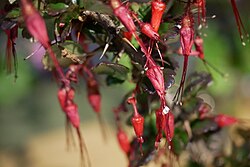
Pollination methods vary by species. While the majority are pollinated by insects, certain species—including R. sanguineum, R. malvaceum, and R. speciosum—rely on hummingbirds. Once the fruit matures, the seeds are dispersed by a variety of mammals and birds, including cattle, deer, elk, and grizzly bears.
These plants also serve as vital hosts for various insects. The larvae of several Lepidoptera (moths and butterflies) feed on them. For example, Buff-tip moth caterpillars show a strong preference for R. alpinum and R. uva-crispa. In agricultural settings, winter moths and currant clearwing moths are considered significant pests.
Cultivation and Human Uses
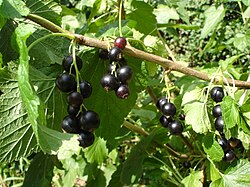
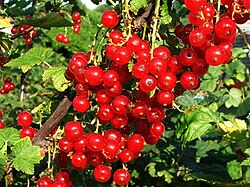
The genus is highly valued in horticulture for both food and ornament. Edible varieties include the blackcurrant, redcurrant, white currant, and the European gooseberry (Ribes uva-crispa), along with various hybrids. It is important to note that "Zante currants" used in baking are actually small-fruited cultivars of the grape Vitis vinifera, not members of the Ribes genus.
Beyond the kitchen, some species are grown as flowering currants for their aesthetic appeal. Historically, Ribes has also been used for medicinal purposes. The Blackfoot people used the root of Ribes hudsonianum to treat kidney and menstrual issues, while the Cree used the fruit of Ribes glandulosum as a fertility enhancer. Additionally, 18th-century European immigrants in North America frequently produced wine from red and white currants.
White Pine Blister Rust and Legal Restrictions
A significant ecological challenge associated with the genus is white pine blister rust, caused by the fungus Cronartium ribicola. Ribes species serve as the telial stage host for this pathogen. Infected plants develop yellow spots on their leaves that become orange and raised on the underside; severe infections can lead to total foliage loss.
The fungus spreads when wind-borne spores from Ribes plants land on the needles of five-needled pines, eventually infecting the entire tree. Because of this, several U.S. states have implemented restrictions on growing certain Ribes species to protect their pine forests.
While many species have genetic resistance, R. nigrum and R. hudsonianum var. petiolare are particularly vulnerable. The following table summarizes the restrictions in several affected U.S. states.
| State | Restrictions |
|---|---|
| North Carolina | All Ribes species are prohibited; active eradication programs exist in the western part of the state. |
| New York | R. nigrum is prohibited statewide. Other species are prohibited in the Adirondacks and Catskills. |
| Michigan | R. nigrum is prohibited statewide. Other species require permits in specific blister rust control areas. |
| Maine | R. nigrum is prohibited statewide; other species are prohibited in certain counties and towns. |
| Ohio | Possession and sale of R. nigrum is prohibited, except for immune cultivars. |
| Delaware | R. aureum and R. nigrum are prohibited entirely; other species require a permit. |
| Pennsylvania | Laws from 1933 exist but are not enforced; all Ribes can be grown. |
Frequently Asked Questions
Are Zante currants related to the Ribes genus?
No. Despite the name, Zante currants are actually a small-fruited cultivar of the grape Vitis vinifera and are not botanically related to the currants in the Ribes genus.
Why are some currants banned in certain U.S. states?
Certain species, particularly R. nigrum, act as alternate hosts for Cronartium ribicola, the fungus that causes white pine blister rust. To protect five-needled pine forests from this pathogen, some states restrict or prohibit the planting of these shrubs.
What is the difference between a currant and a gooseberry?
While both belong to the genus Ribes, they are divided into different subgenera. Currants fall under subgenus Ribes, while gooseberries fall under subgenus Grossularia. They differ in their physical characteristics, such as leaf structure and the presence of thorns.
How are Ribes seeds dispersed in the wild?
Once the berries mature, they are eaten by various birds and mammals—including deer, elk, cattle, and grizzly bears—which then disperse the seeds through their waste.
Which Ribes species are pollinated by hummingbirds?
While most Ribes are insect-pollinated, R. sanguineum, R. malvaceum, and R. speciosum are specifically pollinated by hummingbirds.