John Stewart Bell: The Physicist Who Challenged Quantum Orthodoxy
John Stewart Bell was a visionary physicist from Northern Ireland whose work fundamentally altered our understanding of the universe. While many of his contemporaries accepted the probabilistic nature of quantum mechanics without question, Bell possessed a restless intellectual curiosity that led him to investigate the very foundations of the theory. He is most renowned for Bell's theorem, a landmark discovery that provided a way to experimentally test the validity of hidden-variable theories in quantum physics.
Key Facts
- Born: July 28, 1928, in Belfast, Northern Ireland.
- Died: October 1, 1990, in Geneva, Switzerland.
- Major Achievement: Formulated Bell's theorem (1964), addressing the Einstein-Podolsky-Rosen (EPR) paradox.
- Key Institutions: UK Atomic Energy Research Establishment and CERN.
- Major Awards: Paul Dirac Medal and Prize (1988), Heineman Prize (1989), and Hughes Medal (1989).
Early Life and Academic Journey
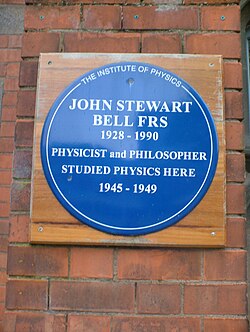
Born into a working-class family in Belfast, Bell faced significant financial hardships. In an era where most of his siblings left school by age 14 to enter the workforce, Bell's determination to become a scientist—supported by his mother—led him to graduate from Belfast Technical High School at 16. He then attended the Queen's University of Belfast, earning a bachelor's degree in experimental physics in 1948 and a second in mathematical physics in 1949.
Bell continued his education at the University of Birmingham, where he completed a PhD in 1956. His doctoral research, supervised by Rudolph E. Peierls, focused on nuclear physics and quantum field theory (the theoretical framework combining classical field theory, special relativity, and quantum mechanics).
Professional Career and Contributions
Bell began his professional career at the UK Atomic Energy Research Establishment (AERE) near Harwell. In 1960, he joined the European Organization for Nuclear Research (CERN) in Geneva, Switzerland. While his primary duties involved theoretical particle physics and accelerator design, Bell dedicated his spare time to a profound avocation: exploring the foundations of quantum theory.
Beyond his original research, Bell was a dedicated communicator of science. He co-translated several volumes of the influential Course of Theoretical Physics by Lev Landau and Evgeny Lifshitz, ensuring these critical texts were accessible to the English-speaking world.
Challenging the Status Quo: Hidden Variables
One of Bell's most significant intellectual battles was against the prevailing belief that "hidden variables"—undiscovered properties that would make quantum mechanics deterministic—were impossible. He specifically critiqued a famous proof by John von Neumann, which had been widely accepted as evidence that hidden variables could not exist.
Bell demonstrated that von Neumann's proof relied on a physical assumption that was not valid for quantum mechanics. Specifically, he argued that the probability-weighted average of the sum of observable quantities does not necessarily equal the sum of the average values of each separate observable. Bell famously described von Neumann's proof as not merely false, but "foolish." This insight reopened the door for the study of hidden-variable theories and set the stage for his most famous work.
Bell's Theorem and the EPR Paradox
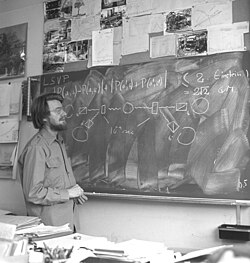
In 1964, Bell published his groundbreaking work on the Einstein-Podolsky-Rosen (EPR) paradox. The EPR paradox suggested that quantum mechanics was incomplete and that "local hidden variables" must exist to explain the correlation between entangled particles without requiring information to travel faster than light.
Bell's theorem provided a mathematical way to test this. He showed that no local hidden-variable theory could reproduce all the predictions of quantum mechanics. This meant that the universe is fundamentally nonlocal, meaning particles can remain connected in ways that transcend distance, a phenomenon known as quantum entanglement.
Relativity and the Spaceship Paradox
Bell's interests extended to the pedagogy of special relativity. He was concerned that Albert Einstein's approach to teaching the subject could be "pedagogically dangerous" and lead to misconceptions regarding the Lorentz-FitzGerald contraction (the phenomenon where a moving object's length is measured to be shorter than its proper length).
To clarify these concepts, Bell developed a relativistic thought experiment known as Bell's spaceship paradox. This paradox serves as a tool to help students and physicists understand the complexities of relativity and material stress in accelerating frames.
| Category | Details |
|---|---|
| Education | BSc (Queen's University Belfast), PhD (University of Birmingham) |
| Primary Research Areas | Quantum Foundations, Particle Physics, Accelerator Design |
| Key Theorem | Bell's Theorem (1964) |
| Notable Paradox | Bell's Spaceship Paradox |
| Major Awards | Paul Dirac Medal, Heineman Prize, Hughes Medal |
Legacy and Honors
John Bell's influence persists through the John Stewart Bell Prize, established in 2008 by the University of Toronto to recognize advances in the foundations of quantum mechanics. In his hometown of Belfast, his legacy is honored through the naming of Bell's Theorem Crescent and the John Bell House student residence, as well as blue plaques at his childhood home and the Queen's University of Belfast.
Frequently Asked Questions
What is Bell's theorem?
Bell's theorem is a mathematical proof showing that the predictions of quantum mechanics are incompatible with local hidden-variable theories. It proves that no theory based on local realism can explain the correlations observed in entangled quantum systems.
What was Bell's critique of von Neumann's proof?
Bell argued that John von Neumann's proof against hidden variables was based on an invalid physical assumption regarding the sum of observable quantities, meaning it did not actually prove that hidden variables were impossible.
What is Bell's spaceship paradox?
It is a thought experiment in special relativity designed to illustrate the effects of Lorentz-FitzGerald contraction and the physical stresses that occur when two ships accelerate identically but remain connected by a string.
Where did John Bell spend most of his professional career?
Bell spent the majority of his career at CERN (the European Organization for Nuclear Research) in Geneva, Switzerland, where he worked on theoretical particle physics and accelerator design.
How did Bell contribute to the accessibility of physics?
Bell co-translated several volumes of the Course of Theoretical Physics by Landau and Lifshitz into English, making these foundational texts available to a wider global audience.