Bell's Theorem and the Conflict Between Quantum Mechanics and Local Realism
At the heart of modern physics lies a profound tension between how we perceive the macroscopic world and how nature behaves at the smallest scales. Bell's theorem is the definitive mathematical and physical framework that addresses this tension, proving that quantum mechanics is fundamentally incompatible with local hidden-variable theories.
First introduced by John Stewart Bell in 1964, this theorem built upon the foundations of the Einstein–Podolsky–Rosen (EPR) paradox. While the EPR paradox highlighted the strange phenomenon of quantum entanglement—where particles remain connected such that the state of one instantly influences the other regardless of distance—Bell provided a way to actually test whether this "spookiness" was a result of missing information or a fundamental property of the universe.
Key Facts
- Core Conclusion: No local hidden-variable theory can reproduce all the predictions of quantum mechanics.
- Locality: The principle that physical processes are influenced only by their immediate surroundings and cannot travel faster than light.
- Hidden Variables: Hypothetical properties of particles not accounted for in quantum theory that would predetermine experimental outcomes.
- Historical Origin: Developed by John Stewart Bell in 1964 as a response to the EPR paradox.
- Experimental Validation: Numerous "Bell tests" have consistently shown violations of Bell inequalities, supporting quantum mechanics over local realism.
Foundational Concepts: Locality and Hidden Variables
To understand Bell's theorem, one must first understand the concept of local realism. Realism is the idea that objects have definite properties even when they are not being observed. Locality is the principle that an object is only influenced by its immediate surroundings, and that information cannot propagate faster than the speed of light.
Albert Einstein and his colleagues proposed that quantum mechanics might be "incomplete." They suggested the existence of hidden variables—internal instructions carried by particles that determine the outcome of a measurement before it happens. If these variables existed and were local, the universe would be predictable and consistent with classical intuition.
Bell's theorem mathematically demonstrated a stark choice: if a theory is local, it will not agree with quantum mechanics; if it agrees with quantum mechanics, it cannot be local.
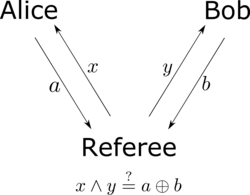
Testing the Theorem: Bell Tests and Experiments
While Bell's theorem provided the theoretical proof, experimentalists sought to put it to the test. A Bell test typically involves creating a pair of entangled particles (such as photons) and sending them to two distant observers, often called Alice and Bob.
By measuring the properties of these particles (such as polarization) at different angles, researchers can calculate the correlation between the results. If the correlations exceed a certain mathematical limit—known as a Bell inequality—then local hidden-variable theories are ruled out.
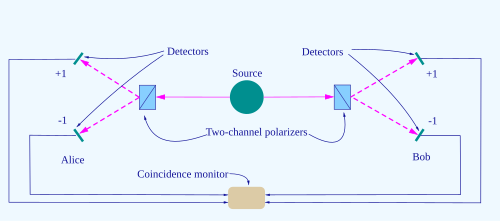
Over the decades, experiments have evolved from early tests in the 1970s to sophisticated "loophole-free" tests in 2015. These modern experiments, including those using electron spins separated by 1.3 kilometers, have consistently reaffirmed that quantum correlations violate Bell's inequalities, confirming the non-local nature of quantum mechanics.
Related Theorems and Interpretations
Bell's work opened the door to several other critical results in quantum foundations:
- GHZ–Mermin (1990): A version of Bell's theorem that does not rely on inequalities but shows a direct contradiction between local realism and quantum mechanics for three or more particles.
- Kochen–Specker Theorem (1967): This theorem addresses quantum contextuality, suggesting that the value of a property depends on the context of the measurement.
- Free Will Theorem: A further extension suggesting that if humans have free will in choosing measurement settings, then particles must also possess a form of "free will" in their responses.
These results lead to various interpretations of reality. The Copenhagen interpretation accepts the probabilistic nature of quantum mechanics, while the Many-worlds interpretation suggests all possible outcomes occur in branching universes. Others explore superdeterminism, where the choice of measurement is predetermined, or non-local hidden variables.
Summary of Quantum Foundations
| Feature | Local Hidden-Variable Theory | Quantum Mechanics |
|---|---|---|
| Determinism | Predetermined by hidden variables | Inherently probabilistic |
| Locality | Strictly local (limited by light speed) | Non-local correlations (entanglement) |
| Measurement | Reveals pre-existing properties | Determines the state upon measurement |
| Bell Inequalities | Must be obeyed | Can be violated |
Frequently Asked Questions
Does Bell's theorem prove that information travels faster than light?
No. While quantum entanglement involves non-local correlations, it cannot be used to send usable information faster than the speed of light, preserving the core tenets of relativity.
What is a "loophole" in a Bell test?
Loopholes are potential experimental flaws—such as the "locality loophole" (where particles are too close) or the "detection loophole" (where not enough particles are measured)—that could theoretically allow a local hidden-variable explanation. Modern tests have closed these loopholes.
What is the difference between the EPR paradox and Bell's theorem?
The EPR paradox was a thought experiment arguing that quantum mechanics was incomplete. Bell's theorem turned that philosophical argument into a testable mathematical inequality that could be proven or disproven in a lab.
What does the violation of Bell inequalities actually mean?
It means that the assumption of local realism is false. Either the universe is non-local (actions here can instantly affect things there), or particles do not have definite properties until they are measured.