John Archibald Wheeler: The Architect of Black Holes and Quantum Foam
John Archibald Wheeler (1911–2008) was a titan of 20th-century theoretical physics whose curiosity spanned the smallest subatomic particles to the vast curvature of the cosmos. A visionary educator and researcher, Wheeler is perhaps most famous for popularizing the term black hole, but his influence extends far deeper into the foundations of how we perceive reality, information, and gravity.
Throughout his career, Wheeler acted as a bridge between the classical physics of Albert Einstein and the emerging world of quantum mechanics. His work not only advanced our technical understanding of the universe but also provided the vocabulary that modern physicists use to describe the most extreme phenomena in space-time.
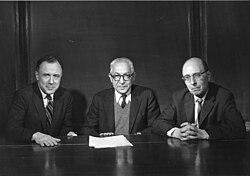
Key Facts
- Pioneering Terminology: Coined or popularized terms including "black hole," "wormhole," "quantum foam," and "neutron moderator."
- Nuclear Contributions: Worked with Niels Bohr to explain the principles of nuclear fission and contributed to the Manhattan Project.
- Academic Legacy: Supervised 46 PhD students at Princeton University, more than any other physics professor there.
- Theoretical Frameworks: Developed geometrodynamics and the "it from bit" concept of information-theoretic physics.
- Major Works: Co-authored the seminal textbook Gravitation with Kip Thorne and Charles Misner.
Early Life and Academic Ascent
Born on July 9, 1911, Wheeler pursued his higher education at Johns Hopkins University, where he earned his BS, MS, and PhD. His early research focused on the theory of the dispersion and absorption of helium, completing his thesis in 1933 under the guidance of Karl Herzfeld.
Wheeler's career trajectory was marked by a desire to be at the center of particle physics research. In 1938, he made a strategic decision to join the faculty at Princeton University as an assistant professor, choosing the institution's growth potential over a higher-ranking associate professorship at Johns Hopkins. He remained at Princeton for nearly four decades, becoming a cornerstone of the department.
Contributions to Nuclear Physics and Weapons
In the late 1930s, Wheeler collaborated with Niels Bohr to elucidate the basic principles of nuclear fission (the process of splitting a heavy atomic nucleus into smaller nuclei). This work was pivotal to the dawn of the atomic age. During World War II, Wheeler's expertise led him to the Manhattan Project, where he worked on the development of the first nuclear weapons.
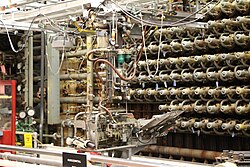
Following the initial atomic bombs, Wheeler's research extended into the realm of thermonuclear weapons. He was involved in the theoretical development of the hydrogen bomb, a project that culminated in the first true hydrogen bomb test, known as Ivy Mike.

Redefining the Cosmos: General Relativity and Geometrodynamics
After World War II, Wheeler became a driving force in reviving interest in general relativity—Einstein's theory of gravitation—within the United States. He sought to unify physics by reducing all physical phenomena, including electromagnetism, to the geometric properties of curved space-time, a program he called geometrodynamics.
In this pursuit, Wheeler envisioned the subatomic realm not as a smooth void, but as a chaotic sea of quantum fluctuations, which he termed quantum foam. He also explored the possibility of wormholes (theoretical bridges connecting distant points in space-time) and geons (electromagnetic or gravitational waves held together by their own gravity).
The Black Hole Legacy
While the concept of gravitationally collapsed objects existed in theory, it was Wheeler who popularized the term "black hole" to describe them. His work in this area was so influential that Stephen Hawking referred to him as the "hero of the black hole story." This research eventually led to the co-authoring of the definitive text Gravitation, which remains a primary resource for students of relativity.
Information Theory and the "It from Bit" Philosophy
In his later years, Wheeler shifted his focus toward the intersection of physics and information. He proposed the "it from bit" concept, suggesting that every physical entity—every "it"—derives its existence from binary choices or information—the "bit." This perspective posits that the universe is fundamentally information-theoretic in origin.
He further expanded this with the participatory anthropic principle, suggesting that observers are not merely passive witnesses to the universe but active participants in bringing it into existence through the act of observation.
Summary of Career and Achievements
| Category | Details |
|---|---|
| Education | Johns Hopkins University (BS, MS, PhD) |
| Primary Institutions | Princeton University, University of Texas at Austin |
| Key Theories | Geometrodynamics, Breit–Wheeler process, Wheeler–DeWitt equation |
| Notable Terms Coined | Black hole, Wormhole, Quantum foam, Neutron moderator |
| Major Awards | Wolf Prize in Physics, National Medal of Science, Enrico Fermi Award |
Frequently Asked Questions
What is the "it from bit" concept?
The "it from bit" concept is the hypothesis that the physical universe is fundamentally composed of information. It suggests that every particle and field of force derives its existence from binary, yes-no questions posed by observers.
How did Wheeler contribute to the study of black holes?
While he did not discover the mathematical possibility of collapsed stars, Wheeler is credited with popularizing the term "black hole" and conducting extensive theoretical work that made the concept accessible and central to modern astrophysics.
What is quantum foam?
Quantum foam is a term coined by Wheeler to describe the chaotic, turbulent nature of space-time at the Planck scale (the smallest possible scale), where quantum fluctuations cause space to warp and fluctuate violently.
Who were some of Wheeler's most famous students?
Wheeler was a prolific mentor, supervising 46 PhD students. Among his most notable students were Nobel laureates Kip Thorne and Richard Feynman.
What was the Breit–Wheeler process?
The Breit–Wheeler process, developed with Gregory Breit, describes the creation of an electron-positron pair from the collision of two photons.