Johann Friedrich Gmelin: The Polymath of Natural History
Johann Friedrich Gmelin was a distinguished German scientist whose work spanned the breadth of the natural world. A true polymath, Gmelin excelled as a naturalist, chemist, botanist, entomologist, herpetologist, and malacologist (a specialist in mollusks). His contributions to the classification of species and his comprehensive textbooks helped shape the academic landscape of the late 18th century.
Key Facts
- Lifespan: August 8, 1748 – November 1, 1804.
- Academic Roles: Professor at the University of Tübingen and the University of Göttingen.
- Major Achievement: Edited and published the 13th edition of Carl Linnaeus's Systema Naturae (1788–1793).
- Taxonomic Impact: Cited as the authority for over 290 bird species and numerous butterfly species.
- Specializations: Chemistry, pharmaceutical science, mineralogy, and botany.
Education and Early Academic Career
Born in Tübingen as the eldest son of Philipp Friedrich Gmelin, Johann Friedrich followed in his father's footsteps by studying medicine at the University of Tübingen. He earned his Master's degree in 1768. His doctoral thesis, written in Latin, focused on the irritability of plants (Irritabilitatem vegetabilium), exploring the reactions of various plant parts through rigorous experimentation.
Gmelin's professional ascent was rapid. In 1769, he began as an adjunct professor of medicine at the University of Tübingen. By 1773, he moved to the University of Göttingen, where he served as a professor of philosophy and an adjunct professor of medicine. His expertise was further recognized in 1778 when he was promoted to full professor of medicine and professor of chemistry, botany, and mineralogy.
Contributions to Natural History and Taxonomy
Gmelin maintained a respected professional relationship with Carl Linnaeus, the father of modern taxonomy. In his youth, Gmelin traveled to Persia to collect plant specimens on Linnaeus's behalf, contributing valuable data to the global understanding of flora.
One of Gmelin's most enduring legacies is his work on the 13th edition of Linnaeus's Systema Naturae, published between 1788 and 1793. In this posthumous edition, Gmelin provided scientific names and descriptions for many new species. This included birds previously cataloged without formal scientific names by John Latham in A General Synopsis of Birds. Consequently, Gmelin is recognized as the taxonomic authority for more than 290 bird species, as well as various butterfly species.
Beyond ornithology, Gmelin made significant marks in other fields. He described the redfin pickerel in 1789, identified numerous new species of amphibians and reptiles in the field of herpetology, and named various gastropods in the field of malacology.
Academic Legacy and Publications
As an educator, Gmelin influenced a new generation of scientists. His notable students included Friedrich Stromeyer, Georg Friedrich Hildebrandt, Carl Friedrich Kielmeyer, and Wilhelm August Lampadius. He was also the father of Leopold Gmelin, who continued the family's scientific tradition.
Gmelin was a prolific author, producing essential textbooks that served as university standards. His writings covered a diverse range of topics, from the history of chemistry and pharmaceutical science to the study of mineral and animal poisons.
| Year | Publication Title | Primary Subject |
|---|---|---|
| 1776/77 | Allgemeine Geschichte der Gifte | General History of Poisons |
| 1780 | Einleitung in die Chemie | Introduction to Chemistry |
| 1781 | Einleitung in die Pharmacie | Introduction to Pharmacy |
| 1788–1793 | Systema Naturae (13th Ed.) | Biological Classification |
| 1799 | Geschichte der Chemie | History of Chemistry |
In recognition of his contributions, the plant genus Gmelina was named in his honor (or possibly shared with J.G. Gmelin) by Linnaeus.
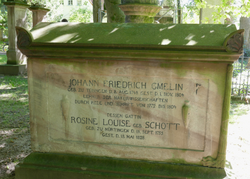
Johann Friedrich Gmelin passed away on November 1, 1804, in Göttingen. He is buried alongside his wife, Rosine Louise Gmelin (née Schott), in the Albani cemetery.
Frequently Asked Questions
What was Johann Friedrich Gmelin's most significant contribution to zoology?
His most significant contribution was editing and publishing the 13th edition of Carl Linnaeus's Systema Naturae, which established the scientific names for over 290 bird species and numerous butterflies.
Which universities were central to Gmelin's career?
Gmelin was associated with the University of Tübingen, where he studied and began his teaching career, and the University of Göttingen, where he eventually became a full professor of medicine, chemistry, botany, and mineralogy.
What is the genus Gmelina?
Gmelina is a genus of plants named by Carl Linnaeus to honor Johann Friedrich Gmelin (and potentially J.G. Gmelin).
What fields of science did Gmelin publish textbooks in?
Gmelin authored textbooks in chemistry, pharmaceutical science, mineralogy, and botany, providing foundational educational materials for universities of his time.
Who were some of Gmelin's notable students?
His students included Georg Friedrich Hildebrandt, Carl Friedrich Kielmeyer, Friedrich Stromeyer, and Wilhelm August Lampadius.