Joe Muranyi: The Versatile Clarinetist of Traditional Jazz
Joe Muranyi (1928–2012) was a distinguished American jazz clarinetist, producer, and critic who dedicated his career to the preservation and performance of early jazz styles. While he possessed the technical training to navigate modern jazz, his heart remained rooted in the vibrant sounds of Dixieland—a style of early jazz characterized by collective improvisation—and the rhythmic drive of swing.
Early Education and Musical Foundations
Muranyi's formal musical journey included studies with the influential Lennie Tristano. However, his primary interests lay in the foundational eras of jazz. After serving in a United States Army Air Forces band, he relocated to New York City during the 1950s to further his education, attending both the Manhattan School of Music and Columbia University.
During the 1950s, Muranyi established himself in the New York scene, playing under the leadership of Eddie Condon. This period allowed him to collaborate with a prestigious array of musicians, including Jimmy McPartland, Max Kaminsky, Yank Lawson, Bobby Hackett, and Red Allen. His versatility was further showcased through his work with the Red Onion Jazz Band from 1952 to 1954, as well as performances with Danny Barker in 1958 and Wingy Manone.
Rise to Prominence and the Louis Armstrong Era
In 1963, Muranyi joined The Village Stompers, a Dixieland ensemble that achieved significant commercial success. The group reached the pop charts with their hit song "Washington Square," bringing traditional jazz sounds to a wider mainstream audience.
One of the most prestigious chapters of his career began in 1967 when he became the clarinetist for the Louis Armstrong All-Stars, a position he held until 1971. A lighthearted anecdote from this era involves Louis Armstrong's initial difficulty pronouncing Muranyi's Hungarian surname; Armstrong began introducing him on stage as "Joe Ma Rainey," a nickname that Muranyi found amusing.
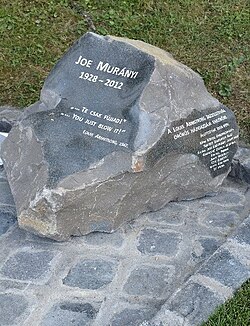
Following his tenure with Armstrong, Muranyi continued to perform with some of the most respected names in jazz, including Roy Eldridge, Cozy Cole, Lionel Hampton, Herman Autrey, Wild Bill Davison, and Zutty Singleton. In 1975, he also performed with the World's Greatest Jazz Band.
Contributions Beyond the Clarinet
While best known for the clarinet, Muranyi was a multi-talented musician who also played the soprano and tenor saxophone and was an enthusiastic vocalist. His influence extended behind the scenes as well; he worked extensively as a record producer and contributed his expertise as a critic, writing liner notes for hundreds of albums.
Key Facts
- Lifespan: January 14, 1928 – April 20, 2012.
- Primary Instrument: Clarinet (also played soprano and tenor saxophone).
- Notable Groups: The Village Stompers and the Louis Armstrong All-Stars.
- Education: Manhattan School of Music and Columbia University.
- Chart Success: Part of the group that recorded the pop hit "Washington Square."
- Industry Role: Prolific record producer and writer of album liner notes.
| Period/Year | Affiliation/Collaboration | Role/Note |
|---|---|---|
| 1950s | Eddie Condon / Red Onion Jazz Band | Early professional collaborations |
| 1963 | The Village Stompers | Pop chart success with "Washington Square" |
| 1967–1971 | Louis Armstrong All-Stars | Featured clarinetist |
| 1975 | World's Greatest Jazz Band | Performer |
Frequently Asked Questions
What style of jazz did Joe Muranyi specialize in?
Joe Muranyi primarily focused on early jazz styles, specifically Dixieland and swing, although he studied under the modern jazz educator Lennie Tristano.
Which famous jazz legend did Joe Muranyi tour with?
Muranyi was the clarinetist for the Louis Armstrong All-Stars from 1967 to 1971.
What was the story behind the name "Joe Ma Rainey"?
Louis Armstrong struggled to pronounce Muranyi's Hungarian family name and began introducing him as "Joe Ma Rainey" on stage, which Muranyi found amusing.
Did Joe Muranyi play instruments other than the clarinet?
Yes, in addition to the clarinet, he played the soprano and tenor saxophone and was also a vocalist.
What were Joe Muranyi's contributions to the recording industry?
Beyond performing, Muranyi was an active record producer and wrote the liner notes for hundreds of jazz albums.