Jazz Etymology: The Linguistic Journey of a Twentieth Century Word
The word jazz is more than just a musical genre; it is one of the most researched and debated terms in modern American English. Named the "Word of the Twentieth Century" by the American Dialect Society, its linguistic history is a complex puzzle involving West Coast slang, baseball terminology, and the vibrant music scenes of Chicago and New Orleans.
While we now associate the term exclusively with a specific style of music, "jazz" did not start that way. It emerged as slang around 1912 on the West Coast of the United States, initially describing energy and spirit rather than melody and rhythm. It wasn't until approximately 1915 in Chicago that the word transitioned into its primary musical meaning.
Key Facts
- Origin: Emerged as West Coast slang around 1912.
- Initial Meaning: Referred to vigor, energy, and "pep" before applying to music.
- Musical Transition: Became associated with music in Chicago around 1915.
- Leading Candidate: The obsolete slang term "jasm" (meaning spirit or energy) is considered a primary source.
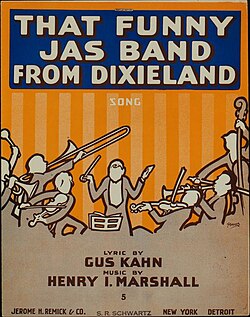
- Early Spellings: Variations like "jas," "jass," and "jasz" were common until 1918.
The Linguistic Roots: From Jasm to Jazz
Many linguists point to jasm—an obsolete slang term for spirit, energy, and vigor—as the most likely ancestor of "jazz." The term first appeared in Josiah Gilbert Holland's 1860 novel, Miss Gilbert's Career, where it described the "inexpressible personal force of the Yankee." This connection is further supported by a 1916 Daily Californian article that used the spelling "jaz-m."
Further back, "jasm" is believed to be a variant of jism (or "gism"), a term dating back to 1842 meaning "spirit; energy; spunk." While "jism" later became a taboo word referring to semen, in the 19th and early 20th centuries, it was used in polite contexts to describe courage or vitality. This duality explains why some early figures, such as composer Eubie Blake, found the word "jazz" uncouth.
Analogous Terms and Early Bands
The evolution of the word mirrors other English slang patterns, such as the relationship between "spasm" (a burst of energy) and "spazz." For instance, Herbert Asbury noted the existence of the "Razzy Dazzy Spasm Band" around 1895, which later evolved into the "Razzy Dazzy Jazzy Band" around 1900.
Jazz in the World of Baseball
Before it hit the airwaves, "jazz" was a staple of sports reporting. In 1913, writer E.T. "Scoop" Gleeson used the term in the San Francisco Bulletin to describe the enthusiasm and "pep" of the San Francisco Seals baseball team. In this context, "jazz" was synonymous with a high-energy spirit rather than music.
Another early sports reference appeared in The New York Times on April 2, 1912, where baseball player Ben Henderson described his "Jazz ball"—a curveball that wobbled unpredictably. This reinforces the idea that "jazz" originally described something erratic, energetic, or exciting.
The Transition to Music
The shift from general slang to a musical descriptor happened rapidly between 1914 and 1917. In Chicago, the term began appearing in press reports to describe energetic performances. A July 11, 1915, article in the Chicago Daily Tribune explicitly linked "jazz" to the blues, noting that "jazz" was the trade name for the "pep" put into the music.
By November 14, 1916, the New Orleans Times-Picayune acknowledged the popularity of "jas bands," claiming that while Chicago had popularized the term, the true home of these syncopated organizations was New Orleans.
Who Named the Music?
Several figures claim the title of the first to apply "jazz" to a band:
- Bert Kelly: A bandleader who claimed in 1957 that he used the West Coast slang term for his original dance band in 1914.
- Tom Brown: A New Orleans trombonist who led a "jass" band in Chicago in 1915.
- Harry James: A cafe manager who allegedly named Stein's Dixie Jass Band after a couple shouted, "Jass it up boy!"
Alternative Theories and Misconceptions
Over the years, several other etymologies have been proposed, though many lack evidence. Some suggest a link to the French verb jaser (to chatter), while others claim the word comes from the jasmine perfume worn in New Orleans' red-light districts. Another theory suggests a derivation from "jezebel," evolving into "jazzbelle." However, most of these are considered false etymologies or anecdotal recollections.
| Proposed Source | Meaning/Context | Status |
|---|---|---|
| Jasm / Jism | Spirit, energy, vigor | Leading candidate |
| Baseball Slang | Pep, enthusiasm, erratic movement | Well-documented early use |
| Jaser (French) | To chatter | Unlikely/Limited evidence |
| Jasmine Perfume | Scent used in New Orleans | Unsupported/Anecdotal |
| Jezebel | Prostitute | Unsupported |
The Word Game Curiosity
Beyond linguistics and music, "jazz" holds a unique place in pop culture as one of the hardest words to guess in the game of hangman. This is due to its short length, the presence of only one vowel, and the use of 'J' and 'Z'—two of the least frequent letters in the Latin alphabet.
Frequently Asked Questions
Did the word jazz originate in New Orleans?
While the music is deeply rooted in New Orleans, the word "jazz" likely originated as slang on the U.S. West Coast around 1912 before moving to Chicago and eventually being adopted in New Orleans around 1916.
What did "jazz" mean before it referred to music?
It was used to describe energy, vigor, pep, and enthusiasm. In sports, it could refer to a "wobbling" curveball or a general sense of excitement.
Is "jazz" related to the word "jism"?
Yes, linguists believe "jazz" evolved from "jasm," which was a variant of "jism." In the 19th century, "jism" meant spirit or spunk, though it later acquired a taboo sexual meaning.
Who was the first person to use "jazz" for a band?
There is no definitive consensus, but Bert Kelly is a leading contender, claiming he used the term for his dance band in 1914. Others point to Tom Brown or the Original Dixieland Jass Band.
Why were there different spellings like "jass"?
Early variations such as "jas," "jass," and "jasz" were common in print and slang until approximately 1918, when the spelling "jazz" became standardized.