Japanese Language: History, Structure, and Global Reach
Nihongo, the Japanese language, is a fascinating linguistic system with deep historical roots and a complex writing structure. As a member of the Japonic language family, it is spoken by approximately 123 million native speakers as of 2020. While its prehistory remains somewhat mysterious, the language has evolved through distinct stages—from Old Japanese to the modern standard used today.
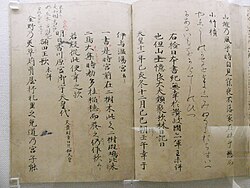
Key Facts
- Native Speakers: Approximately 123 million (2020 data).
- Language Family: Japonic.
- Writing System: A mixed script of Kanji, Hiragana, and Katakana.
- Official Status: Official language in Angaur, Palau.
- Global Presence: Significant emigrant communities in Brazil, the United States, and Peru.
The Evolution of Japanese
The history of Japanese is characterized by significant external influences and internal shifts. While Chinese documents from the 3rd century AD contain early traces of the language, substantial texts in Old Japanese did not emerge until the 8th century.
Historical Eras and Linguistic Shifts
The language has transitioned through several critical periods:
- Early Middle Japanese: During the Heian period (794–1185), massive waves of Sino-Japanese vocabulary entered the language, fundamentally altering its phonology.
- Late Middle Japanese: Between 1185 and 1600, the language underwent extensive grammatical changes and saw the first appearance of European loanwords.
- Early Modern Japanese: In the early 17th century, the linguistic center of gravity shifted from the Kansai region to the Edo region (modern-day Tokyo), forming the basis for the standard dialect.
- Modern Japanese: Following the end of Japan's isolation in 1853, the influx of European loanwords increased, particularly those with English roots.
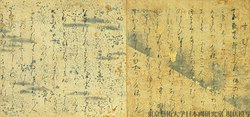
Writing Systems and Scripts
Japanese utilizes a unique mixed writing system that combines several different scripts to convey meaning, grammar, and pronunciation.
Kanji, Hiragana, and Katakana
The system relies on Kanji (Chinese characters) for core meanings, supplemented by two phonetic scripts known as Kana:
- Hiragana: Used primarily for grammatical elements and native Japanese words.
- Katakana: Often used for foreign loanwords and emphasis.

In addition to these, Japanese also utilizes Japanese Braille and Signed Japanese for accessibility.
Phonology and Grammar
The sound system of Japanese is structured around specific vowels and consonants. The vowel system is relatively simple, consisting of five primary sounds.

Vowels and Consonants
The Japanese vowel structure includes close, mid, and open vowels. The consonant system includes various categories such as bilabials, alveolars, and nasals. Special linguistic units known as mora (such as /N/ and /Q/) also play a role in the rhythm of the language.
Sentence Structure and Particles
Unlike English, which often relies on word order to indicate grammatical roles, Japanese uses particles (postpositions) to clarify the function of nouns. For example, the particle "wa" marks the topic, while "no" indicates possession.
Adjectives in Japanese are divided into two main types:
- Keiyōdōshi (na-adjectives): These are followed by a form of the copula (such as "na").
- Keiyōshi (i-adjectives): Often referred to as "true adjectives," these can predicate sentences directly.
Geographic Distribution and Dialects
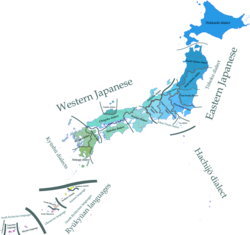
While Standard Japanese is widely understood, the language features various regional dialects. These range from the Eastern and Western groups to specific regional variations like Kyūshū and Hachijō.
Beyond Japan, large Japanese-speaking communities exist globally. Brazil hosts the largest emigrant population, with an estimated 1.4 to 1.5 million people. Other notable populations are found in the United States (particularly Hawaii and California), Peru, Argentina, Australia, Canada, and the Philippines.
| Location | Percentage of Intelligibility |
|---|---|
| Kyoto City | 67.1% |
| Ōgata, Kōchi | 45.5% |
| Tatsuta, Aichi | 44.5% |
| Kumamoto City | 38.6% |
| Osaka City | 26.4% |
| Kanagi, Shimane | 24.8% |
| Maniwa, Okayama | 24.7% |
| Kagoshima City | 17.6% |
| Kiso, Nagano | 13.3% |
| Himi, Toyama | 4.1% |

Frequently Asked Questions
What is the difference between Nihongo and Nihonga?
Nihongo refers to the Japanese language, whereas Nihonga refers to a style of traditional Japanese painting.
How many people speak Japanese worldwide?
As of 2020, there are approximately 123 million native speakers of Japanese.
Is Japanese an official language anywhere else?
Yes, Japanese is an official language in Angaur, Palau, alongside Palauan and English.
Why is there so much interest in learning Japanese?
International interest grew significantly following Japan's economic boom in the 1980s and the global rise of Japanese pop culture, such as anime and video games, since the 1990s.
What are the main components of the Japanese writing system?
The writing system is a mix of Kanji (characters representing concepts) and Kana (Hiragana and Katakana, which represent sounds).