The Meiji Restoration: Japan's Transformation from Feudalism to Modern Empire
The Meiji Restoration (Meiji Ishin), which officially began on January 3, 1868, stands as one of the most dramatic turning points in global history. In a remarkably short period, Japan transitioned from an isolated, feudal society governed by a military dictatorship to a centralized, industrial world power. This era saw the overthrow of the Tokugawa shogunate, the abolition of the centuries-old samurai class, and the birth of the Empire of Japan.
The Foundation: Life Under the Tokugawa Shogunate
To understand the restoration, one must first understand the bakufu—the shogunate government that ruled during the Edo period. Japan was organized under a rigid social hierarchy where position was inherited. At the theoretical top was the Emperor and the Imperial Court, but actual political power rested with the shōgun.
Below the shōgun were the daimyō (powerful feudal lords) and the samurai. This system, described by historian Marius B. Jansen as "feudal autonomy," allowed daimyō to control their own domains provided they remained loyal to the shōgun through irregular taxation and the system of alternate attendance. The samurai, who made up roughly 5–6% of the 30 million population, were further divided into upper, middle, and lower ranks.
The bakufu managed power through the distribution of land, measured in koku—the amount of rice a given area could produce annually. By 1650, the shōgun and his close allies controlled the majority of the national 26 million koku, while the remaining 38% was held by tozama daimyō (outside lords), many of whom were descendants of rivals defeated at the Battle of Sekigahara and were located far from the centers of power in western Japan.
Cracks in the System: Economic and Foreign Pressure
By the mid-19th century, the shogunate's grip began to slip. The Tenpō Reforms (1841–1843), intended to fix political and economic instability, instead highlighted the divide between the bakufu and the daimyō. Famine and popular unrest, such as the Osaka revolt, plagued the country. Efforts to enforce austerity and limit consumption alienated the samurai, some of whom abandoned their status to seek mercantile freedom.
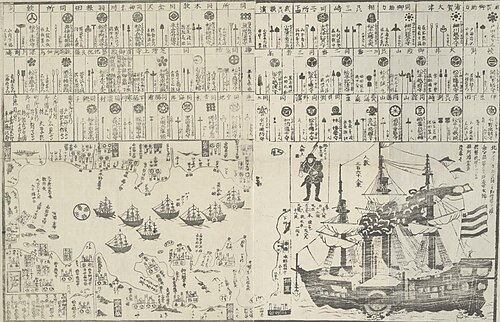
Simultaneously, Japan's policy of isolation was challenged by foreign powers. While the bakufu had dealt with sporadic Russian contact in the north and British interests in the south, the arrival of the United States proved decisive. The American expedition to open Japan's ports forced the shogunate to negotiate, ending centuries of seclusion.
The Unequal Treaties
Japan reluctantly signed treaties with the United States, Britain, France, the Netherlands, and Russia. The 1858 Treaty of Amity and Commerce with the U.S. was particularly contentious. It granted extraterritoriality—meaning foreigners were subject to their own laws rather than Japanese law—and opened five ports to free trade. These became known as the "unequal treaties" because they heavily favored the Western powers.
The Rise of the Shishi and Political Violence
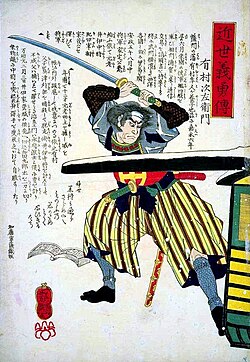
The shogunate's inability to resist foreign encroachment sparked a firestorm of domestic opposition. A group of low- and middle-ranking samurai known as shishi ("men of spirit") emerged. Driven by a blend of Neo-Confucian loyalty and Shintō revivalism, they championed the ideology of sonnō jōi ("Revere the Emperor, Expel the Barbarians").
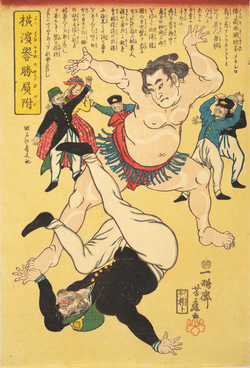
The shishi viewed the bakufu as self-interested and weak. Intellectuals like Yoshida Shōin argued for direct action to protect the national purity of the Imperial Court. This period of unrest culminated in 1860 with the assassination of Ii Naosuke, the tairō (great elder) who had pushed through the treaties against the Emperor's wishes.
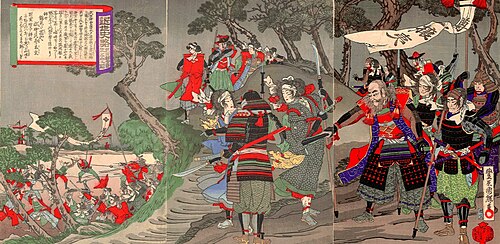
As the conflict intensified, some shishi moved toward conciliation with their own domain officials to build a broader front against the shogunate. In the Satsuma and Tosa domains, leaders like Saigō Takamori and Sakamoto Ryōma began organizing a resistance that balanced traditional feudal loyalties with a new devotion to the Emperor.
Foreign Intervention and Military Failure
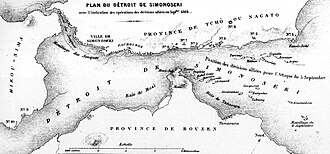
The drive to "expel the barbarians" often led to violent clashes with foreign navies. However, military failures in 1863 and 1864, including the allied attack on Shimonoseki, proved that Japan could not simply fight its way back to isolation. This realization shifted the goal from merely expelling foreigners to modernizing Japan so it could compete with them.
The Fall of the Shogunate and the Boshin War
The tide turned with the formation of the Satchō Alliance—a secret pact between the powerful Satsuma and Chōshū domains. This alliance provided the military and political leverage needed to challenge the bakufu.
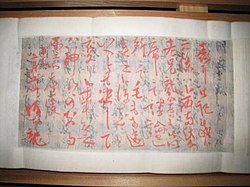
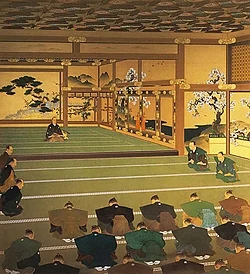
In 1867, the last shōgun, Tokugawa Yoshinobu, informed officials of his decision to resign, hoping to maintain some influence in a new government. However, the loyalists pushed for a total restoration of Imperial power.
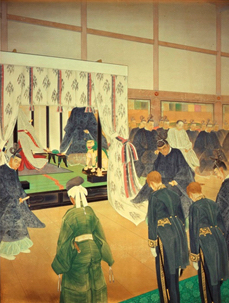
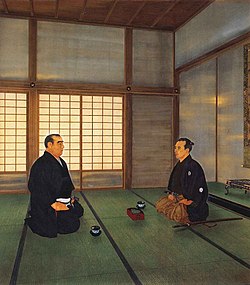
The transition was not entirely peaceful. The Boshin War (1868–1869) pitted Imperial forces against remnants of the shogunate. The conflict ended in May 1869 after the Battle of Hakodate, where the final breakaway Republic of Ezo was defeated. Following the victory, the capital was moved from Edo to Tōkyō, and Emperor Meiji took up residence there in 1869.
Building a Modern State: Imperial Reforms
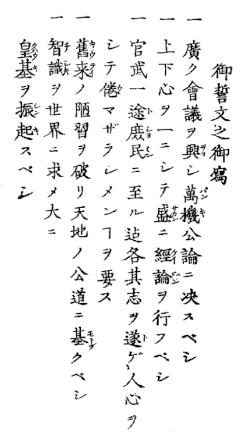
The new government immediately set out to dismantle the feudal order. In April 1868, the Charter Oath was promulgated, outlining the goals of the new administration, including the pursuit of knowledge throughout the world to strengthen the empire.
Abolition of the Domains and the Samurai Class
The government faced the difficult task of convincing daimyō to give up their land. Through a series of compromises and political maneuvers, the 302 feudal domains were formally reorganized into 72 prefectures by 1872. This effectively dissolved the feudal system.
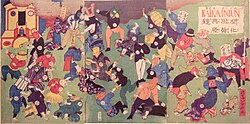
The samurai class, once the elite warriors of Japan, saw their privileges stripped away. The government abolished their stipends and, in 1871, issued the Dampatsurei edict, which forced samurai to cut off their traditional topknots. This signaled the end of the samurai as a distinct social caste.
Industrialization and Economic Growth
To avoid becoming a colony of the West, the Meiji government invested heavily in industrialization. While early efforts in the 1860s were small, the 1870s and 80s saw a surge in imported technology and infrastructure.
Raw silk became Japan's primary export, overtaking China in the global market due to the standardization of production. The revenue from silk exports funded the purchase of industrial machinery and raw materials. However, this growth came at a high cost to the peasantry; land tax rates were set at approximately 30% of harvests—significantly higher than in Europe or Qing China.
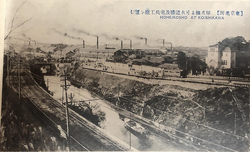
The results of this rapid modernization are evident in the growth of Japan's infrastructure and shipping capabilities between 1872 and 1914:
| Category | Early Meiji (c. 1872-1873) | Late Meiji (c. 1913-1914) | Nature of Growth |
|---|---|---|---|
| Railways | 18 miles (29 km) | 7,100 miles (11,400 km) | Massive expansion of inland transport |
| Steamships | 26 ships | 1,514 ships | Rapid growth in naval and trade capacity |
| Silk Exports | 646 million (1868-72) | 9,462 million (1909-14) | Dominance of the global silk market |
| Steel/Iron | Negligible | 21.3 million metric tons | Transition to heavy industrial production |