James Franck: The Physicist Who Proved Bohr's Atomic Theory
James Franck (1882–1964) was a distinguished German-American physicist whose work fundamentally altered our understanding of the atom. Best known for his experimental validation of quantum theory, Franck shared the 1925 Nobel Prize in Physics for discovering the laws governing how electrons impact atoms. His career spanned two continents and several of the 20th century's most prestigious institutions, marked by a steadfast commitment to both scientific rigor and ethical integrity.
Key Facts
- Nobel Prize: Awarded the 1925 Nobel Prize in Physics alongside Gustav Hertz.
- Major Discovery: The Franck–Hertz experiment provided empirical evidence for the quantized energy levels of atoms.
- Ethical Stand: The first academic to resign from a German university in protest of the Nazi Law for the Restoration of the Professional Civil Service in 1933.
- War Effort: Contributed to the development of gas masks during World War I and authored the Franck Report regarding the ethical use of atomic weapons in 1945.
- Later Research: Conducted pioneering studies on the mechanism of photosynthesis.
Early Life and Academic Foundation
Born in Hamburg in 1882, Franck initially intended to study law and economics at the University of Heidelberg. However, his fascination with science, encouraged by a lifelong friendship with Max Born, led him to switch his focus to physics and chemistry. To gain a stronger foundation in the physical sciences, he transferred to the University of Berlin, where he completed his doctorate in 1906.
In the German academic system of the time, a doctorate was insufficient for a professorship; one required a habilitation (a qualification allowing a person to teach at a university). Franck achieved this in 1911 by publishing a substantial body of work, including 34 articles. He was a prolific collaborator, working with notable scientists such as Lise Meitner and Robert Pohl, though his most significant partnership was with Gustav Hertz.
The Franck–Hertz Experiment
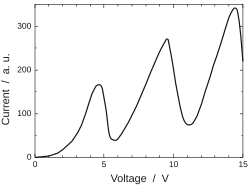
The defining achievement of Franck's early career was the Franck–Hertz experiment. In 1914, Franck and Hertz demonstrated that electrons colliding with mercury atoms lost energy in specific, discrete amounts. They observed that the wavelength of the resulting ultraviolet light corresponded exactly to the 4.9 eV of energy lost by the electrons.
This result provided the first direct experimental proof of the Bohr model, which proposed that electrons exist in quantized energy levels rather than arbitrary orbits. Although Franck later admitted he had not initially recognized the fundamental significance of Niels Bohr's theory, the experiment became a cornerstone of modern quantum physics.
Military Service and World War I
Franck's scientific career was interrupted by World War I. He served as a volunteer in the German Army, eventually reaching the rank of lieutenant. He was assigned to a unit led by Fritz Haber, where he helped locate sites for chlorine gas attacks. Despite the nature of his service, he continued his scientific pursuits, co-writing a paper with Hertz while recovering from pleurisy in a hospital.
Later in the war, Franck worked at the Kaiser Wilhelm Institute for Physical Chemistry and Electrochemistry, focusing on the development of gas masks. His service earned him the Iron Cross (both 1st and 2nd Class) and the Hanseatic Cross.
![Left to right: Max Reich [de], Max Born, James Franck, and Robert Pohl (the bonzen) in 1923](/images/d7/15/d7158753cc1c83ae4561a68de7028b62d6f9fbaeddeedaa3ff4699025026f0f9.jpg)
Leadership in Göttingen and the Nazi Era
In 1920, Franck was appointed Professor of Experimental Physics and Director of the Second Institute for Experimental Physics at the University of Göttingen. Alongside Max Born, he helped transform Göttingen into a global epicenter for physics, investing his own funds to equip the laboratory with state-of-the-art technology.
This era ended abruptly in 1933 when the Nazi Party rose to power. The government enacted the Law for the Restoration of the Professional Civil Service, which targeted Jewish civil servants and political opponents. Although Franck was exempt as a WWI veteran, he resigned in April 1933 in protest of the law's injustice, becoming the first academic to do so.
Life in the United States and the Atomic Bomb
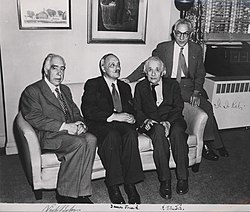
Franck emigrated to the United States in 1935, first joining Johns Hopkins University and later the University of Chicago in 1938. He became a naturalized U.S. citizen in 1941. During World War II, he played a role in the Manhattan Project, heading the Chemistry Division and chairing a committee on the political and social problems of the atomic bomb.
In June 1945, he co-authored the Franck Report. This document urged the U.S. government not to use the atomic bomb on Japanese cities without prior warning, arguing that mankind was not yet ethically or politically prepared to use such power wisely. Despite these warnings, the Interim Committee proceeded with the bombings.
Later Years and Legacy
Following the war, Franck married Hertha Sponer in 1946. He spent his emeritus years at the University of Chicago focusing on the complex mechanism of photosynthesis (the process by which plants use sunlight to synthesize nutrients). He received the Rumford Prize in 1955 for this work.
James Franck died of a heart attack in 1964 while visiting his former home of Göttingen. He is remembered not only as a brilliant experimentalist but as a man of conscience who stood against totalitarianism and warned against the unchecked use of nuclear weapons.
| Category | Details |
|---|---|
| Born/Died | August 26, 1882 – May 21, 1964 |
| Key Experiment | Franck–Hertz experiment (Quantized energy levels) |
| Major Awards | Nobel Prize in Physics (1925), Max Planck Medal (1951), Rumford Prize (1955) |
| Key Institutions | University of Berlin, University of Göttingen, University of Chicago |
| Notable Document | The Franck Report (1945) |
Frequently Asked Questions
What was the significance of the Franck–Hertz experiment?
The experiment provided the first empirical evidence that atoms absorb energy only in specific, quantized amounts, confirming the theoretical predictions made by Niels Bohr regarding atomic energy levels.
Why did James Franck resign from the University of Göttingen?
Franck resigned in 1933 to protest the Nazi government's Law for the Restoration of the Professional Civil Service, which allowed for the dismissal of Jewish civil servants and political opponents.
What was the purpose of the Franck Report?
The Franck Report was a recommendation submitted in 1945 advising against the unannounced use of atomic bombs on Japanese cities, citing ethical and political concerns.
What did James Franck study in his later career?
In his later years, Franck focused his research on the photochemical processes involved in photosynthesis, for which he was awarded the Rumford Prize in 1955.
Who did James Franck share the Nobel Prize with?
He shared the 1925 Nobel Prize in Physics with Gustav Hertz for their discovery of the laws governing the impact of an electron upon an atom.