Jambalaya: The Rich History and Cultural Flavors of Louisiana's Iconic Rice Dish
Jambalaya is more than just a meal; it is a savory reflection of Louisiana's complex history. This hearty rice dish is a fusion of African, Spanish, and French influences, blending meats, seafood, and vegetables into a single, aromatic pot. From the bustling streets of New Orleans to the rural bayous of Acadiana, jambalaya stands as a testament to the cultural syncretism of the American South.
At its core, jambalaya is a one-pot meal where raw rice is cooked directly in a rich stock of browned meats and vegetables, allowing the grains to absorb every drop of flavor. This distinguishes it from other famous Louisiana dishes like gumbo or étouffée, where the rice is typically prepared separately and served as a base.
Key Facts
- Origin: Developed in Louisiana, USA, through a blend of West African, Spanish, and French culinary traditions.
- Primary Styles: Creole (contains tomatoes) and Cajun (no tomatoes).
- Core Technique: Unlike gumbo, the rice in jambalaya is cooked in the pot with the other ingredients.
- Cultural Roots: Strongly linked to West African one-pot rice dishes like jollof rice and thiéboudienne.
- World Capital: Gonzales, Louisiana, was proclaimed the "Jambalaya capital of the world" in 1968.
The Origins and Etymology of Jambalaya
The word "jambalaya" has several debated origins. The Oxford English Dictionary traces it to the Provençal word jambalaia, meaning a "mish mash" or a rice pilaf. Other theories suggest it is a contraction of the French jambon à la yaya ("ham with rice"), combining French and Yoruba languages. While some folk etymologies suggest a blend of the Spanish words jamón (ham) and paella, historians find little evidence for this, as ham is not always a primary feature of the dish.
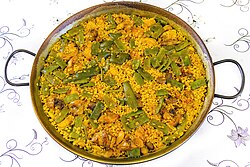
Historically, the dish is a syncretic blend. During the colonial period, French and Spanish settlers in Louisiana interacted with enslaved West Africans who possessed extensive knowledge of rice cultivation. This intersection created a unique New World dish that combined the Spanish paella (a saffron-infused rice dish) with West African traditions.
The West African Connection
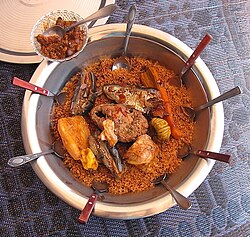
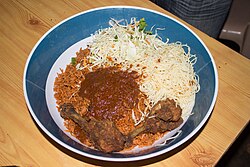
Many historians and researchers, including Kayla Stewart and Kelley Fanto Deetz, point to West African roots, specifically jollof rice and the Senegalese dish thiéboudienne (made with red rice, fish, cassava, and carrots). In West Africa, the concept of dafa ("cook everything") involves simmering meat, fish, and shellfish in one pot with rice. The spicy heat characteristic of jambalaya is widely attributed to these West African influences, particularly from the rice-growing regions of Senegal.
Regional Variations: Creole vs. Cajun
In Louisiana, jambalaya is broadly divided into two primary styles based on geography and ingredients.
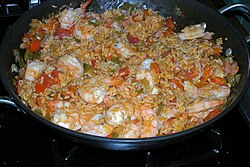
Creole Jambalaya (Red Jambalaya)
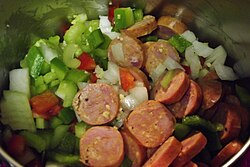
Common in New Orleans and surrounding areas, Creole jambalaya is known as "red jambalaya" because it incorporates tomatoes. The process begins with the "trinity"—a mixture of celery, onions, and bell peppers—sautéed with meats like chicken and andouille sausage (a spicy smoked sausage). Seafood is often added, and the rice and stock are simmered together until tender.
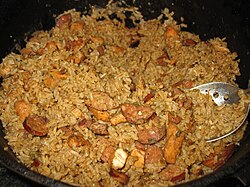
Cajun Jambalaya (Brown Jambalaya)
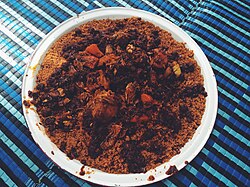
Found primarily in southwestern and south-central Louisiana (Acadiana), Cajun jambalaya contains no tomatoes. Instead, it gets its characteristic brown color from the sucs—the caramelized bits of meat that stick to the bottom of a cast-iron pot during browning. This version relies heavily on the caramelization of natural sugars in the meats and vegetables to create a deep, savory flavor.
Comparing Louisiana Rice Dishes
While jambalaya, gumbo, and étouffée share similar ingredients, their preparation and consistency differ significantly.
| Feature | Jambalaya | Gumbo | Étouffée |
|---|---|---|---|
| Rice Preparation | Cooked in the pot with ingredients | Cooked separately; served as a bed | Cooked separately; served as a bed |
| Key Thickener/Additive | Rice grains | Okra or filé powder | Roux-based stew |
| Common Proteins | Sausage, chicken, seafood | Sausage, seafood, meats | Shellfish (shrimp or crawfish) |
| Consistency | Dry to slightly wet | Stew-like/Soup | Thick stew |
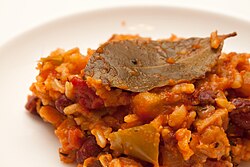
Cultural Legacy and Modern Presence
Jambalaya's flexibility made it a staple for those with limited resources, as it could be adapted based on whatever meats and vegetables were available. In the rural swamp country of Acadiana, this meant incorporating local game such as alligator, boar, venison, or nutria. In New Orleans, the dish evolved into the more "soupy" red version.
The dish first appeared in print in a Provençal poem in 1837 and later in an Alabama cookbook in 1878. Today, it remains a symbol of Louisiana pride, celebrated annually at the Jambalaya Festival in Gonzales, the official "Jambalaya capital of the world."
Frequently Asked Questions
What is the difference between Cajun and Creole jambalaya?
The primary difference is the use of tomatoes. Creole jambalaya (red jambalaya) includes tomatoes, while Cajun jambalaya (brown jambalaya) does not, relying instead on browned meats for color and flavor.
How is jambalaya different from gumbo?
The main difference is how the rice is cooked. In jambalaya, the rice is cooked inside the pot with the meats and vegetables. In gumbo, the rice is cooked separately and the stew is served over it.
Where did jambalaya originate?
Jambalaya originated in Louisiana, USA. It is a fusion dish that combined the culinary traditions of West African enslaved people, Spanish settlers (paella), and French colonists.
What is the "trinity" in jambalaya?
The trinity is a foundational aromatic base consisting of onions, celery, and green or red bell peppers, typically used in a ratio of 50% onion, 25% celery, and 25% pepper.
Is jambalaya related to jollof rice?
Yes, many historians believe jambalaya has roots in West African jollof rice and other one-pot rice dishes like thiéboudienne, brought to Louisiana by enslaved people from regions such as Senegal.