Jabberwocky: The Linguistic Legacy of Lewis Carroll's Nonsense Masterpiece
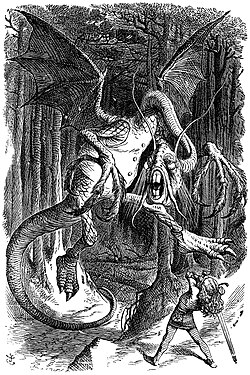
In the realm of English literature, few works are as delightfully baffling as "Jabberwocky." Written by the English author and mathematician Lewis Carroll, this nonsense poem tells the tale of a hero's quest to slay a creature known as the Jabberwock. It first appeared in his 1871 novel Through the Looking-Glass, the celebrated sequel to Alice's Adventures in Wonderland.
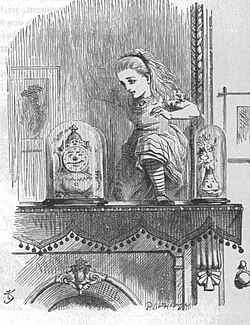
The poem is deeply embedded in the narrative of Alice's journey through a "back-to-front" dreamscape. Upon encountering the White King and White Queen, Alice discovers a book written in an unintelligible language. Realizing she is in an inverted world, she uses a mirror to read the verses in reflection, revealing the puzzling, whimsical lines of "Jabberwocky."
Key Facts
- Author: Lewis Carroll
- Original Publication: 1871 in Through the Looking-Glass
- Genre: Nonsense poetry
- Legacy: Created famous neologisms like "chortle" and "galumphing"
- Cultural Impact: Inspired films, musical compositions, and Dungeons & Dragons lore
The Power of Neologisms and Lexicon
"Jabberwocky" is widely regarded as one of the greatest nonsense poems in the English language. Its brilliance lies in its use of neologisms—newly coined words—that feel intuitively meaningful despite being invented. These playful terms have successfully transitioned from the poem into standard English usage.
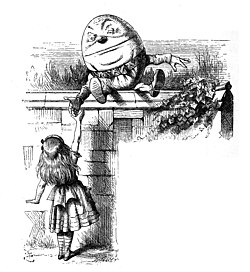
For instance, the word chortled is recognized by the Oxford English Dictionary as a combination of "chuckle" and "snort." Similarly, the term galumphing has become a staple of the English lexicon. Within the poem itself, characters like Humpty Dumpty provide definitions for the more obscure terms, such as explaining that to gimble means "to make holes like a gimlet."
A Summary of Linguistic Impact
| Term | Origin/Meaning | Status |
|---|---|---|
| Chortle | Combination of "chuckle" and "snort" | Standard English |
| Galumphing | Invented by Carroll | Standard English |
| Gimble | To make holes like a gimlet | Literary Neologism |
Global Translations and Interpretations
The poem's unique structure has challenged translators for over a century. Because the poem relies on the sound and feel of words, translating it requires more than just literal meaning; it requires capturing the "nonsense" essence.
Notable translations include:
- Russian: D.G. Orlovskaya's "Barmaglot," which uses specific terms like "Brandashmyg" for Bandersnatch.
- Chinese: Linguist Chao Yuen Ren invented new characters to mimic the original sounds.
- Ancient Greek: M. L. West published versions mimicking the epic styles of Homer and Nonnus.
- Other Languages: The poem has been translated into French, German, Bengali, Brazilian Portuguese, Arabic, Croatian, Latin, and many others.

Cultural Reception and Modern Legacy
The influence of "Jabberwocky" extends far beyond the printed page, permeating music, film, and gaming.
Music and Film
The poem has inspired numerous musical works, from the 1968 single by Boeing Duveen and The Beautiful Soup to the 1971 album by Donovan. In cinema, it served as the inspiration for Jan Švankmajer's 1971 short film and Terry Gilliam's 1977 feature film, Jabberwocky.
Gaming and Fantasy Lore
In the world of tabletop gaming, the Jabberwock was introduced as a monster in Dungeons & Dragons in 1981. This inclusion was later solidified in the Monstrous Compendium and The Wild Beyond the Witchlight. Additionally, the Vorpal Sword—a legendary weapon capable of decapitating creatures in a single blow—is a direct reference to the poem's lore.
Frequently Asked Questions
What is a neologism?
A neologism is a newly coined word or expression. "Jabberwocky" is famous for introducing several such words into the English language.
In which book does the Jabberwocky poem appear?
The poem appears in Lewis Carroll's 1871 novel Through the Looking-Glass, which is the sequel to Alice's Adventures in Wonderland.
What is a Vorpal Sword?
In the context of the poem and subsequent fantasy lore like Dungeons & Dragons, a Vorpal Sword is a magical weapon capable of decapitating a creature with a single strike.
Why is the poem considered "nonsense"?
It is considered a nonsense poem because it uses whimsical, invented, and seemingly unintelligible language to create a sense of playfulness and wonder.
How did Alice read the poem?
Alice discovered that the poem was written in mirror writing. By holding a mirror to the pages, she was able to read the reflected verses.