Israeli Retribution Operations (1951–1966)
Following the 1948 Arab-Israeli War, the region entered a period of intense instability characterized by cross-border raids and skirmishes. To counter these threats, Israel adopted a policy of retribution operations—military raids designed to deter enemy attacks by striking back at the sources of aggression. These operations evolved from small-scale tactical strikes to large-scale military engagements involving paratroopers, special forces, and air support.
Key Facts
- Timeframe: The primary phases of these operations occurred between April 1951 and November 1966.
- Primary Targets: Operations were primarily directed at Egyptian, Jordanian, and Syrian military posts and villages.
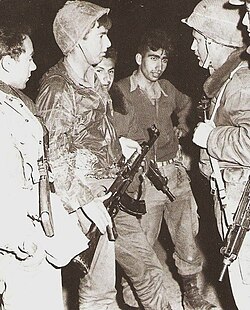
- Key Units: The IDF paratroopers and the specialized Unit 101 played central roles in these raids.
- Casualties (1949–1956): Approximately 200 Israelis were killed by cross-border attacks, while between 2,700 and 5,000 Arabs were killed, including many unarmed civilians.
- Strategic Impact: Operation Black Arrow is cited by President Gamal Abdel Nasser as a primary motivator for the 1955 Egyptian-Czech arms deal.
The First Phase: 1951–1956
The early 1950s were marked by a cycle of violence. The first retribution operation occurred on April 5, 1951, following the el-Ḥamma incident where seven Israeli soldiers were killed. This initial attempt, carried out by the Israeli Air Force, failed when the aircraft missed their targets.
As the policy matured, the IDF shifted toward ground-based raids. One of the most controversial events was Operation Shoshana (the Qibya massacre) on October 14, 1953. Commanded by Ariel Sharon and involving Unit 101 and paratroopers, the force attacked the village of Qibya in the Jordanian-controlled West Bank. The operation resulted in the deaths of 69 villagers—two-thirds of whom were women and children—and the destruction of 45 houses, a school, and a mosque.
Engagements with Egypt
Tensions with Egypt led to several high-intensity operations in the Gaza Strip and the Nitzana Demilitarized Zone:
- Operation Black Arrow (1955): A strike against the Egyptian army resulting in 38 Egyptian and 8 IDF deaths.
- Operation Elkayam (1955): A raid on Khan Yunis police forces that killed 72 Egyptian soldiers.
- Operation Egged (1955): A paratrooper raid on a military post at Kuntilla, killing 12 Egyptian soldiers and capturing 29.
- Operation Volcano (1955): A response to an invasion of the Nitzana youth village, resulting in 81 Egyptian deaths and 55 captures.
Operations Against Syria and Jordan
Israel also targeted Syrian posts on the Sea of Galilee and the Golan Heights, such as Operation Olive Leaves (December 1955), which killed 54 Syrian soldiers. In Jordan, operations like Operation Jonathan (September 1956) and Operation Samaria (October 1956) targeted police forces and military outposts. Operation Samaria was particularly costly, with 100 Jordanian and 17 IDF soldiers killed.
Beyond direct raids, Israel employed targeted killings. In July 1956, military intelligence assassinated Egyptian officers Colonel Mustafa Hafez and Colonel Salah Mustafa using bomb-laden packages delivered via double agents and mail.
Summary of Major Operations (1951–1966)
| Operation Name | Year | Primary Target | Key Outcome/Casualties |
|---|---|---|---|
| Operation Shoshana | 1953 | Jordan (Qibya) | 69 villagers killed; village destroyed |
| Operation Black Arrow | 1955 | Egypt (Gaza) | 38 Egyptian, 8 IDF killed |
| Operation Olive Leaves | 1955 | Syria (Galilee) | 54 Syrian, 6 IDF killed |
| Operation Samaria | 1956 | Jordan (Qalqilya) | 100 Jordanian, 17 IDF killed |
| Operation Cricket | 1960 | Syria (Tawfiq) | 6 Syrian, 3 IDF killed |
| Samu Incident | 1966 | Jordan (as-Samu) | 18 Jordanians, 1 IDF killed |
The Second Phase: 1960–1966
The 1956 Sinai War paused the first phase of retribution operations. When they resumed, the focus shifted primarily toward Jordan and Syria, as these borders became the primary sources of attacks.
Operation Cricket (January 1960) marked the return of this policy, with Golani forces destroying the Syrian village of Tawfiq. This was followed by Operation Swallow (March 1962), where the Golani Brigade raided Syrian posts in Nuqayb, resulting in 30 Syrian and 7 IDF deaths.
The period culminated in the Samu Incident on November 13, 1966. In response to sabotage, the IDF attacked the village of as-Samu. The operation involved the bombing of dozens of houses and the death of 18 Jordanians, including the death of IDF Lt. Col. Yoav Shaham. The event also triggered an air battle between Jordanian Hawker Hunter aircraft and Israeli Dassault Mirage III aircraft.
Frequently Asked Questions
What was the purpose of the retribution operations?
The operations were designed as a deterrent strategy to stop cross-border infiltrations and attacks by striking back at the military posts or villages from which the attacks originated.
Which Israeli military units were most involved?
The IDF paratroopers, the Golani Brigade, and the specialized Unit 101 were the primary forces used in these raids.
How did these operations affect international relations?
These operations often escalated tensions. For example, Operation Black Arrow is credited by President Gamal Abdel Nasser as a key reason for Egypt seeking an arms deal with the Czech Republic in 1955.
Who were the primary targets during the second phase (1960–1966)?
After the Sinai War, the retribution operations were mainly directed at Jordan and Syria, as the majority of attacks against Israel were originating from those borders.
What was the human cost of these conflicts between 1949 and 1956?
Approximately 200 Israelis were killed by cross-border attacks and another 200 soldiers died in clashes. Between 2,700 and 5,000 Arabs were killed, including many unarmed civilians.