Iran-Iraq WarSaddam HusseinRuhollah KhomeiniKhuzestanShatt al-Arab

Iran–Iraq War: A Comprehensive History of the Eight-Year Conflict

Iran–Iraq War: A Comprehensive History of the Eight-Year Conflict The Iran–Iraq War was one of the longest and most devastating conventional conflicts of the 20th century. Lasting from Se...

Iran–Iraq War: A Comprehensive History of the Eight-Year Conflict

The Iran–Iraq War was one of the longest and most devastating conventional conflicts of the 20th century. Lasting from September 22, 1980, to August 20, 1988, the war was characterized by brutal trench warfare, the use of chemical weapons, and a strategic stalemate that left both nations economically shattered and burdened by immense human loss.

The conflict emerged from a volatile mix of territorial disputes, ideological clashes following the Iranian Revolution, and the ambitions of Iraqi leader Saddam Hussein. What began as an attempt by Iraq to seize strategic territory evolved into a war of attrition that drew in global superpowers and reshaped the geopolitics of the Persian Gulf.
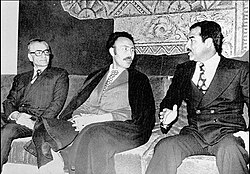
A meeting of Mohammad Reza Pahlavi, Houari Boumédiène, and Saddam Hussein (left to right) during the Algiers Agreement in 1975

Key Facts

  • Duration: 7 years, 10 months, and 4 weeks.
  • Outcome: Inconclusive; the borders returned to the status quo ante bellum (the state existing before the war).
  • Total Fatalities: Estimated between 450,000 and 500,000 for Iran, with Iraqi military deaths ranging from 105,000 to 500,000.
  • Economic Impact: Iran suffered an estimated $561 billion in economic losses.
  • Major Territorial Focus: The Shatt al-Arab waterway and the oil-rich Khuzestan province.

Origins and Outbreak

The roots of the conflict lay in the dispute over the Shatt al-Arab, a strategic river forming part of the border between the two nations. Following the Iranian Revolution, Iraq perceived an opportunity to annex the Khuzestan province, a region vital for its oil production and home to a significant ethnic Arab population.
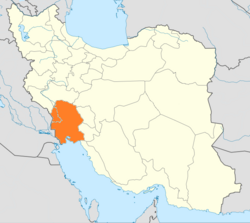
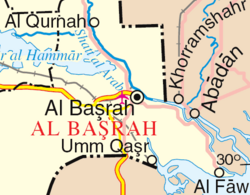
The location of Khuzestan province in Iran, which Iraq planned to annex

The Shatt al-Arab on the Iran–Iraq border

On September 22, 1980, Iraqi forces launched a full-scale invasion of Iran. The initial strategy aimed for a swift victory through air strikes and rapid ground advances, targeting key cities and military installations.
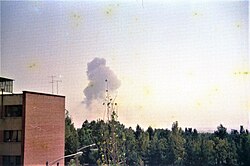
Explosion in Mehrabad Air Base in Tehran after Iraqi forces attacked Tehran on 22 September 1980

The Course of the War

1980–1982: Invasion and Iranian Counter-Offensive

The early stages of the war saw Iraqi forces capture several towns, including the strategic port of Khorramshahr. However, the Iraqi advance stalled due to fierce Iranian resistance and logistical failures. By 1982, Iran shifted from a defensive posture to a series of offensives, such as Operation Fath ol-Mobin and Operation Beit ol-Moqaddas, which eventually led to the liberation of Khorramshahr.
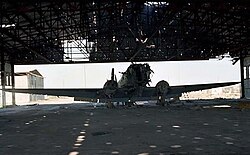
Destroyed Iranian C-47 Skytrain

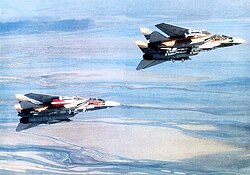
Iranian F-14A Tomcats equipped with AIM-54A, AIM-7 and AIM-9 missiles

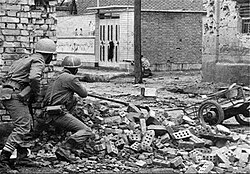
Resistance of the outnumbered and outgunned Iranians in Khorramshahr slowed the Iraqis for a month.

1983–1987: Stalemate and War of Attrition

Following the recapture of its territory, Iran sought to push into Iraqi soil to force a regime change in Baghdad. This period was marked by "human wave" attacks—large-scale infantry assaults—and a grueling stalemate in the marshes and deserts. Iraq responded with a "dynamic defense" strategy and the increasing use of chemical weapons to halt Iranian advances.
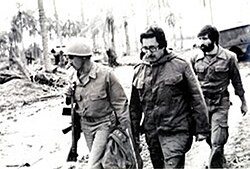
Iranian president Abulhassan Banisadr during a visit to the frontlines

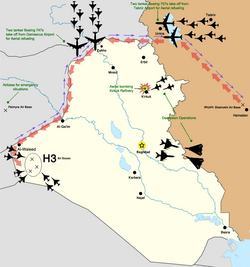
The surprise attack on H-3 airbase is considered to be one of the most sophisticated air operations of the war.

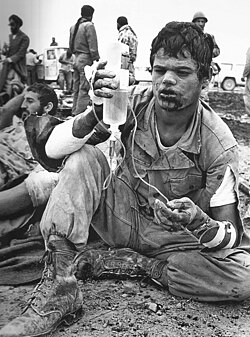
A wounded Iranian soldier holding an IV bag

The Tanker War and the War of the Cities

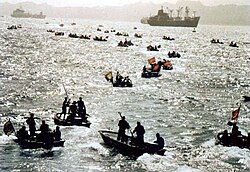
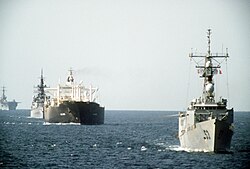
As the ground war stalled, the conflict expanded into the Persian Gulf. In the Tanker War, both sides attacked commercial oil tankers to disrupt the other's economy. This drew the United States into the conflict through Operation Earnest Will, providing naval escorts for Kuwaiti tankers.
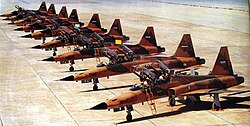
Iranian Northrop F-5 aircraft during the war

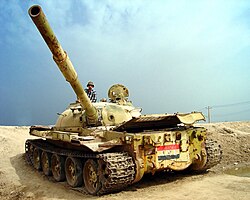
Iraqi T-62 tank wreckage in Khuzestan province, Iran

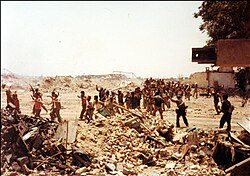
Iraqi soldiers surrendering after the Liberation of Khorramshahr

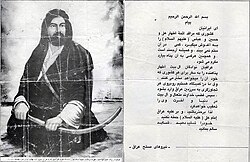
An admonitory declaration issued from the Iraqi government in order to warn Iranian troops in the Iran–Iraq War. The statement says: "Hey Iranians! No one has been downtrodden in the country where Ali ibn Abi Ṭālib, Husayn ibn Ali and Abbas ibn Ali are buried. Iraq has undoubtedly been an honourable country. All refugees are precious. Anyone who wants to live in exile can choose Iraq freely. We, the Sons of Iraq, have been ambushing foreign aggressors. The enemies who plan to assault Iraq will be disfavoured by God in this world and the hereafter. Be careful of attacking Iraq and Ali ibn Abi Ṭālib! If you surrender, you might be in peace."

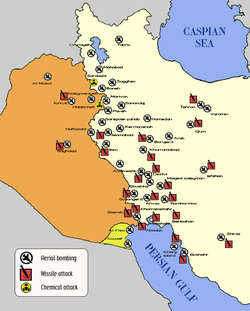
Simultaneously, the "War of the Cities" saw both nations launch missiles and air raids against civilian population centers to break the enemy's morale.
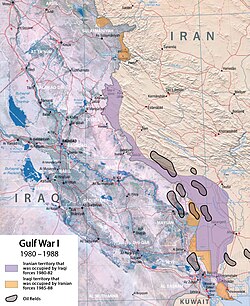
The furthest ground gains made by both sides during the war

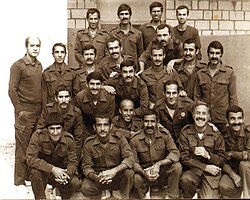
Iranian POWs in 1983 near Tikrit, Iraq

An Iraqi POW who was shot by Iranian troops after they conquered the Iraqi Majnoon oil field in October 1984

Military Strength and Technology

The war highlighted a significant imbalance in hardware. Iraq generally possessed a superior number of tanks and artillery, while Iran initially had a stronger air force, including the advanced F-14A Tomcat. However, international sanctions and the U.S. embargo severely limited Iran's ability to maintain its equipment.
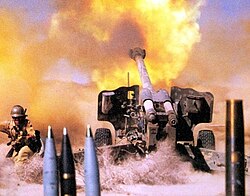
Iranians firing a 152mm D-20 howitzer

Operation Earnest Will: Tanker convoy No. 12 under US Navy escort (21 October 1987)

A map indicating the attacks on civilian areas of Iran, Iraq, and Kuwait that were targeted during the war of the cities

Comparison of Military Strength (1980 vs 1987)
Asset Iraq (1980) Iraq (1987) Iran (1980) Iran (1987)
Tanks 2,700 4,500+ 1,740 1,000
Fighter Aircraft 332 500+ 445 65
Helicopters 40 150 500 60
Artillery 1,000 4,000+ 1,000+ 1,000+

The Final Phase and Ceasefire

By 1988, both nations were exhausted. Iraq launched a series of successful offensives to reclaim lost ground, while Iran faced internal unrest and severe economic strain. Following a series of clashes, including Operation Mersad, Iran finally accepted a UN-brokered ceasefire on August 20, 1988.
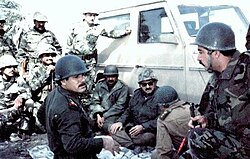
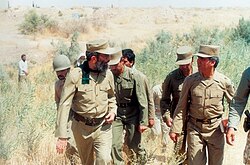
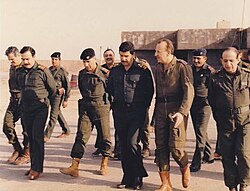
Iraqi commanders discussing strategies on the battlefront, 1986

Iranian President Ali Khamenei on the battlefront during the war

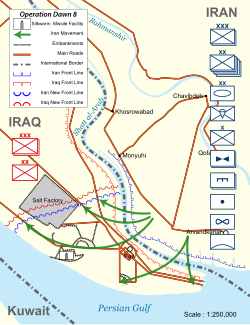
Operation Dawn 8 during which Iran captured the al-Faw peninsula

Burned-out vehicles shown in the aftermath of Operation Mersad[citation needed]

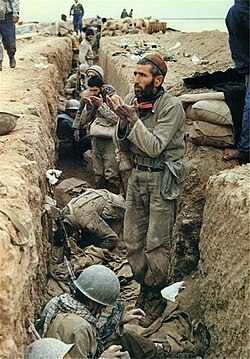
Iranian soldiers praying inside a trench during Operation Karbala-5

Adnan Khairallah, Iraqi Defence Minister, meeting with Iraqi soldiers during the war

IRGC navy speedboats using swarm tactics

The Iranian frigate IS Sahand burns after being hit by 20 U.S. air launched missiles and bombs, killing a third of the crew, April 1988[182]

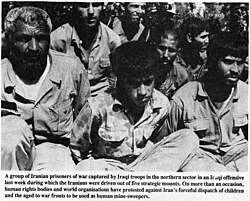
Iranian soldiers captured during Iraq's 1988 offensives

USS Vincennes in 1987 a year before it shot down Iran Air Flight 655

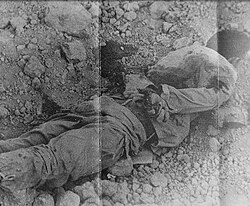
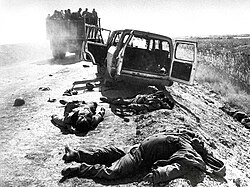
MEK soldiers killed in Operation Mersad, 1988

Chemical Warfare and Human Cost

One of the most controversial aspects of the war was Iraq's systematic use of chemical agents, including mustard gas and nerve agents. These attacks targeted both Iranian soldiers and Kurdish civilians, leading to thousands of casualties and long-term health crises.
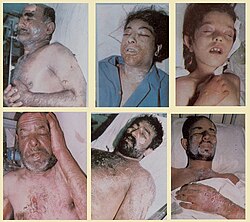
Victims of the 1987 chemical attack on Sardasht, West Azerbaijan, Iran

The human toll was staggering. Beyond the military deaths, hundreds of thousands of civilians perished. The legacy of the war is preserved today in various memorials and museums across both nations.
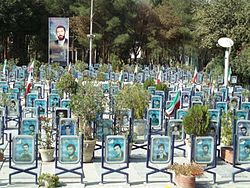
Iranian Martyr Cemetery in Isfahan

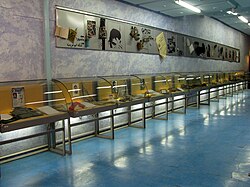
The Iranian Martyrs Museum in Tehran

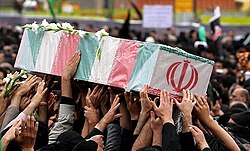
An Iranian soldier's funeral in Mashhad, 2013

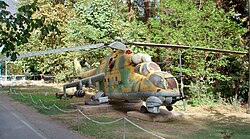
An Iraqi Mil Mi-24 on display at the military museum of Sa'dabad Palace in Iran

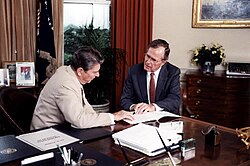
President Ronald Reagan and Vice President George H. W. Bush in the Oval Office in 1984

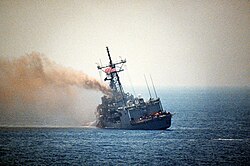
USS Stark listing following two hits by Exocet missiles

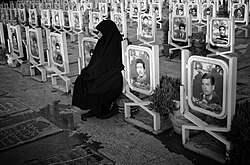
An Iranian mother mourning her son in a military cemetery in Isfahan, 2011.

Frequently Asked Questions

Who won the Iran–Iraq War?

The war ended in a stalemate. Neither side achieved its primary strategic goals, and the borders returned to their original positions before the conflict began.

Why did Iraq invade Iran in 1980?

Iraq sought to resolve a long-standing dispute over the Shatt al-Arab waterway and aimed to annex the oil-rich Khuzestan province, believing the post-revolutionary Iranian government was too weak to resist.

What was the "Tanker War"?

The Tanker War was a phase of the conflict where both Iran and Iraq attacked commercial oil tankers in the Persian Gulf to cripple each other's oil exports and economy.

How did the United States participate in the conflict?

The U.S. primarily supported Iraq through intelligence and financial means to prevent an Iranian victory, and deployed the Navy in Operation Earnest Will to protect oil shipping in the Gulf.

What were the consequences of chemical weapon use?

Iraq used mustard and nerve agents extensively, causing thousands of immediate deaths and leaving survivors with permanent respiratory and skin injuries, most notably in attacks like the one on Sardasht.