Isla de la Cartuja: Seville's Historic Peninsula of Art and Innovation
Located in the heart of Seville, Spain, Isla de la Cartuja (the Island of the Carthusians) is a site where deep historical roots meet modern urban ambition. Situated along the Guadalquivir River, this area has evolved from a secluded monastic retreat into a vibrant hub of technology, culture, and entertainment.
From Cloistered Monastery to Global Stage
The area takes its name from the Monasterio de Santa María de las Cuevas, a cloistered monastery (Cartuja) that once dominated the landscape. This site holds significant historical weight as the place where Christopher Columbus resided while planning his landmark voyage to the west.
For centuries, the site remained a true island, isolated between two branches of the Guadalquivir River. However, this changed in 1992 to accommodate Expo '92, a world's fair celebrating the 500th anniversary of the first Columbian expeditions. To facilitate the event, the river channel system was rearranged, connecting the island to the Triana neighborhood via a wide southern isthmus, effectively transforming it into a peninsula.
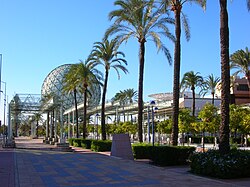
Modern Infrastructure and Connectivity
The transition from an island to a peninsula brought significant architectural advancements. Today, the area is linked to the rest of the city by striking engineering feats, most notably the Puente del Alamillo, designed by Santiago Calatrava, and the Puente de la Barqueta.
Urbanization has continued to accelerate over the last decade. The skyline was notably altered in 2016 with the completion of the Sevilla Tower (formerly known as the Cajasol Tower), a skyscraper that serves as a landmark for the district's commercial growth.
A Hub of Science, Culture, and Leisure
Isla de la Cartuja is no longer just a historical site; it is a center for research and recreation. The Cartuja 93 park stands as the area's most significant infrastructure, serving as a research and development complex that employs 15,000 people.
Education and Arts
The district hosts several academic and cultural institutions, including:
- University Schools of Engineering and Communications: Providing high-level technical education.
- Centro Andaluz de Arte Contemporáneo (CAAC): The Andalusian Contemporary Art Center, housed within the historic Monastery of Santa Maria de las Cuevas.
- Pavilion of Navigation: A musealized space reflecting the legacy of the Expo '92.
- Jardín Americano: A public botanic garden known as the American Garden.
Entertainment and Sports
Visitors to the area can explore a variety of leisure options, from the Isla Mágica amusement park to the La Cartuja Stadium. The district is also a center for performing arts, featuring the Central Theatre, the Rocío Jurado auditorium, and various concert halls and discothèques.
Key Facts
- Original Geography: Formerly an island; now a peninsula connected to the Triana neighborhood.
- Historical Significance: Site of the Monasterio de Santa María de las Cuevas, where Christopher Columbus planned his voyages.
- Major Event: Hosted Expo '92 to mark the 500th anniversary of Columbian expeditions.
- Economic Engine: Cartuja 93 park employs 15,000 people in R&D.
- Architectural Landmark: Home to the Calatrava-designed Puente del Alamillo and the Sevilla Tower.
Area Summary
| Category | Key Sites / Entities |
|---|---|
| History | Monasterio de Santa María de las Cuevas, Expo '92 |
| Science & Tech | Cartuja 93 Park, University Schools of Engineering and Communications |
| Culture & Art | CAAC, Pavilion of Navigation, Jardín Americano |
| Leisure | Isla Mágica, La Cartuja Stadium, Rocío Jurado auditorium |
| Infrastructure | Puente del Alamillo, Puente de la Barqueta, Sevilla Tower |
Frequently Asked Questions
Why is it called Isla de la Cartuja?
The name translates to "Island of the Carthusians," referring to the Monasterio de Santa María de las Cuevas, a cloistered monastery located on the site.
Is it still an island?
No. While it was originally isolated by two branches of the Guadalquivir River, the river channel was rearranged for Expo '92, connecting it to the mainland via an isthmus and making it a peninsula.
What is the significance of the Monasterio de Santa María de las Cuevas?
Beyond its religious history, it is the place where Christopher Columbus lived while planning his first voyage to the west.
What is Cartuja 93?
Cartuja 93 is a major research and development complex located on the peninsula that employs approximately 15,000 people.
Which famous bridges connect the area to the city?
The most notable bridges are the Puente de la Barqueta and the Puente del Alamillo, the latter of which was designed by the architect Santiago Calatrava.