Isaac Newton: The Architect of Modern Physics and Mathematics
Sir Isaac Newton was a towering figure of the Scientific Revolution, whose contributions to physics, mathematics, and astronomy fundamentally altered the human understanding of the universe. From the formulation of the laws of motion to the invention of calculus, Newton provided the mathematical framework that governed science for centuries. His work transitioned natural philosophy from qualitative observation to quantitative precision.
Born in Woolsthorpe-by-Colsterworth, Lincolnshire, on January 4, 1643 (December 25, 1642, by the Old Style calendar), Newton's intellectual journey took him from the King's School to Trinity College, Cambridge. It was here that he began his deep dive into the works of the great thinkers of his time, eventually surpassing them to create a new system of the world.
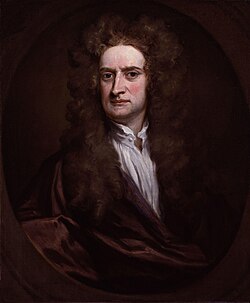
Key Facts
![Some of the figures added by Isaac Newton in his 1672 and 1681 editions of the Geographia Generalis. These figures appeared in subsequent editions as well.[38]](/images/87/5c/875c72340ad86db6363c2433fc27dc5b885a9fb64c644f06938824732b7af147.jpg)
- Primary Fields: Physics, mathematics, astronomy, natural philosophy, alchemy, and theology.
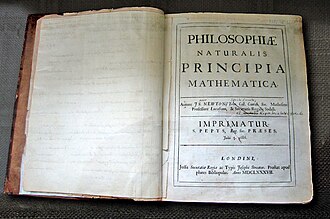
- Major Works: Philosophiæ Naturalis Principia Mathematica (1687) and Opticks (1704).
- Key Discoveries: Universal gravitation, the three laws of motion, and the composition of white light.
- Mathematical Innovations: Developed calculus (the method of fluxions) and the binomial series.
- Public Service: Served as Master of the Royal Mint and President of the Royal Society.
Scientific Contributions and Discoveries
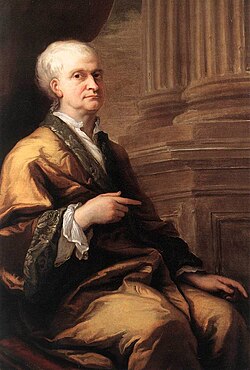
Newtonian Mechanics and Gravitation
Newton's most influential work, the Principia, outlined the laws of motion and the law of universal gravitation. He proposed that every mass exerts an attractive force on every other mass, a concept that explained both the falling of an apple and the orbits of planets. This unification of terrestrial and celestial mechanics was a watershed moment in science.
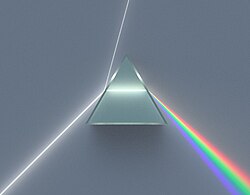
Optics and the Nature of Light
Newton's experiments with prisms revealed that white light is not a single entity but a composite of all the colors of the visible spectrum. This discovery of dispersion challenged previous theories of light. To further his astronomical observations, he invented the reflecting telescope, which used mirrors instead of lenses to reduce chromatic aberration.
![A replica of the reflecting telescope Newton presented to the Royal Society in 1672 (the first one he made in 1668 was loaned to an instrument maker but there is no further record of what happened to it).[95]](/images/5c/e3/5ce3bb3f89d57519e99a65a9db29e30cae398ee1eae74801b8002ba15401a72c.jpg)
Mathematics and Calculus
In the realm of mathematics, Newton developed the method of fluxions, known today as calculus, to describe rates of change. He also contributed the binomial series and Newton's method for finding roots of functions, providing essential tools for engineers and scientists worldwide.
Philosophy of Science
![Coat of arms of the Newton family of Great Gonerby, Lincolnshire, afterwards used by Sir Isaac[197]](/images/f1/b5/f1b5737525ba2996bf0003bea9e0ed7e686213a9b2ff02e7261234bd6534aea1.webp)
Newton did not just provide answers; he provided a methodology. In the Principia, he established four foundational rules for modern science:
- Admit no more causes of natural things than are both true and sufficient to explain their appearances.
- To the same natural effect, assign the same causes.
- Qualities of bodies, which are found to belong to all bodies within experiments, are to be esteemed universal.
- The fourth rule emphasizes the necessity of experimental evidence to support theoretical claims.
Later Life and Public Career
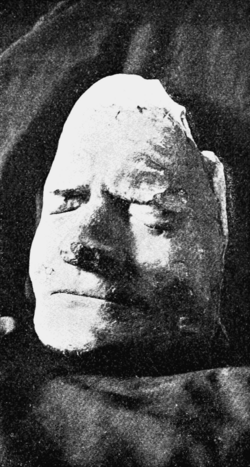
Beyond the laboratory, Newton held several prestigious positions. He was the 2nd Lucasian Professor of Mathematics at Cambridge and later the 12th President of the Royal Society (1703–1727). In 1699, he became Warden of the Mint, eventually rising to Master of the Mint, where he applied his rigorous mind to currency and economics.
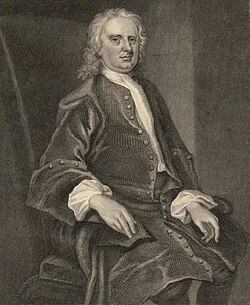
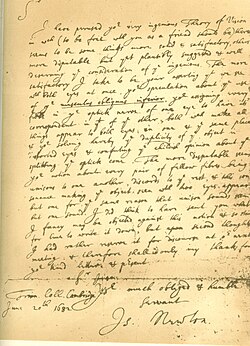
Despite his public image as a rationalist, Newton spent significant time studying alchemy and theology, often in private. His diligence in studying the Bible and his interest in the hidden properties of matter show a man deeply invested in the mysteries of creation.
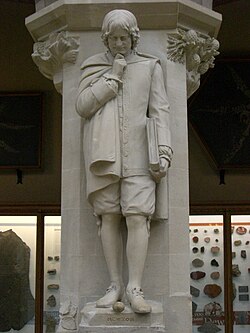
Legacy and Commemoration
![Newton (1795, detail) by William Blake. Newton is depicted critically as a "divine geometer".[239]](/images/ba/36/ba36272f7e08c8b426767616b0da710bedc0df432c2585326e5b414b7f9a51a9.jpg)
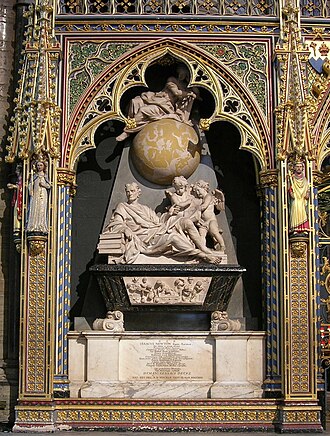
Newton was knighted in 1705 and is buried in Westminster Abbey. His legacy is preserved not only in textbooks but in the very way we approach scientific inquiry. He is often remembered through the story of the falling apple, a symbol of the moment he connected the gravity of Earth to the motion of the stars.
| Category | Details |
|---|---|
| Lifespan | 1643 – 1727 |
| Education | Trinity College, Cambridge |
| Key Publications | Principia (1687), Opticks (1704) |
| Major Offices | President of the Royal Society, Master of the Mint |
| Honors | Knight Bachelor (1705), FRS (1672) |
Frequently Asked Questions
What are Newton's three laws of motion?
Newton's laws describe the relationship between a body and the forces acting upon it, and its motion in response to those forces. They form the basis of classical mechanics.
Did an apple actually fall on Newton's head?
While the "apple story" is a famous part of his legacy, it is generally viewed as a simplified narrative of how he began contemplating the universal nature of gravity after observing a falling apple.
What is the difference between the reflecting telescope and previous telescopes?
Newton's reflecting telescope used a curved mirror to gather light instead of a glass lens, which eliminated the rainbow-like blurring (chromatic aberration) common in refracting telescopes of the time.
What was Newton's role at the Royal Mint?
As Master of the Mint, Newton was responsible for the production of coinage and worked to stabilize the English currency, applying his analytical skills to combat counterfeiting.
Was Newton involved in things other than physics?
Yes, Newton was deeply involved in alchemy, theology, and economics, and he served as a Member of Parliament for the University of Cambridge.