International Organization for Migration: History, Mandate, and Global Impact
The International Organization for Migration (IOM) is a UN-related organization dedicated to managing the complexities of global migration. From providing operational assistance to refugees and migrant workers to supporting internally displaced persons (IDPs)—people forced to flee their homes but who remain within their country's borders—the IOM serves as a primary intergovernmental body ensuring that migration remains humane and orderly.
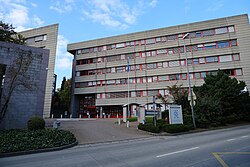
Headquartered in Geneva, Switzerland, the IOM operates on a global scale, coordinating efforts between member states to address the challenges of human mobility in the face of conflict, natural disasters, and economic instability.
Key Facts
- Founded: December 6, 1951.
- Status: UN-related organization (affiliated since 2016).
- Leadership: Directed by Director General Amy Pope.
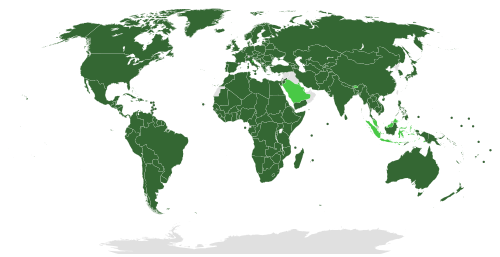
- Membership: 174 member states and 8 observer states (as of 2026).
- Budget: Approximately US$ 3.7 billion (2024).
- Workforce: 22,351 staff members representing 175 nationalities (2024).
- Official Languages: English, French, and Spanish.
Evolution and History
Foundations and Early Years (1951–1989)
The IOM was established in 1951 to address the crisis of war refugees and displaced persons in post-World War II Europe. Initially acting as a logistics agency, it organized the transport of nearly one million migrants during the 1950s. The organization's growth is reflected in its series of name changes: starting as the Provisional Intergovernmental Committee for the Movement of Migrants from Europe (PICMME) in 1951, it became the Intergovernmental Committee for European Migration (ICEM) in 1952, the Intergovernmental Committee for Migration (ICM) in 1980, and finally the International Organization for Migration (IOM) in 1989.
During its early years, the ICEM's subsidized transport programs disrupted existing commercial migration networks. Private travel agencies that previously handled documentation and bookings faced tensions with the agency over pricing and authority, eventually leading to hybrid arrangements where the agency relied on commercial carriers.
Integration into the United Nations
The IOM's relationship with the United Nations evolved from observer status in 1992 to a formal affiliation in September 2016, following a unanimous General Assembly resolution. This transition strengthened the IOM's ability to fulfill its mandate and integrate with other UN agencies.
In December 2018, the IOM supported the creation of the Global Compact for Migration in Marrakesh, Morocco—the first intergovernmental agreement of its kind. To implement this compact, the UN Secretary-General established the UN Network on Migration in 2019, which the IOM coordinates alongside partners such as the UNHCR (United Nations High Commissioner for Refugees), WFP (World Food Programme), and UNDP (United Nations Development Programme).
Organizational Structure and Governance
The IOM is governed by a council where all member states are represented. This council is the highest decision-making body, responsible for adopting the annual budget and setting programmatic objectives. The organization is funded through donations and voluntary contributions from member states.
While the main headquarters are in Geneva, the IOM maintains liaison offices in New York City and Addis Ababa, and operates the Global Migration Data Analysis Centre (GMDAC) in Berlin. The Director General is elected by member state delegates for a five-year term. Currently, Amy Pope serves as Director General, supported by Deputy Directors General Ugochi Daniels and SungAh Lee.
| Category | Detail |
|---|---|
| Headquarters | Geneva, Switzerland |
| Member States | 174 |
| Observer States | 8 |
| Annual Budget | US$ 3.7 Billion |
| Total Staff | 22,351 |
Global Mandate and Humanitarian Operations
The IOM's mandate is broad, covering assistance for migrant workers, refugees, and IDPs. This flexibility allows the organization to respond rapidly to crises, though it has faced criticism regarding legal accountability in protection issues. The IOM frequently collaborates with the UNHCR to manage complementary mandates.
As a central actor in the UN's humanitarian aid system, the IOM provides essential services including:
- Emergency shelter and site management.
- Basic medical and sanitary care.
- Life safety and protection services.
- Telecommunications and logistics coordination.
- Stabilization and peacebuilding in migration contexts.
The IOM has been active in numerous global emergencies, including the 2004 Asian tsunami, the 2003 invasion of Iraq, the 2010 Haiti earthquake, and the European migrant crisis. In 2026, the IOM and the International Federation of Red Cross and Red Crescent Societies (IFRC) assumed co-leadership of the Shelter, Land and Site Coordination Cluster to guide global humanitarian shelter management.
Criticisms and Controversies
Despite its humanitarian goals, the IOM has faced significant criticism from human rights organizations. In 2003, Amnesty International and Human Rights Watch criticized the IOM's involvement in Australia's "Pacific Solution," specifically the operation of processing centres on Nauru and Manus Island. Critics argued the IOM lacked a refugee protection mandate and contributed to arbitrary detention.
Further concerns were raised by the Refugee Council of Australia in 2022 regarding IOM-operated community housing for refugees in Indonesia, with reports of inhumane conditions and lack of medical care. Additionally, in 2024, the organization was criticized for its perceived inability or unwillingness to intervene in cases involving Uyghur refugees.
Frequently Asked Questions
What is the difference between the IOM and the UNHCR?
While both work with displaced populations, the UNHCR has a specific mandate for refugee protection, whereas the IOM has a broader mandate covering all aspects of migration, including migrant workers and voluntary migration, often focusing on logistics and operational assistance.
How is the IOM funded?
The IOM does not have assessed contributions; instead, its budget is comprised of voluntary contributions from member states and private donations.
What is the Global Compact for Migration?
Adopted in 2018, it is the first intergovernmental agreement designed to cover all dimensions of international migration in a holistic and comprehensive manner.
Who leads the IOM?
The organization is led by a Director General, currently Amy Pope, who is elected by the member states for a five-year term.
What are the official languages of the IOM?
The official languages used by the organization are English, French, and Spanish.